Celebrity-Followed 'Dito Consumption' Trend
Jelly-Form Health Supplement Market Doubles in 3 Years
Safety Verification Needed When Purchasing Products
Jung Yujin (32), an office worker who usually enjoys running and swimming for health management, has recently been engrossed in watching the Olympic games after work. Jung said, "Since I like exercising, I naturally pay attention to the drinks athletes consume during competitions, and I especially noticed Shin Yubin eating jelly," adding, "I thought that if an athlete takes jelly during the Olympics, it must be of a certain quality, so I immediately looked it up."
 Korea's national table tennis player Shin Yu-bin is eating an energy jelly during the Paris Olympics match. [Source=YouTube screen capture]
Jelly, once stigmatized as 'junk food,' has successfully transformed its image. Thanks to the 'Ditto consumption' trend, where consumers buy only products used by influencers and celebrities, interest in uniquely shaped and textured jelly has increased. Additionally, various health functional foods have improved accessibility by being formulated into easy-to-eat jelly forms.
According to market research firm Euromonitor on the 7th, the domestic e-commerce market share of the sugar confectionery category, including jelly and candy, was 7.1% last year, up 0.3 percentage points from 6.8% the previous year. The market share of sugar confectionery, which was around 3.4% in 2018, has steadily increased every year, more than doubling in five years.
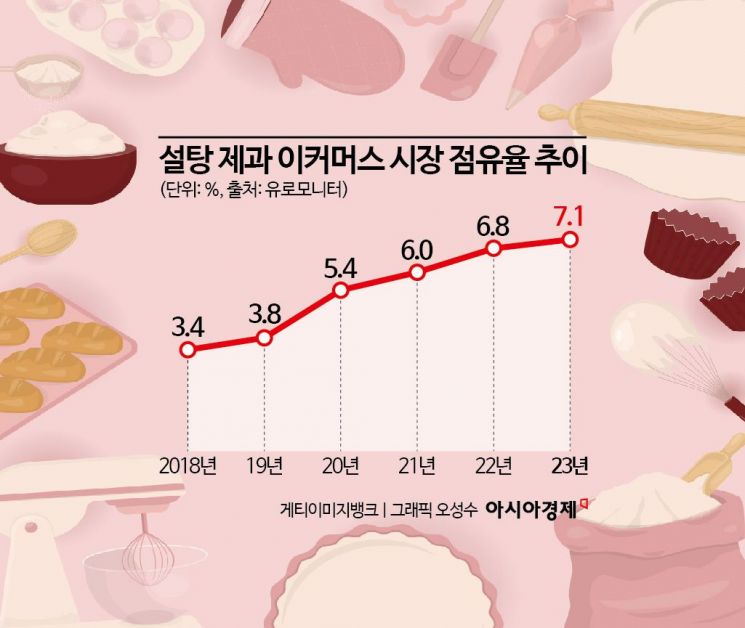
The recent growth of the jelly market is rooted in 'Ditto consumption' based on various social networking services (SNS). Ditto consumption is a compound word of the Latin word 'Ditto,' meaning 'the same,' and consumption, referring to the habit of purchasing products based on recommendations from specific individuals or content. As celebrities introduce jelly products they enjoy in daily life and influencers post videos eating jelly with vibrant colors and unique textures, related consumption has increased.
Recently, the sight of table tennis national representative Shin Yubin eating an energy gel during a match at the Paris Olympics sparked a sensation, leading to a 'sold-out frenzy' for the product, which is a phenomenon in the same context. Especially, consumers in their teens and twenties search for products through TikTok or Shorts and consume based on that, prompting many companies to quickly import or produce products trending on SNS.
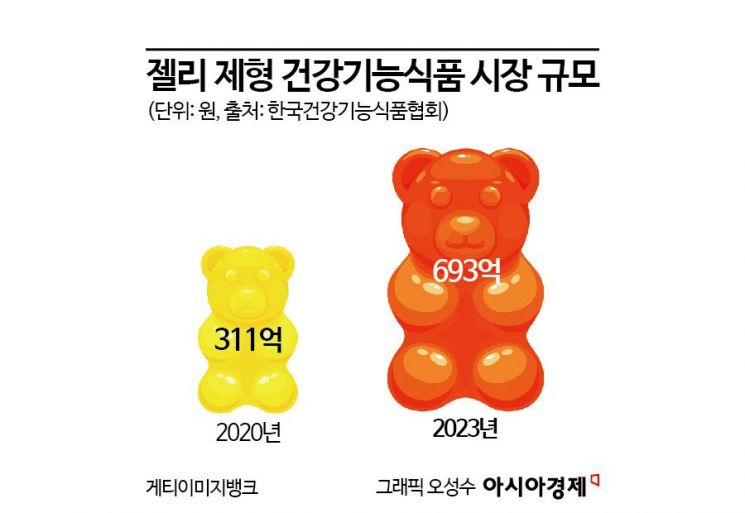
Alongside Ditto consumption, another pillar of the recent jelly market growth is jelly products emphasizing functionality beyond snacks. Since the COVID-19 pandemic, the number of light consumers seeking functional health products has increased, and among them, jelly-type health supplements that are tasty and easy to consume have gained attention, leading to increased consumption. According to the Korea Health Supplements Association, the jelly-form health supplement market grew more than twice from 31.1 billion KRW in 2020 to 69.3 billion KRW last year.
As the market grows, companies that previously sold pill-type products are renewing their products into jelly forms. Although jelly forms cannot contain all nutrients, they are preferred by consumers for their taste and ease of consumption, prompting companies to actively respond. A representative from KGC Ginseng Corporation's CheongKwanJang, which sells 'Jjin Saeng Hong Sam Gummy,' explained the development background, saying, "Gummy jelly satisfies both taste and convenience and has recently been attracting attention in the health food market. We made it so that young customers can easily enjoy the vitality of red ginseng in daily life at work or school."
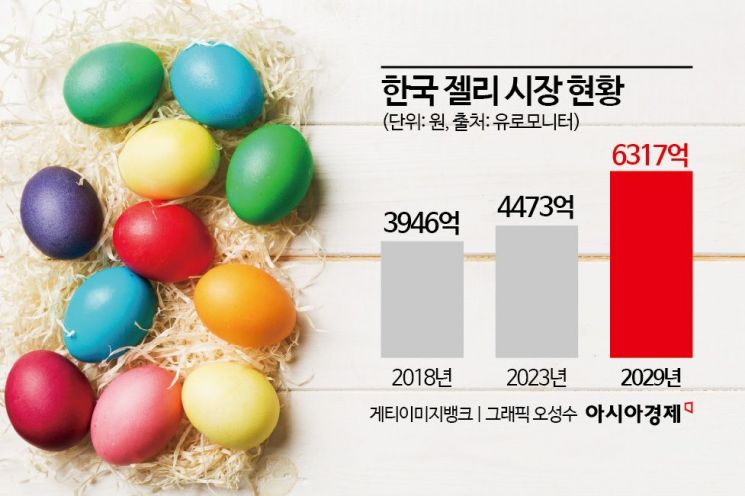
With various flavors, forms, and functional products being released, the jelly market is expected to continue its growth trend for the time being. According to Euromonitor, the domestic jelly market, which was worth 394.6 billion KRW in 2018, grew to about 447.3 billion KRW last year and is expected to reach approximately 631.7 billion KRW by 2029.
However, concerns about health issues such as excessive sugar intake from jelly and safety problems with some products have also been raised. Especially, due to the nature of SNS, where general consumers can easily create related content, caution is needed when introducing products or recipes without safety considerations. According to the Food Labeling and Advertising Act, manufacturers have the obligation to provide accurate labeling on products to offer correct information to consumers.
In fact, the Health and Environment Research Institute checked the content, sugar, and unauthorized tar colorants of 10 popular eatable jelly products from online markets last month. The results showed that five products weighed 3-6% less than labeled, three products exceeded the labeled sugar content by 151-258%, and one product violated both content and sugar labeling. Among the detected products, six were of Chinese origin and one was domestic, with the domestic product containing 6% less than labeled.
© The Asia Business Daily(www.asiae.co.kr). All rights reserved.
![Clutching a Stolen Dior Bag, Saying "I Hate Being Poor but Real"... The Grotesque Con of a "Human Knockoff" [Slate]](https://cwcontent.asiae.co.kr/asiaresize/183/2026021902243444107_1771435474.jpg)

















