For Safety and Operational Stability, 5-Month Trial Operation
Shipbuilding Delayed Due to Test Schedule Postponement
Two Vessels to Launch on Han River in October... Total of 8 by Year-End
Verification of Ships, Facilities, Equipment and Emergency Response Training
The Seoul Metropolitan Government has postponed the official launch of Riverbus to March next year. This measure aims to ensure operational safety and system stability, with delays in ship construction also becoming a factor. The pilot operation of Riverbus, which will officially be named 'Hangang Bus,' will begin in October.
On the 6th, Seoul announced that following the Hangang Bus operation plan revealed last February, and after discussions with navigation experts, the city council, the National Assembly, and the Hangang Citizens' Committee, it reflected opinions emphasizing the need for a sufficient pilot operation period, and will conduct a five-month pilot operation starting in October.
Previously, Seoul had announced plans to proceed with the project without setbacks through thorough process management such as constructing piers, improving accessibility, and building ships, aiming for the official launch of Hangang Bus in October.
However, both internal and external criticisms pointed out insufficient preparations for the smooth operation of Hangang Bus. In July, Joo Yong-tae, head of Seoul's Future Hangang Headquarters, visited the NYC Ferry operator in New York, which operates six routes and 38 vessels, to directly identify shortcomings of Hangang Bus. At that time, Seoul officials reportedly compared and confirmed processes such as captain competency verification and training before official operation, route familiarization, pier docking training, emergency response, and facility operation.
There were also issues during the shipbuilding process. In the development of the hybrid propulsion system, over 40 test items are required for official certification by authorized institutions for key components such as batteries, converters, and inverters. Among these, there was a backlog of applicants waiting for battery module and system item tests, causing delays in the testing schedule itself. Additionally, for the piers, some process delays occurred due to design changes reflecting review opinions during the public design review process, such as installing elevators for mobility-impaired pedestrians and opening rooftop spaces.
Accordingly, Seoul plans to postpone the official launch of Hangang Bus to March next year and secure safety through a phased pilot operation over five months covering five key areas: ▲ship and facility verification ▲personnel training ▲route verification ▲emergency response training ▲commercial trial operation. According to the revised schedule, ships are expected to be completed with two vessels starting Hangang service in October, two in November, and four in December. For piers, external construction will begin with four locations (Magok, Yeouido, Oksu, Jamsil) in October, followed by three locations (Mangwon, Jamwon, Ttukseom) in November.
Measures to improve accessibility for Hangang Bus are also underway. All consultations with related agencies for establishing and adjusting bus routes and linking with Ddareungi bike-sharing have been completed, and related construction is in progress. The public transportation transfer system, including transfer discounts, application of the Climate Companion Card, and installation of T-money terminals, will also be prepared in line with the official launch schedule of Hangang Bus.
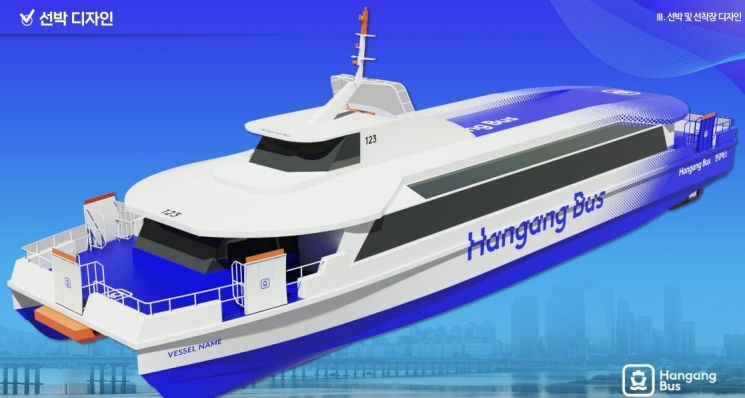
On this day, Seoul also unveiled the designs of the ships and piers, finalized through discussions and public design reviews from last year to June this year. The ship's exterior is based on a catamaran form to enhance speed and minimize wave impact, designed with a streamlined shape considering fuel efficiency. The ship's color scheme uses white as the base to reflect the diverse and beautiful colors and light of the Hangang River, including seasons, weather, sunrise, and sunset, accented with a refreshing blue.
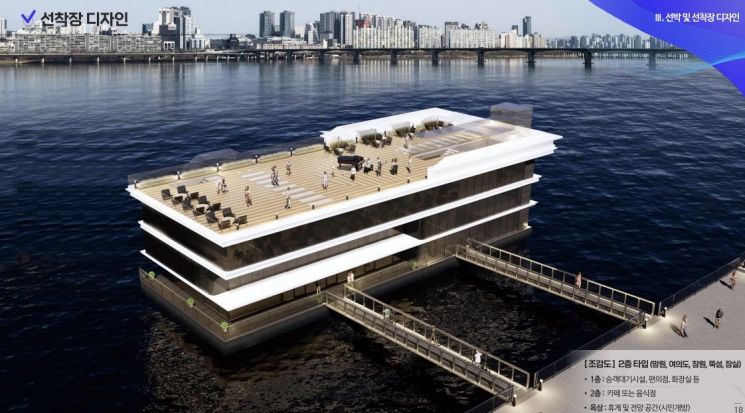
The piers are planned in two types?single-story and two-story?considering passenger demand and the characteristics of the surrounding Hangang parks. Magok and Oksu are single-story types, while Mangwon, Yeouido, Jamwon, Ttukseom, and Jamsil are two-story types. The piers will include not only passenger waiting areas but also convenience facilities such as convenience stores, cafes, restaurants, and restrooms.
Head Joo said, "We hope that the new water public transportation, Hangang Bus, will become a friendly and beloved successful brand for citizens and tourists alike," adding, "To operate Hangang Bus safely and stably, we will thoroughly prepare through sufficient pilot operations, including verification of ships, facilities, and equipment, as well as training of operating personnel."
© The Asia Business Daily(www.asiae.co.kr). All rights reserved.
![Clutching a Stolen Dior Bag, Saying "I Hate Being Poor but Real"... The Grotesque Con of a "Human Knockoff" [Slate]](https://cwcontent.asiae.co.kr/asiaresize/183/2026021902243444107_1771435474.jpg)
















