Travel Packages: High Unit Prices and Long Settlement Cycles
Major Discounts on Overseas Travel Packages
Points Sold at Discounts Usable Like Cash
Attracting 'Sangtechjok' to Secure Cash Quickly
Qoo10 Group is increasingly revealing signs of 'circular financing,' where funds from its affiliates Tmon and Wemakeprice (TMEP) were used when acquiring subsidiaries like the U.S. online shopping mall Wish. This was possible because TMEP focused on selling travel products with long settlement cycles. They also employed a method of tying up funds for extended periods through their own point system, which can be used like cash.
According to the e-commerce industry on the 6th, TMEP concentrated more on promotions for travel products because the settlement cycle for these products can stretch like a rubber band. Consumers purchase products at least a month before their travel dates, sometimes even six months in advance.
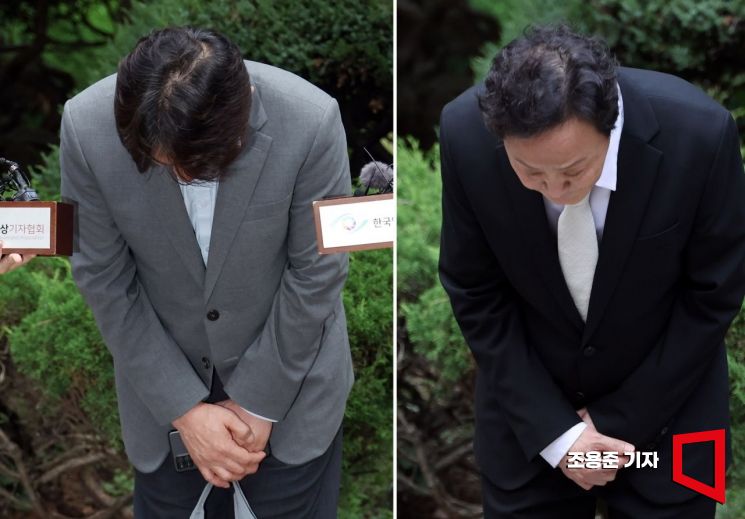 Ryu Hwa-hyun, CEO of Wemakeprice (left), and Ryu Kwang-jin, CEO of TMON, are greeting each other as they attend the hearing at the Seoul Bankruptcy Court in Seocho-gu, Seoul on the 2nd. The court plans to review the reasons for TMON and Wemakeprice's rehabilitation applications, their debt status, and funding plans. Photo by Jo Yong-jun jun21@
However, travel products are settled based on the departure date, not the sales date. If a consumer books a product in January for a trip departing in July, the travel agency receives the settlement payment according to the next month's settlement schedule. In this case, TMEP can hold the payment due to the travel agency for more than six months.
TMEP was aggressive in selling travel products. Their travel products were about 5% cheaper than competitors' products due to various promotions. Since travel products have high unit prices, even a 1% higher discount rate attracts consumers. Due to this structure, it is estimated that out of the 230 billion KRW in confirmed unsettled amounts by TMEP to date, over 100 billion KRW is related to travel.
Until this issue surfaced, Tmon actively promoted discount products in collaboration with organizations such as the Hong Kong and Macau Tourism Boards. According to IGAWorks Mobile Index, on the day before the issue broke out, June 6, TMEP's card payment amount was estimated at 89.71 billion KRW, more than five times the average daily payment amount of 16.7 billion KRW from June 17 to 30.
Another reason TMEP could use settlement funds from sellers for circular financing was its point system. Tmon sold 'Tmon Cash,' a point that can be used like cash, at up to a 10% discount. For example, customers could purchase 50,000 KRW worth of Tmon Cash for 45,000 KRW. This attracted so-called 'Sangtech-jok' (point arbitrage enthusiasts). Sangtech refers to buying gift certificates cheaply and converting them into points to make a profit. If a 50,000 KRW dining gift certificate is sold at a 10% discount for 45,000 KRW, consumers can buy the gift certificate with Tmon Cash purchased at a 10% discount earlier, earning a 10,000 KRW profit. TMEP was also active in gift certificate discount promotions because it was a good way to quickly secure cash when short.
Additionally, TMEP paid refunds for mobile gift certificates and others in points. For example, if a delivery app gift certificate was not registered in the app and a certain period passed, it would be automatically refunded, but the refund was given in points. Until consumers use the points, the payment amount remains with TMEP.
The 2022 Tmon audit report showed a point provision liability of 1 billion KRW. In 2023, Wemakeprice's point provision liability was 350 million KRW. This refers to points unused by customers. Although unused points are recognized as liabilities in accounting, for TMEP they are practically liquid funds. Also, when consumers use points, it is recognized as sales, which helps inflate the company's size.
Meanwhile, TMEP, which caused a large-scale settlement delay, will enter the Autonomous Restructuring Support (ARS) program with court approval. ARS is a system where the court supports voluntary restructuring negotiations between debtors and creditors before a rehabilitation procedure decision is made. The purpose is to resolve disputes quickly, amicably, and at minimal cost. The company and creditors can extend this period by one month at a time, up to a maximum of three months, if necessary.
© The Asia Business Daily(www.asiae.co.kr). All rights reserved.
![Clutching a Stolen Dior Bag, Saying "I Hate Being Poor but Real"... The Grotesque Con of a "Human Knockoff" [Slate]](https://cwcontent.asiae.co.kr/asiaresize/183/2026021902243444107_1771435474.jpg)











