Ministry of Agriculture, Food and Rural Affairs Announces 'Youth Policy Directions for Agriculture and Rural Areas'
Reform Promotion Team Collaborates with Youth to Identify Reform Tasks
The government has decided to strengthen full-cycle support for startups in all agricultural sectors, including agri-food, smart farms, seeds, and pesticides, to nurture 30,000 young farmers. While broadly providing information on available resources such as vacant houses and closed schools to youth preparing for startups, it also plans to expand the business scope of agricultural corporations to include upstream and downstream sectors.
On the 5th, Song Miryeong, Minister of Agriculture, Food and Rural Affairs, announced these plans at Lux Square, a youth startup complex cultural space located in Jincheon, Chungbuk, under the title "Directions for Promoting Youth Policies in Agriculture and Rural Areas."
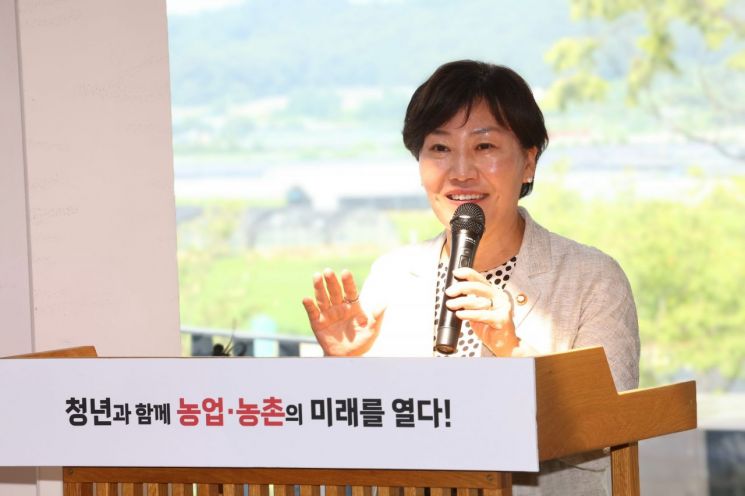 Song Miryeong, Minister of Agriculture, Food and Rural Affairs, is delivering a greeting on the 5th at Lux Square, a youth startup complex cultural space located in Jincheon, Chungbuk.
The Ministry of Agriculture, Food and Rural Affairs is promoting three major transformations in agricultural policy (digital, generational, and rural space) to create new opportunities amid the crisis in agriculture and rural areas. In particular, to solve chronic problems in the agricultural field, the ministry has been operating a 'Reform Promotion Task Force (TF)' involving all departments since January. Among these, measures for youth, the core future actors in agriculture and rural areas, were identified as a representative task of the TF through field meetings and expert policy consultations.
Yoon Wonsup, Director of Agricultural Policy at the Ministry, explained, "This measure expands the scope of youth policies in agriculture and rural areas from the existing focus on agricultural production to the entire agri-food industry value chain. It sets three major directions for youth policies: deregulation to remove barriers to free youth startups, strengthening youth's leading roles in policy processes, and more. Based on this, it includes field-oriented tasks essential for youth who will lead the future agri-food industry."
Promoting Youth Startup Activation Across All Agricultural and Rural Sectors
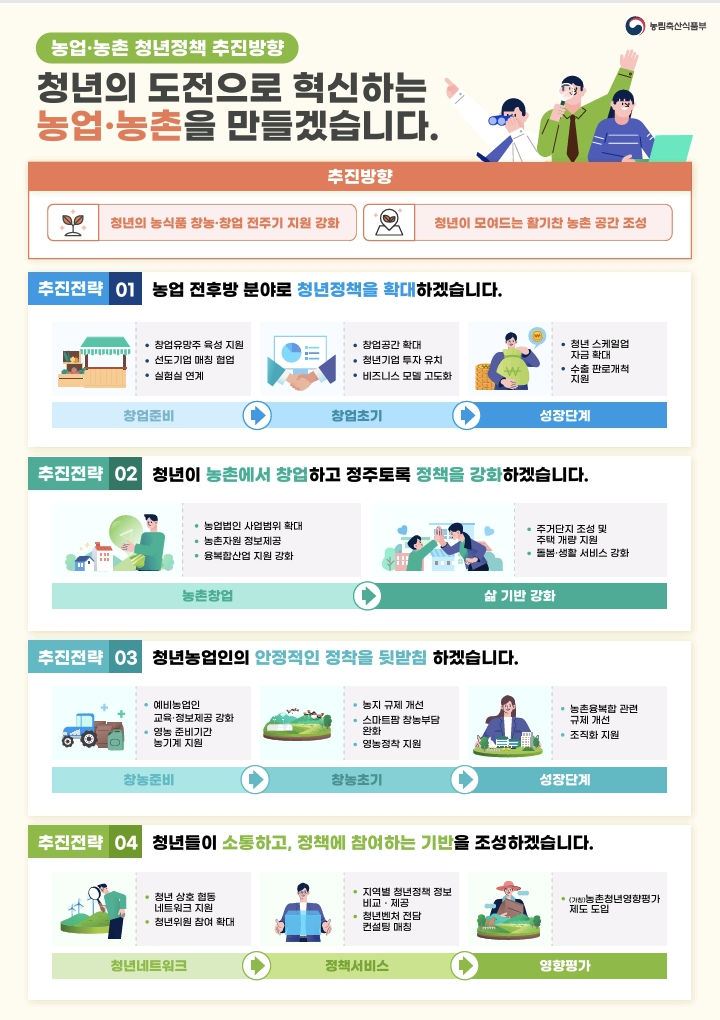
Earlier, in October 2022, the Ministry announced through the "1st Basic Plan for Successors and Youth Farmers (2023?2027)" its commitment to nurture 30,000 young farmers under 40 who will lead agricultural innovation. First, the ministry will promote youth startups not only in agricultural production but across all agricultural and rural sectors. To help promising youth ideas develop step-by-step into successful business models from the startup preparation stage, it will focus on supporting the selection, promotion, and investment of agri-food youth ventures called 'Startup Rookie.' It will also promote collaborative marketing and consulting support using leading companies' foundations and link support with university laboratory infrastructure.
To ensure stable scale-up and enhance export competitiveness of youth enterprises, the ministry will operate an agri-food youth enterprise growth fund (worth 47 billion KRW) according to enterprise growth stages and provide preferential support for policies related to residence space, scale-up funds, and export expansion. Additionally, to reduce information search costs for youth preparing startups based in rural areas, it will widely provide information on available rural resources such as vacant houses and closed schools by linking various rural industry platforms including the Vacant House Bank, Rural Convergence Business Portal, Wellchon, Spatial Information System, and Green Road.
To help young entrepreneurs settle in rural areas and revitalize local economies, the ministry plans to expand youth rural settlement bases to improve living conditions, strengthen rural childcare support and weekend care services during busy farming seasons, and continuously expand cultural and welfare-related living service infrastructure.
Regulatory Improvements Including Expansion of Agricultural Corporation Business Scope to Upstream and Downstream Sectors
The ministry will also improve regulations that hinder free youth startups, such as significantly expanding the business scope of agricultural corporations based in rural areas. Director Yoon said, "Recently, there has been increasing demand among youth to advance technology in agricultural production and expand business into smart agriculture-related equipment and service supply sectors, or to operate convergence and new industries such as tourism and experiences in rural areas. Therefore, by expanding the business scope of agricultural corporations, which was previously limited to farming-related businesses, to upstream and downstream sectors, we will provide new rural startup opportunities for youth and promote local economic revitalization."
Currently, when benefiting from the farming settlement support project, regulations require using only self-produced agricultural products during the mandatory farming period. Going forward, the ministry will allow the use of externally procured agri-food raw materials in processing and experience businesses to facilitate rapid business expansion. The 'Smart Farm Comprehensive Fund,' which previously only allowed loans for expensive fixed greenhouses, will add small-scale vinyl greenhouses to the list of eligible facilities to reduce the initial cost burden and management risks for young farmers with low capital mobilization capacity.
Additionally, for the powdered rice production complexes that currently support only those cultivating 30 hectares or more, the ministry will operate pilot complexes at the city/county level where small-scale powdered rice complexes (5?30 hectares) managed by youth farmer organizations can participate to support early farming settlement. It will also improve regulations to allow those selected for the farming settlement support project, who have not yet registered agricultural management information, to rent agricultural machinery from rental offices to quickly prepare for full-scale farming.
To activate youth startups and policy participation as key players in the three major agricultural policy transformations, the ministry will establish an agricultural and rural youth network (tentative name) involving young farmers, agri-food upstream and downstream linked companies, and rural startup companies to strengthen mutual information sharing and business collaboration systems. It will also introduce a 'Youth Impact Assessment on Agricultural and Rural Policies (tentative name)' system to predict and evaluate the impact of new agri-food financial projects on youth inflow and employment/startups, utilizing the results in policy processes.
Minister Song said, "The role of youth is very important to overcome crises in agriculture and rural areas such as climate change, rural aging, and rural extinction. We will set new directions for agriculture and rural policies together with youth and continue to communicate with passionate young people to discover concrete action tasks."
© The Asia Business Daily(www.asiae.co.kr). All rights reserved.
![Clutching a Stolen Dior Bag, Saying "I Hate Being Poor but Real"... The Grotesque Con of a "Human Knockoff" [Slate]](https://cwcontent.asiae.co.kr/asiaresize/183/2026021902243444107_1771435474.jpg)

















