Monthly Average Income 1,452,000 KRW
Decrease of 12,000 KRW Compared to Previous Year
Last year, the number of workers engaged through online platforms reached 883,000. This represents an 11.1% increase (88,000 people) compared to the previous year. In particular, the number of workers in the information technology (IT) and professional services sectors showed a notable increase.
The Ministry of Employment and Labor and the Korea Employment Information Service announced the '2023 Platform Workers Survey' containing these findings. The report is based on a sample survey of 50,000 people aged 15 to 69 randomly selected nationwide.
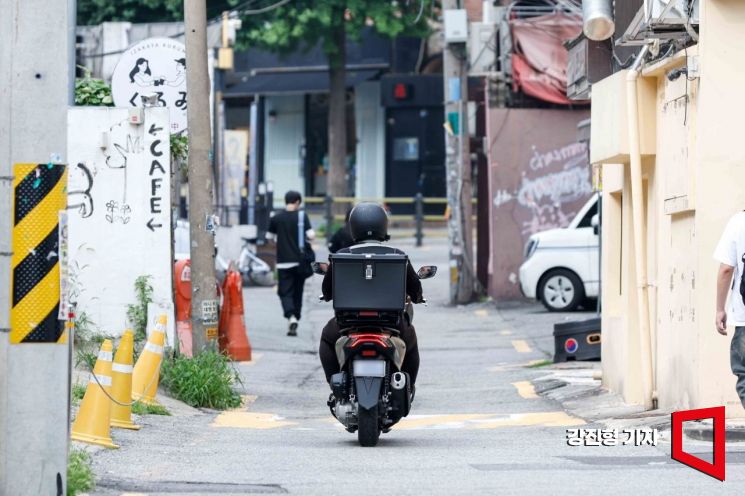 A motorcycle delivery worker is making a delivery on Hongdae Street in Mapo-gu, Seoul. Photo by Jinhyung Kang aymsdream@
The number of workers engaged through online platforms last year was 883,000, an 11.1% increase from the previous year. Compared to 2022 (795,000), which saw a 20.3% increase from 2021 (661,000), the growth rate has slowed but still maintained a double-digit increase. This is the result of industrial changes such as the development of digital technology combined with social changes favoring flexible working styles.
In particular, the platform worker growth rates were prominent in the IT services (141.2%) and professional services (69.4%) sectors. Conversely, the delivery anddriving (-5.5%) sectors showed a decline, unlike in the past. This appears to be due to reduced delivery demand following the end of the COVID-19 pandemic.
The household and care (-1.9%) sectors, which shrank by 1.9% compared to the previous year, require appropriate workforce supply. This is because demand for care services is increasing due to the spread of dual-income households and the aging population. According to the Statistics Korea regional employment survey, the number of employed household and childcare helpers was 105,000 in the second half of last year, down from 114,000 in the second half of the previous year. This decline has continued since the second half of 2021 (121,000).
Regarding the gender distribution of platform workers, the female proportion was 29.6% (261,000), relatively lower than males. However, this is an increase from 25.8% (205,000) recorded in 2022. By age group, the proportion of workers was highest among those in their 30s (28.7%), followed by 40s (26.9%), 50s (20.2%), and 20s (13.8%).
The proportion of 'main job type' workers?those earning more than 50% of their income from platform jobs or working more than 20 hours per week?was 55.6% last year, down from 57.7% the previous year. Conversely, the 'side job type' (21.8%), earning 25-50% of income from platform jobs or working 10-20 hours per week, and the 'occasional participation type' (22.6%), earning less than 25% or working less than 10 hours per week, saw an increase in their proportions.
Last year, the average number of working days per month and daily working hours were 14.4 days and 6.2 hours, respectively, slightly down from the previous year. Monthly income from platform jobs also decreased by 12,000 KRW to an average of 1,452,000 KRW.
Job difficulties cited included ▲requests for tasks not in the contract (12.2%) ▲health and safety risks and anxiety (11.9%) ▲unilateral contract changes (10.5%) ▲difficulty recognizing experience when moving to other jobs (9.7%) ▲delayed payment (9.5%), among others.
Kwon Chang-jun, Director of Labor Reform Policy at the Ministry of Employment and Labor, stated, "With the development of digital technology, the number of platform workers is expected to continue increasing, but they still face many difficulties such as unfair treatment." He added, "While promoting the enactment of the 'Act on Support and Protection for Vulnerable Workers' (tentative name), we will implement policies that help workers, such as preparing standard contracts, establishing rest areas, and supporting dispute resolution."
© The Asia Business Daily(www.asiae.co.kr). All rights reserved.
![Clutching a Stolen Dior Bag, Saying "I Hate Being Poor but Real"... The Grotesque Con of a "Human Knockoff" [Slate]](https://cwcontent.asiae.co.kr/asiaresize/183/2026021902243444107_1771435474.jpg)















