Ministry of Employment and Labor Announces Final Minimum Wage on the 5th
First Time Surpassing 10,000 Won in 37 Years Since System Implementation
Discussion on This Month's Minimum Wage Decision System Begins
The government announced the minimum wage to be applied from next year as 10,030 KRW per hour. Improvements to related systems were also announced. Given the significant labor-management conflicts during the minimum wage determination process, it was deemed essential to improve this system. In academia, there have been many calls to change the minimum wage determination system to a government decision structure based on expert discussions.
The Ministry of Employment and Labor announced on the 5th that the minimum wage for next year has been set at 10,030 KRW per hour. When converted to a monthly salary, this amounts to 2,096,270 KRW (based on 40 hours of prescribed work per week and 209 hours per month).
The Ministry of Employment and Labor published the minimum wage proposal, which was resolved by the Minimum Wage Commission after 11 plenary meetings on the 12th of last month, and allowed an objection period until the 29th of the same month. During this period, there were no objections from labor or management groups. This is the first time in four years since 2020.
Minister of Employment and Labor Lee Jeong-sik said, "I believe the Minimum Wage Commission made the decision after fully considering our economic and labor market conditions, the difficulties faced by low-wage workers and small business owners, and I respect this decision."
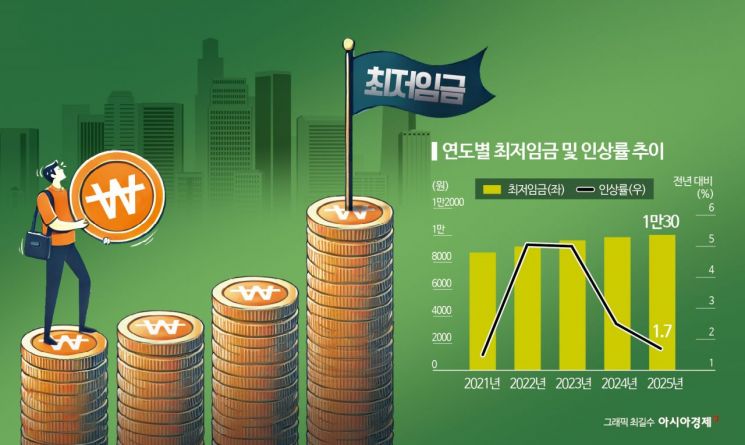
Next year's minimum wage attracted attention as it surpassed the 10,000 KRW mark for the first time in 37 years since the related system was implemented. However, compared to this year's minimum wage (9,860 KRW), it increased by 1.7% (170 KRW), which is a relatively modest rise. This is the second-lowest increase rate in history, following 2021 (1.5%). Although there was discussion about applying differentiated minimum wages by industry during the decision process, it was decided to apply the same minimum wage across all workplaces.
The government plans to actively promote and guide the implementation of next year's minimum wage in the field. Through workplace education, consulting, and labor supervision, they will encourage compliance with the minimum wage.
Efforts to improve the minimum wage system will also be actively pursued. This is because every year, there have been serious labor-management conflicts during the minimum wage determination process, with deliberations breaking down and physical clashes occurring, among other issues. Earlier, Lee In-jae, chairman of the Minimum Wage Commission, stated after deciding next year's minimum wage, "There are limits to rational and productive discussions progressing under the current decision system," emphasizing the need for system reform.
The Ministry of Employment and Labor will form a discussion body this month consisting of experts from various fields to establish the minimum wage determination system. They also plan to carefully consider opinions from workplaces where the minimum wage is applied. On the same day, Minister Lee visited a workplace in Daejeon and said, "Improving the minimum wage system is a task that can no longer be postponed." He added, "We will prepare improvement measures while carefully collecting opinions from the field."
In academia, there have been opinions that the minimum wage determination process, which has become like wage negotiations, needs to be changed. Professor Kang Sung-jin of Korea University’s Department of Economics said, "Since the minimum wage has sufficiently increased, it is important to determine the rate of increase going forward, and there are many objective methods to decide this." He argued, "It is appropriate for experts to gather and propose objective indicators such as productivity and inflation to the government, and for the government to refer to these and make a decision."
Regarding differentiated application by industry, Professor Kang diagnosed, "It would be better to apply it regionally like in Japan rather than calculating by industry, which is not easy, and sufficient discussion is needed." He also added, "It would be good if the minimum wage could be differentiated and diversified in application, but the social costs could be greater," and "Since it could be complicated to implement in practice, applying it anew is not an easy issue."
© The Asia Business Daily(www.asiae.co.kr). All rights reserved.
![Clutching a Stolen Dior Bag, Saying "I Hate Being Poor but Real"... The Grotesque Con of a "Human Knockoff" [Slate]](https://cwcontent.asiae.co.kr/asiaresize/183/2026021902243444107_1771435474.jpg)















