Following the Constitutional Court's Decision of Constitutional Incompatibility Regarding Punishment Provisions After the Second Trial Sentencing
The Supreme Court overturned a guilty verdict for a man accused of violating the Public Official Election Act by distributing 300 documents promoting then-People Power Party candidate Oh Se-hoon's real estate policy two days before the Seoul mayoral by-election held on April 7, 2021.
After the second trial verdict was announced, the Constitutional Court ruled the provision punishing the distribution of printed materials not authorized by the Public Official Election Act from "180 days before the election day (or from the date the reason for the by-election is confirmed) until the election day" as unconstitutional. Since the provision punishing the distribution of 'documents,' which is considered less illegal, also has potential unconstitutionality, it must be examined accordingly.
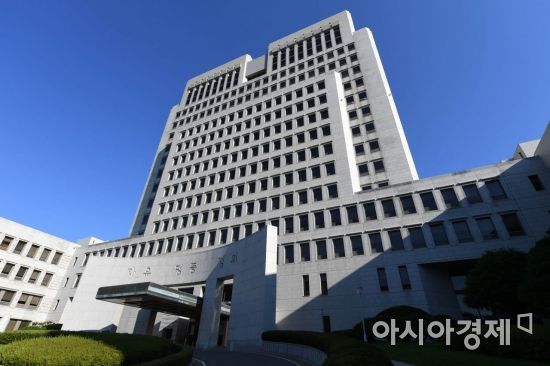
According to the legal community on the 5th, the Supreme Court's 3rd Division (Presiding Justice Lee Heung-gu) overturned the original verdict that sentenced Kim, who was indicted for violating Article 93(1) of the Public Official Election Act (distribution of documents by illegal means), to a fine of 1 million won, and remanded the case to the Seoul High Court.
The court stated, "The lower court should have examined and judged the constitutionality of the pre-amendment Article 93(1) of the Public Official Election Act concerning 'distribution of documents' and the relevant part of Article 255(2)(5) concerning 'distribution of documents under Article 93(1),' or the necessity of amending the indictment to avoid unconstitutional results. The lower court's failure to do so and its decision to uphold the first trial's guilty verdict on the charges had a significant impact on the judgment," explaining the reason for the remand.
At the time of the first and second trials against Kim, Article 93(1) of the Public Official Election Act (prohibition of distribution or posting of documents or posters by illegal means) stipulated that, except in cases permitted by law, documents or printed materials containing content supporting, recommending, or opposing political parties or candidates could not be distributed, posted, or disseminated from 180 days before the election day until the election day for general elections, or from the date the reason for the by-election was confirmed until the election day for by-elections.
Violations were punishable under Article 255(2)(5) of the same law.
Kim, who was the redevelopment promotion committee chairman of a district in Eunpyeong-gu, Seoul, was indicted for having volunteers distribute 300 copies of a document titled "Newsletter" containing statements such as "If candidate Oh Se-hoon becomes mayor, redevelopment and reconstruction will be revitalized!" and "Candidate Oh Se-hoon promised to revitalize redevelopment and reconstruction and will ease regulations with mayoral authority; if private redevelopment and reconstruction are revitalized, public redevelopment will lose momentum and become impossible!" into mailboxes of 42 buildings in the area two days before the Seoul mayoral by-election on April 5, 2021.
At the time, Kim was in conflict with another residents' group promoting public redevelopment in the same district. On March 29, 2021, he visited the People Power Party headquarters and met with a certain People Power Party lawmaker to convey difficulties in the redevelopment process. A few days later, he returned to the party headquarters and, after receiving an appointment letter as a special advisor for urban maintenance revitalization for Oh Se-hoon's election campaign, committed the act.
The prosecution charged Kim, asserting that he distributed documents supporting candidate Oh Se-hoon during a period when distributing such documents was prohibited (from the confirmation of the by-election reason until the election day).
The first trial court found Kim guilty and sentenced him to a fine of 1 million won.
During the trial, Kim argued that his intention was merely to inform residents in the redevelopment area about Oh's reconstruction and redevelopment policies, not to influence the election, but this was not accepted.
The court judged that, considering Kim met with a People Power Party lawmaker before distributing the documents to submit a request for easing redevelopment regulations and was appointed as a special advisor for urban maintenance revitalization for Oh Se-hoon's campaign, his purpose went beyond merely informing residents about Oh's redevelopment policies. It was to effectively form a positive public opinion in the area to favor Oh in the by-election.
Kim appealed, but the second trial court upheld the same judgment.
However, after the second trial guilty verdict against Kim was announced on June 23, 2022, the Constitutional Court issued a ruling of constitutional inconsistency regarding the provisions of the Public Official Election Act applied to Kim.
On July 21, 2022, the Constitutional Court ruled constitutional inconsistency on parts of Article 93(1) of the Public Official Election Act concerning "posting of posters, distribution and posting of printed materials" and "advertisements, attachment and posting of documents or posters," as well as the relevant parts of Article 255(2)(5) that punish these acts.
Then, on March 23, 2023, the Constitutional Court again ruled constitutional inconsistency on the "distribution of printed materials" part of Article 93(1) and its corresponding punishment provision.
The Constitutional Court judged that these provisions excessively and broadly restrict the political freedom of expression of candidates and voters, thus violating the Constitution.
A constitutional inconsistency ruling is a type of unconstitutional decision issued by the Constitutional Court to prevent confusion and legal gaps that arise from simple unconstitutional rulings and to respect the legislature's lawmaking authority. The Court clearly stated that the provisions violate the Constitution and set a deadline for the legislature to amend the law.
At the time of the constitutional inconsistency ruling on the "distribution of printed materials" part, the Court stated, "The unconstitutionality of the challenged provisions lies not in restricting the act of distributing printed materials to influence elections but in broadly regulating such acts over a long period, thereby prohibiting and punishing political expressions such as distributing printed materials, which candidates or ordinary voters can easily perform at low cost without harming equal opportunity or fairness in elections. The legislature should decide, after sufficient discussion, the extent to which political expression methods should be permitted."
Following the Constitutional Court's ruling, the law was amended on August 30, 2023, changing the prohibited period for distributing documents and similar materials from "180 days before the election day until the election day" to "120 days before the election day until the election day."
In light of these series of Constitutional Court rulings, the Supreme Court judged that the punishment provisions applied to Kim also have potential unconstitutionality and that the second trial should be reopened to examine this.
Referring to the three Constitutional Court rulings, the court stated, "Although the constitutional inconsistency ruling is a modified form of unconstitutional decision not stipulated in the Constitution or the Constitutional Court Act, it corresponds to an unconstitutional decision on legal provisions. The reasons for each constitutional inconsistency ruling are that the relevant parts of the pre-amendment Article 93(1) and Article 255(2)(5) of the Public Official Election Act excessively restrict the political freedom of expression of candidates and voters, and set the regulation period unreasonably long from '180 days before the election day until the election day,' violating the principle of proportionality and infringing political freedom of expression," emphasizing this point.
The court further pointed out, "Although the parts concerning 'distribution of documents' in the pre-amendment Article 93(1) and Article 255(2)(5) applied to the defendant were not subjects of the Constitutional Court's rulings, they may also be evaluated as violating the principle of proportionality and infringing political freedom of expression for the same reasons stated in the constitutional inconsistency rulings."
Although the Constitutional Court did not directly rule the "distribution of documents" part applied to Kim as unconstitutional, since the reason for ruling the "distribution of printed materials" part unconstitutional was the excessively broad regulation period, it is highly likely that the Court would also find the "distribution of documents" part unconstitutional. This judgment is also reasonable considering that the illegality of distributing printed materials is greater than that of general documents.
Ultimately, the court concluded, "The lower court should have examined and judged the constitutionality of the 'distribution of documents' part of Article 93(1) and the relevant part of Article 255(2)(5) or the necessity of amending the indictment to avoid unconstitutional results. The lower court's failure to do so and its decision to uphold the first trial's guilty verdict had a significant impact on the judgment."
At the time of the second trial against Kim, the Constitutional Court had not yet ruled on the unconstitutionality of Article 93(1) or the punishment provision Article 255(2) applied to Kim. However, the Court was reviewing the constitutionality of these provisions following a referral from another court.
Considering the Constitutional Court rulings issued after the second trial verdict, it is almost certain that the Court would find the "distribution of documents" part applied to Kim unconstitutional. Therefore, the Supreme Court overturned the guilty verdict and ordered a retrial.
The Criminal Act adopts the principle of legality (nullum crimen sine lege). Also, the Constitutional Court's unconstitutional rulings on punishment provisions have retroactive effect. Therefore, even if Kim's act would be punishable under the amended law following the Constitutional Court's constitutional inconsistency rulings, if the punishment provisions applied to Kim at the time of the act were unconstitutional, Kim cannot be punished under those provisions.
© The Asia Business Daily(www.asiae.co.kr). All rights reserved.
![Clutching a Stolen Dior Bag, Saying "I Hate Being Poor but Real"... The Grotesque Con of a "Human Knockoff" [Slate]](https://cwcontent.asiae.co.kr/asiaresize/183/2026021902243444107_1771435474.jpg)
















