40°C Recorded in Jeomdong-myeon, Yeoju-si, Gyeonggi
'Double High Pressure' Covers the Korean Peninsula
11 Heat-Related Deaths This Year
For the first time in five years since 2019, temperatures have exceeded 40 degrees Celsius, and the current heatwave is expected to continue for at least ten days. As the Tibetan High and North Pacific High pressure systems cover the Korean Peninsula, heat-related illnesses are occurring nationwide.
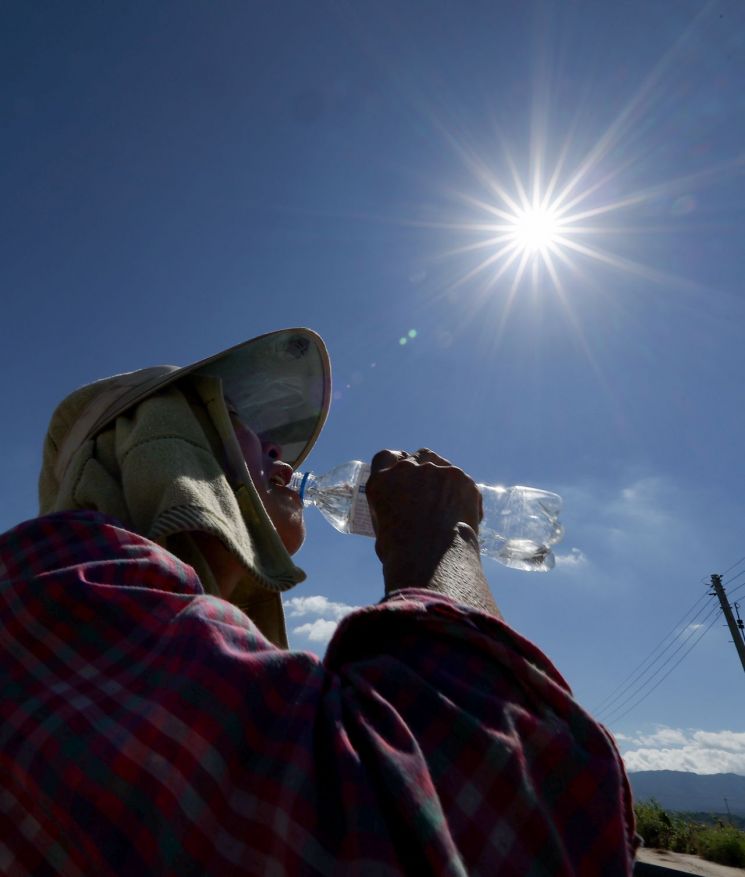 A farmer is cooling off by drinking water while harvesting peppers in a farmland in Dasan-myeon, Goryeong-gun, Gyeongbuk.
 [Image source=Yonhap News]
According to the Korea Meteorological Administration on the 5th, the automatic weather observation equipment installed in Jeomdong-myeon, Yeoju-si, Gyeonggi Province, recorded a temperature of 40 degrees Celsius at around 3:33 PM the previous day. Currently, there are two high-pressure systems around the Korean Peninsula. The upper atmosphere occupied by the Tibetan High experiences adiabatic warming within the high-pressure zone, while the middle and lower layers receive hot and humid air from the North Pacific High. The air heats up due to direct sunlight, causing temperatures to rise. Adiabatic warming refers to the phenomenon where the temperature increases as the volume of air contracts under adiabatic conditions. The entire atmospheric column, from the lower to the upper layers, is filled with hot air.
Temperatures exceeding 40 degrees Celsius are very rare in South Korea. On August 1, 1942, Daegu recorded 40 degrees Celsius, and on August 1, 2018, temperatures rose above 40 degrees in Hongseong, Bukchuncheon, Uiseong, Yangpyeong, and Chungju. On August 14 of the same year, Uiseong again recorded temperatures above 40 degrees. On August 5, 2019, 40.2 degrees Celsius was observed in Gosam-myeon, Anseong-si, Gyeonggi Province. There is also speculation that the current double high-pressure system may not yet be at its peak. When these two high-pressure systems are strongest, the heatwave reaches its peak, but it is uncommon for the peak to occur in early August.
As more severe heatwaves approach, the potential for increased casualties is high. According to the Ministry of the Interior and Safety's "Heatwave Response Situation Report," from May 20 to August 3, there have been 1,546 cumulative cases of heat-related illnesses. The estimated number of deaths due to heat-related illnesses is 11. Among these, 5 deaths occurred on August 2 and 3, with 2 and 3 deaths respectively.
The Korea Meteorological Administration's medium-term forecast predicts that from the 7th to the 14th, morning temperatures will range from 23 to 27 degrees Celsius and daytime temperatures from 30 to 36 degrees Celsius, exceeding average temperatures and maintaining levels similar to the current situation. Nationwide, the highest perceived temperature is expected to reach up to 35 degrees Celsius, and tropical nights are expected to continue.
© The Asia Business Daily(www.asiae.co.kr). All rights reserved.
![Clutching a Stolen Dior Bag, Saying "I Hate Being Poor but Real"... The Grotesque Con of a "Human Knockoff" [Slate]](https://cwcontent.asiae.co.kr/asiaresize/183/2026021902243444107_1771435474.jpg)















