"Give Me the Money Owed" Civil Lawsuit Intensifies
Up to 2 Million KRW Retainer Fee Promoted by Small Law Firms
Creditor Relief Procedures During Rehabilitation and Bankruptcy
Same Effect as Civil Lawsuit... Practical Benefits Unclear
Although the movement for damage compensation lawsuits by victim vendors against TMON and WEMAKEPRICE (TMEP) is gaining momentum, there are criticisms that these lawsuits have no practical benefit as they are equivalent in effect to the ‘creditor acknowledgment or denial statement preparation and creditor investigation confirmation judgment’ in the rehabilitation and bankruptcy procedures. From the perspective of the affected small business owners, it is considered a more realistic response to secure their creditor rights through procedures such as verifying the creditor list with a low filing fee, preparing creditor acknowledgment or denial statements, and reviewing the trustee’s report, rather than paying huge attorney fees and filing civil lawsuits.
According to the legal community on the 5th, some small law firms are promoting ‘civil lawsuits for seller settlement payments’ targeting TMEP victim vendors. Some law firms have announced retainer fees of up to 4 million KRW and performance fees of around 10% depending on the claim amount for preservation measures such as provisional seizure and civil lawsuits for monetary claims. However, since the rehabilitation and bankruptcy procedures are essentially collective creditor relief processes, there is little practical benefit in separately pursuing civil lawsuits by paying expensive attorney fees at this time. This is because all procedures such as debt collection, provisional seizure, and compulsory execution are impossible due to a comprehensive payment prohibition order.
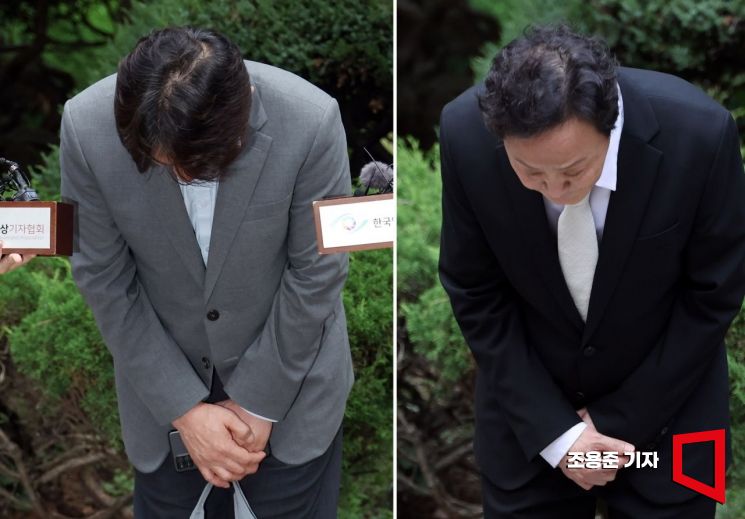 Ryu Hwa-hyun, CEO of Wemakeprice (left), and Ryu Kwang-jin, CEO of Tmon, are greeting each other as they attend the hearing at the Seoul Bankruptcy Court in Seocho-gu, Seoul on the 2nd. The court plans to review the reasons for Tmon and Wemakeprice's rehabilitation applications, their debt status, and funding plans. Photo by Jo Yong-jun jun21@
A corporate rehabilitation specialist lawyer explained, “The meaning of a civil lawsuit is that the court explicitly confirms the plaintiff’s claim amount and enforces the judgment against the opposing party, but the rights of creditors are already included within the corporate rehabilitation and bankruptcy procedures.” The lawyer added, “If my claim amount is accurately stated in the creditor list, it has the same effect as winning a civil lawsuit.”
In fact, the general corporate rehabilitation procedure proceeds in the order of ‘rehabilitation application → commencement decision → preparation of creditor list → creditors’ claim reporting → preparation of creditor acknowledgment or denial statements → investigation report by accounting firm → establishment of rehabilitation plan → creditors’ meeting → rehabilitation approval decision.’ An important step from the creditor’s perspective is having their claim included in the creditor list (specified in the claim report and acknowledgment or denial statement). If the claim amount reported by TMON or WEMAKEPRICE differs, a ‘creditor investigation confirmation judgment’ is conducted, which also exists within the rehabilitation and bankruptcy procedures. Ultimately, timely claim reporting and verifying that one’s claim is included in the creditor list is crucial, and even if there is a dispute over the claim amount, a separate creditor investigation confirmation judgment procedure can be followed.
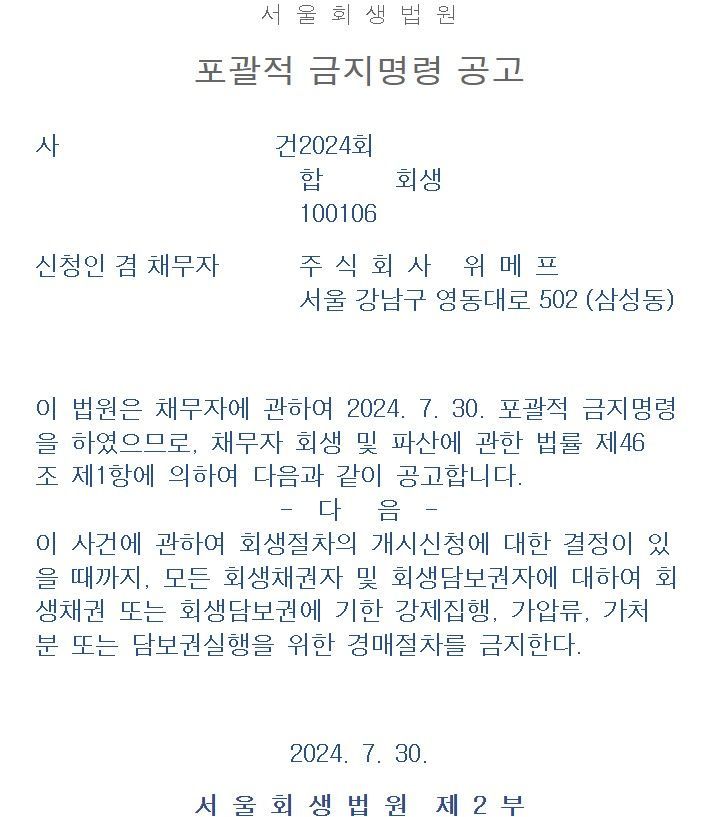 The comprehensive injunction announced by the Seoul Rehabilitation Court on July 30. The comprehensive injunction is a measure that freezes all claims until the court decides to commence court receivership. Once this decision is made, procedures such as creditors' compulsory execution, provisional seizure, and auction are suspended. [Image source=Seoul Rehabilitation Court]
An anonymous rehabilitation and bankruptcy specialist lawyer advised, “The filing fee for civil lawsuits increases according to the claim amount, but the filing fee for creditor investigation confirmation judgments is fixed regardless of the claim amount,” adding, “Even if the case goes to civil court, it is common to determine the repayment amount according to the rehabilitation plan, so it is meaningless to pay expensive attorney fees and proceed with a civil lawsuit.”
For this reason, corporate bankruptcy specialist lawyers advise that even if civil lawsuits are pursued, it is necessary to request claim reporting representation or require law firms to include relief measures in separate agreements when there is no practical benefit to the lawsuit. One lawyer said, “Reviewing the trustee’s report or inspecting acknowledgment or denial statements and creditor council materials can be done at a low cost, so it would be advantageous to be aware of this and contract with law firms accordingly.”
© The Asia Business Daily(www.asiae.co.kr). All rights reserved.
![Clutching a Stolen Dior Bag, Saying "I Hate Being Poor but Real"... The Grotesque Con of a "Human Knockoff" [Slate]](https://cwcontent.asiae.co.kr/asiaresize/183/2026021902243444107_1771435474.jpg)

















