The Supreme Court has ruled recognizing the Korea Institute for Curriculum and Evaluation's (hereinafter referred to as the Institute) liability for damages to copyright holders for posting college scholastic ability test evaluation questions created by quoting literary or artistic works on its website, allowing anyone to download them.
According to copyright law, while it is true that the Institute can use published copyrighted works in the college scholastic ability test questions without prior permission from the copyright holders, and that posting the test questions on the website for download has public interest and non-profit aspects, allowing unlimited downloads without any restrictions on the subject or period cannot be regarded as a legitimate use of copyright, the ruling states.
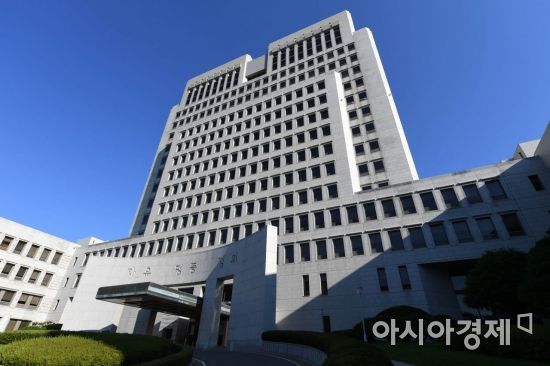
On the 4th, according to the legal community, the Supreme Court's 3rd Division (Presiding Justice No Jeong-hee) affirmed the lower court's partial ruling in favor of the Korea Literary and Artistic Copyright Association, ordering the Institute to pay 10 million won plus interest in the damages claim appeal lawsuit filed by the Association against the Institute.
The court explained the reason for dismissing the Institute's appeal, stating, "There is no error in the lower court's judgment regarding the legal requirements for establishing liability for damages due to copyright infringement, nor was there any failure to conduct necessary hearings that affected the judgment."
The Copyright Association is an organization authorized under copyright law to manage copyright trust operations, entrusted with the rights of reproduction and transmission of works from copyright holders, collecting usage fees, and distributing them to the trustors.
The Institute is a public institution established for the purpose of researching and developing curricula for schools below high school level, conducting educational assessments, creating, administering, and grading nationwide academic evaluation tests.
The Copyright Association filed a lawsuit in October 2019 demanding compensation of about 17.2 million won, claiming that the Institute's posting of college scholastic ability test and high school entrance exam questions quoting works managed by the Association on its website from 2009 to 2019 constituted copyright infringement.
The Association argued that the Institute infringed the transmission rights of copyright holders managed by the Association by making about 150 works, including poems, novels, and artworks, quoted in the questions accessible for viewing or downloading by anyone.
On the other hand, the Institute argued, "The posting act in this case is an act of quoting published works within a fair practice and a justifiable scope for education, etc., permitted under Article 28 of the Copyright Act, or an act of using works that does not conflict with the normal use of the work and does not unjustly harm the legitimate interests of the author, permitted under Article 35-3, Paragraph 1 of the Copyright Act at the time of the act."
At the time of the posting act, Article 28 (Quotation of Published Works) of the Copyright Act stipulated that "published works may be quoted within a justifiable scope and in accordance with fair practice for purposes such as reporting, criticism, education, and research."
Also, Article 35-3 (Fair Use of Works), Paragraph 1, stipulated that except for cases under Articles 23 to 35-2 and Articles 101-3 to 101-5, works may be used if it does not conflict with the normal use of the work and does not unjustly harm the legitimate interests of the author. This provision, newly established in December 2011, can be seen as a comprehensive clause allowing exceptional quotations of works.
The first-instance court ruled in favor of the Institute.
The court stated, "All the works in this case are published works, and disclosing evaluation questions to ensure equal learning opportunities for examinees and transparent management of exams aligns with the public interest."
The court also held that Article 28 of the Copyright Act, which separately regulates cases where published works can be quoted for education, etc., does not exclude the application of Article 35-3 of the same law.
The court concluded, "Article 35-3 of the Copyright Act is a comprehensive fair use provision established on December 2, 2011, and enforced from March 15, 2012, considering the difficulty of predicting various situations requiring limitations on copyright property rights. It is reasonable to view the defendant's posting act as permitted under either Article 28 or Article 35-3 of the Copyright Act."
As grounds for this judgment, the court cited: ▲ ensuring equal learning opportunities for examinees and public interest in disclosing evaluation questions for transparent management of various exams; ▲ the defendant's posting act not appearing to be for profit or other private interests beyond public interest; ▲ all works in this case being published works with high academic and artistic value, frequently used for exams or educational purposes, necessitating broad allowance for quotations for such purposes; ▲ the quantitative and qualitative proportion of the works in the evaluation questions not being significant; ▲ the defendant indicating the author's name and work title when quoting the works; ▲ and the works and evaluation questions having completely different purposes, characteristics, and uses, with no possibility of the evaluation questions substituting the demand for the works.
Meanwhile, Article 32 of the Copyright Act applied in this case (Reproduction as Exam Questions) stipulated that "in cases necessary for school entrance exams or other tests or certifications related to knowledge and skills, published works may be reproduced and distributed within a justifiable scope for that purpose. However, this does not apply if done for profit." In 2020, the law was amended to add "public transmission" to the types of permitted acts, allowing reproduction, distribution, or public transmission of published works within a justifiable scope.
Regarding this, the first-instance court held that "'quotation' under Article 28 of the Copyright Act includes the use of works such as reproduction, distribution, and public transmission beyond mere quotation."
However, the second-instance court's judgment differed. The appellate court overturned the first-instance ruling dismissing the plaintiff's claim and recognized the Institute's liability for damages of 10 million won.
Separately from the allowance under copyright law for quoting works in exam questions, the appellate court held that posting the questions on the website after the exam and allowing unlimited downloads cannot be regarded as legitimate use of the works.
First, the appellate court, unlike the first-instance court, judged that, in light of the wording and purpose of Article 32 of the Copyright Act, the use of works for exam questions is limited to the scope necessary for the exam's purpose (such as question creation, objection handling, grading), and even under the amended law adding public transmission, such acts are not permitted.
The court stated, "Article 32 of the Copyright Act allows free use without prior permission from copyright holders only for non-profit exams conducted for public interest, considering the difficulty of maintaining secrecy if permission were required before the exam, such as the risk of question content being disclosed."
It continued, "Considering the wording and purpose of the provision, the effective limitation on copyright holders' property rights, and the significance of balancing conflicting interests between copyright holders and the public, the scope of free use of works for exam questions should be limited to what is necessary for objective and fair evaluation of examinees' learning ability and knowledge. Therefore, disclosing exam questions without the copyright holder's consent after the exam should only be allowed within a limited scope necessary for verification processes such as objections and proper grading."
The court added, "Allowing free use of works beyond the necessary scope after the exam ends, when secrecy is no longer needed and procedural requirements are completed, could replace demand for the works for learning, education, or appreciation, exceeding the intended scope of the provision."
Furthermore, "The posting act in this case transmits the works used in the exam to an unspecified large number of people without limitation on period for several years after the entire exam process, including question creation and grading, is completed, without the copyright holder's permission. Therefore, it is not included in the legitimate scope necessary for the exam's purpose and cannot be considered permitted even under the current Article 32 of the Copyright Act, which added public transmission."
The court also judged that the Institute's posting of exam questions is difficult to regard as permitted under Articles 28 or 35-3 of the Copyright Act.
In the trial, the Institute argued, "The posting act aims to allow the public to study the evaluation questions to prepare for various exams and enhance fairness and objectivity of the exams. In particular, the performance assessment question material collection is intended for teachers at all school levels to use as teaching materials, thereby improving and developing curricula and teaching methods."
However, the court rejected this, stating, "According to the Institute's claim, the posting act results in providing the works as learning or educational materials to the public. However, the Institute is not an educational institution or support institution authorized under Article 25, Paragraph 2 of the Copyright Act to transmit published works within the scope necessary for classes or class support. Based on the submitted evidence, it is difficult to conclude that providing learning or educational materials directly to the public is within the Institute's business scope."
Article 25 (Use for School Education Purposes) Paragraph 1 of the Copyright Act allows published works to be included in textbooks necessary for educational purposes in high schools and lower-level schools.
Paragraph 2 of the same article permits educational institutions established under special laws or under the Early Childhood Education Act, Elementary and Secondary Education Act, Higher Education Act, or operated by national or local governments, and educational support institutions affiliated with them, to reproduce, distribute, perform, exhibit, or publicly transmit parts of published works necessary for classes or support.
The court noted that there is a market formed for paying certain compensation when using works as learning materials, so the Institute allowing an unspecified large number of people to download exam questions containing copyrighted works free of charge for a long time is not a normal usage method, and posting questions without indicating sources cannot be regarded as legitimate use.
The court stated, "According to Paragraph 4 of the old Copyright Act Article 25, even the educational institutions or support institutions specified in the provision must pay compensation to copyright holders except for high schools and lower-level schools. There is a normal usage method structured on copyright holders' permission and users' payment of usage fees, and a certain market has formed for this."
It continued, "However, the defendant's posting act resulted in free use of the works as learning materials without the copyright holders' permission, which contradicts the normal usage method formed for learning materials."
Additionally, the court pointed out, "The defendant posted about 38 out of 153 works without indicating their sources, causing these works without source indication to be continuously exposed to an unspecified large number of people on the internet for a long time. Considering all these circumstances, it is difficult to view the defendant's posting act as a fair quotation within a justifiable scope or as a use that does not conflict with normal usage methods or unjustly harm the author's legitimate interests. Therefore, the defendant's use of the works without permission and without payment through the posting act cannot be justified."
Ultimately, the court held that the Institute must bear liability for damages under copyright law.
Article 125 (Claim for Damages) Paragraph 1 of the Copyright Act stipulates that "if a person who holds copyright or other rights protected under this law claims damages against a person who infringed those rights intentionally or negligently, and if the infringer gained profits from the infringement, the amount of such profits shall be presumed to be the amount of damages suffered by the copyright holder."
The court concluded, "The defendant initially used the works as passages in the evaluation questions without obtaining permission from the authors or their trustees due to the exam's purpose and necessity. However, after the entire exam process ended, when the secrecy of the exam was lost, the defendant had the opportunity to negotiate permission with the copyright holders. Considering the Institute's establishment, duration, nature of business, and knowledge or ability to know the legal provisions and practices regarding use of works, at least negligence exists in infringing the plaintiff's transmission rights. Therefore, the defendant is obligated to compensate the plaintiff for damages caused by infringement of transmission rights."
The Institute appealed, but the Supreme Court found no problem with the second-instance court's judgment.
The court stated, "The works used in the posting act are published works, mostly fictional and creative works such as poems, novels, and artworks. Among them, poems and artworks were mostly used in full, and parts of novels were used. Meanwhile, the defendant did not impose restrictions on posting period or download eligibility for most of the posting period, making it difficult to evaluate that the defendant used the works within the necessary scope."
It also noted, "There was already a market where those who want to use the works managed by the plaintiff as learning materials obtain permission and pay usage fees to the plaintiff. There is also a reasonable likelihood that a market for providing past exam questions and learning materials by transmission will develop in the future."
It added, "However, the defendant's posting act transmitted the works included in the evaluation questions without permission from the plaintiff, differing from the normal usage methods in such markets. This raises a significant risk of substituting demand or damaging market value for the works. Therefore, the posting act affects the current or potential market or value of the works."
The court stated, "Even when educational institutions or support institutions use works to achieve school education purposes under copyright law, except for some educational institutions, they must pay compensation to copyright holders. Educational institutions must also take necessary measures such as copy protection to prevent infringement when transmitting parts of works for classes."
It continued, "However, the defendant is neither an educational institution nor a support institution under the old Copyright Act Article 25, and did not take necessary measures such as copy protection to prevent infringement. The defendant posted the works for public use for a long time without permission from the plaintiff, and failed to indicate sources for some works, violating the source indication obligation under Article 37 of the Copyright Act. Such usage cannot be considered legitimate."
Finally, the court stated, "The defendant is a public institution operated with government subsidies, and under Article 105, Paragraph 5 of the Copyright Act, usage fees collected by copyright trust management organizations like the plaintiff are set through procedures including consultation with stakeholders and approval by the Minister of Culture, Sports and Tourism. Therefore, the defendant could have paid the approved usage fees for the works and posted past exam questions including the evaluation questions on its website for public use, appropriately balancing public interest in providing learning materials and the legitimate interests of authors."
And the court concluded, "Even considering the public interest and non-profit aspects of providing the evaluation questions to the public, it is difficult to regard the posting act as not conflicting with normal usage methods or unjustly harming the legitimate interests of the authors."
© The Asia Business Daily(www.asiae.co.kr). All rights reserved.
![Clutching a Stolen Dior Bag, Saying "I Hate Being Poor but Real"... The Grotesque Con of a "Human Knockoff" [Slate]](https://cwcontent.asiae.co.kr/asiaresize/183/2026021902243444107_1771435474.jpg)















