It Seems to Be a Rebuttal Aiming to Avoid a Total Defeat in Security and Intelligence Warfare
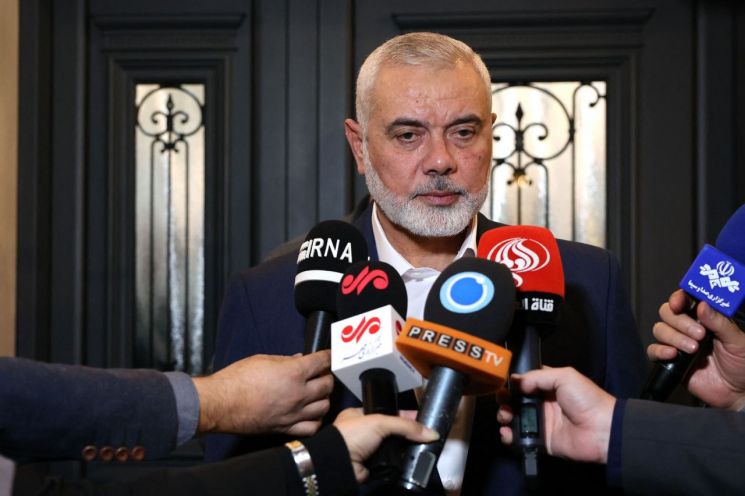 Ismail Haniyeh, the political leader of the Palestinian armed faction Hamas, is speaking to reporters ahead of a meeting with Hossein Amir-Abdollahian, Iran's Foreign Minister, on December 20 last year (local time) in Doha, Qatar.
 [Photo by Yonhap News]
The Islamic Revolutionary Guard Corps (IRGC) of Iran announced through its own investigation that the means used to assassinate Ismail Haniyeh, the top political leader of the Palestinian armed faction Hamas, on the 31st of last month was a short-range projectile. This explanation contradicts Western media reports attributing the assassination to explosives planted by Israeli intelligence agencies at Haniyeh's residence.
On the 3rd (local time), Iran's state-run IRNA news agency reported this. It is the first official statement from Iran regarding Haniyeh's assassination, coming three days after the killing in Tehran, the capital of Iran, on the 31st of last month. The Revolutionary Guard stated in a press release, "A short-range projectile carrying about 7 kg of warhead was launched outside the residence where Haniyeh stayed," adding, "It was planned and executed by the Zionist regime (Israel) with the criminal support of the U.S. government." They further added, "There will be severe punishment at the right time, place, and in an appropriate manner."
From the early stages of the incident, Iran judged that the assassination was an 'airstrike' by Israel. On the day of the assassination, Iran's semi-official Fars News Agency described that "Haniyeh was martyred by a missile launched from the air." The previous day, it also reported that "Haniyeh's residence on the 4th floor of the Zafaraniyeh building (in Tehran) was hit by a projectile." Lebanon's pro-Hezbollah media outlet Al-Mayadeen also conveyed through Iranian sources that "the missile came from abroad."
On the other hand, on the 1st, the U.S. daily The New York Times (NYT) cited multiple officials from Middle Eastern countries, Iran, and the U.S., reporting that the bomb had already been planted in the residence about two months before Haniyeh's assassination. It explained that the bomb was remotely detonated when Haniyeh entered the residence. The Wall Street Journal (WSJ) and Axios reported that Israeli intelligence agency Mossad analyzed Haniyeh's behavioral patterns, as he frequently traveled to Tehran, and accurately identified the room he would use. They also reported that the bomb planted in Haniyeh's residence was equipped with artificial intelligence (AI) capabilities. The British daily The Telegraph reported the previous day that Israel recruited members of the IRGC to plant the bomb.
Meanwhile, Israel has neither confirmed nor denied involvement in Haniyeh's assassination. However, it has already drawn a line regarding the possibility of airstrikes. On the 1st, Daniel Hagari, the chief spokesperson for the Israel Defense Forces, acknowledged the airstrike on Beirut, the capital of Lebanon, on the night of the 30th of last month but told local media Times of Israel that "there were no other airstrikes by missiles or Israeli drones in the Middle East region that night."
Israeli and Middle Eastern media view Iran's explanation of an external airstrike as an attempt to avoid the total failure of security and intelligence operations after suffering the humiliation of a VIP being killed in the heart of its own territory. Ynet interpreted, "The claim that Israel infiltrated agents into the VIP residence in Tehran to assassinate the guest stems from the Iranian regime's embarrassment over a serious security failure."
© The Asia Business Daily(www.asiae.co.kr). All rights reserved.
![Clutching a Stolen Dior Bag, Saying "I Hate Being Poor but Real"... The Grotesque Con of a "Human Knockoff" [Slate]](https://cwcontent.asiae.co.kr/asiaresize/183/2026021902243444107_1771435474.jpg)
















