Statistics Korea July Consumer Price Trends
Petroleum Products Up 8.4% Due to Rising International Oil Prices and Reversal of Fuel Tax Reduction
The consumer price inflation rate has remained in the 2% range for the fourth consecutive month. However, due to the rise in international oil prices and the rollback of fuel tax cuts, petroleum prices recorded the highest increase in 21 months.
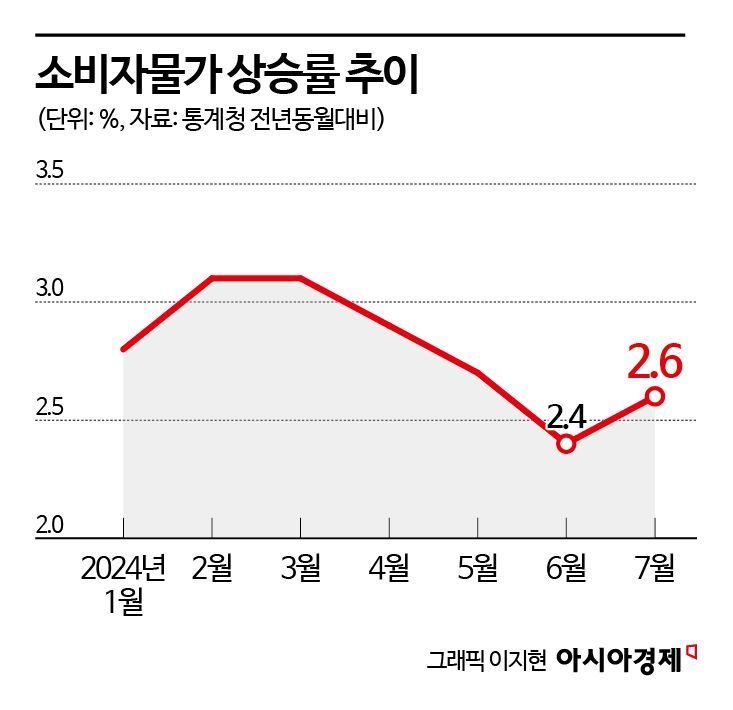
According to the Consumer Price Trends released by Statistics Korea on the 2nd, the consumer price index in July rose 2.6% compared to the same month last year. This marks a slight rebound in July following April (2.9%), May (2.7%), and June (2.4%). Mi-sook Gong, Director of Economic Trend Statistics at Statistics Korea, explained, "The expanded increase in petroleum prices and the rise in services excluding dining out influenced the inflation rate."
Petroleum prices rose by 8.4%, pushing up overall inflation. This increase was significantly larger than the previous month’s 4.3%. It is the highest increase in 21 months since October 2022, when prices rose 10.3%. This was due to rising international oil prices alongside a reduction in the fuel tax cut. The price of Dubai crude oil, the benchmark for imported crude oil, increased from $82.6 per barrel in June to $83.8 per barrel in July. Director Gong also noted, "There is a base effect from last year when petroleum prices were low." In July last year, petroleum prices fell 25.9% compared to the previous year.
Prices of agricultural, livestock, and fishery products also rose 5.5% compared to the previous year. In particular, agricultural products increased by 9.0%. This was influenced by the continued strong price trend of fruits such as apples (39.6%) and pears (154.6%). Pears recorded the highest increase since the start of statistical surveys. Although vegetable prices fell 1.9% compared to the previous year, they rose sharply compared to the previous month due to weather impacts such as heavy rain. Spinach rose 62.1%, lettuce 57.2%, and napa cabbage 27.3%.
Director Gong explained, "There was also adverse weather such as heavy rain in July last year, so the year-on-year increase was not high. However, due to the short growth cycle of vegetables, prices rose significantly compared to the previous month because of weather-related fluctuations."
Prices for personal services also rose 2.9%, slightly expanding from 2.7% in the previous month. Dining out prices increased by 2.9%, and services excluding dining out rose by 3.0%. This was due to the holiday season demand, which pushed up prices for services such as tourism and accommodation compared to the previous month. Statistics Korea explained that insurance services and apartment management fees also increased, contributing to the rise in services excluding dining out compared to the previous year.
The core inflation rate (excluding agricultural products and petroleum) rose 2.1% year-on-year, showing a similar level to the 2.0% increases in May and June. The index excluding food and energy rose 2.2% compared to the same month last year. The living cost index, which tracks 144 frequently purchased items with a high expenditure share that consumers are sensitive to price changes, rose 3.0% compared to the previous year, slightly higher than June’s 2.8% increase.
The fresh food index surged 7.7% compared to the same month last year, but the increase was significantly slower than the previous month’s 11.7%. Fresh fruits rose 21.3%, showing the strongest upward trend. In contrast, fresh vegetables and fresh fishery products fell by 1.7% and 1.0%, respectively.
The government forecasted that inflation would slow down again to the low to mid 2% range starting in August. Beom-seok Kim, First Vice Minister of the Ministry of Economy and Finance, said at the '28th Vice Ministerial Meeting on Inflation' held at the Government Seoul Office on the same day, "Although consumer prices rose 2.6% in July due to heavy rains and international oil price impacts, inflation has remained in the 2% range for four consecutive months, and core inflation rose 2.2%, indicating a continued trend of price stability. If temporary factors such as adverse weather are resolved and no additional shocks occur, the inflation slowdown to the low to mid 2% range is expected to resume from August."
He added, "We will closely monitor international oil price trends related to Middle East tensions and respond promptly according to contingency plans. We will also do our utmost to stabilize agricultural product supply and demand through measures such as releasing stockpiles of napa cabbage and radish and providing discount support." Furthermore, he said, "We will continue to support the food industry to reduce cost burdens and communicate with the industry to ensure that cost reductions are reflected in prices."
The Ministry of Economy and Finance predicted that agricultural and fishery product prices would remain stable except for apples and pears. A ministry official said, "Lettuce and perilla leaves, which are affected by weather, will soon recover in production and stabilize supply and demand, and the production of seasonal fruits such as grapes and peaches is also stable." However, since supply shortages of apples and pears continue, the official noted that there are not many factors for price declines in the near term.
© The Asia Business Daily(www.asiae.co.kr). All rights reserved.
![Clutching a Stolen Dior Bag, Saying "I Hate Being Poor but Real"... The Grotesque Con of a "Human Knockoff" [Slate]](https://cwcontent.asiae.co.kr/asiaresize/183/2026021902243444107_1771435474.jpg)















