Korea Consumer Agency Investigates 14 Products
"Cola Products Contain Caffeine"
A survey has found that consuming zero-calorie beverages available on the market for the purpose of dieting or disease reduction is not advisable. The calorie content of zero-calorie beverages was only 1 to 22% lower compared to regular sugar-sweetened carbonated drinks.
On the 1st, the Korea Consumer Agency announced the results of testing the safety of 14 zero-calorie beverage products, including sweeteners, sugar content, and heavy metals, as well as investigating labeling practices and prices. The results showed that the sweetener content in zero-calorie beverages available on the market was at 3 to 13% of the acceptable daily intake (ADI). All zero-calorie beverage products surveyed used 'acesulfame potassium' and 'sucralose.' These ingredients are high-intensity sweeteners that are 200 to 600 times sweeter than sugar.
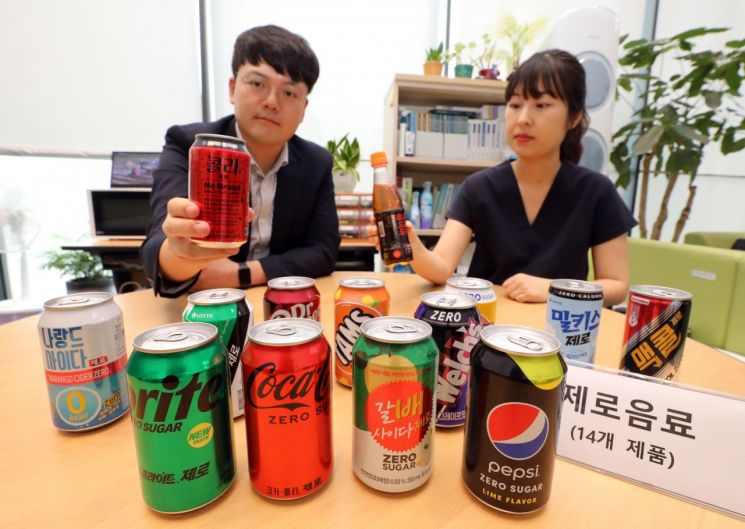 The Korea Consumer Agency released comparative information on the sweeteners and sugar content, safety, labeling practices, and prices of 14 zero-calorie beverage products on the 1st. The photo shows Consumer Agency staff examining the target products. Photo by Yonhap News
The acesulfame potassium content was highest in 'Miero Fiber Sparkling Zero' at 20 mg per 100 ml, while 'Milkis Zero' and 'Chilsung Cider Zero' had the lowest at 7 mg. Sucralose content was highest in 'Sprite Zero' and 'McCol Zero' at 27 mg per 100 ml, whereas 'Miero Fiber Sparkling Zero' and 'Chilsung Cider Zero' had the lowest at 14 mg.
Sweeteners have an established acceptable daily intake for safe use. The acesulfame potassium and sucralose content in one zero-calorie beverage corresponded to 3 to 13% of the ADI for adults (based on a body weight of 60 kg). The Consumer Agency advised, "The World Health Organization (WHO) recommends not using sweeteners as a means for dieting or disease reduction," and added, "Health-conscious consumers should reduce their intake of sweetener-added beverages as much as possible and replace them with water."
All zero-calorie beverages met the 'zero sugar (no sugar)' labeling criteria. Among the 14 products, sugar was not detected in 13, and Milkis Zero contained 0.4 g per 100 ml. According to the Ministry of Food and Drug Safety standards, sugar content below 0.5 g per 100 ml can be labeled as 'none.' Regular sugar-sweetened carbonated drinks contain about 10 g of sugar per 100 ml.
The calorie content of zero-calorie beverages ranged from 2 to 32 kcal, which is 1 to 22% less than regular sugar-sweetened carbonated drinks (144 kcal per serving). Among the 14 products, 13 had calories of 3 kcal or less per 100 ml, while Miero Fiber Sparkling Zero had about 9 kcal per 100 ml. Four cola zero-calorie beverages contained 3 to 13 mg of caffeine per 100 ml. 'Pepsi Zero Sugar Lime' had the highest caffeine content at 13 mg, and 'No Brand Cola Zero' had the lowest at 3 mg. Regular sugar-sweetened cola contains about 10 mg of caffeine per 100 ml. Additionally, all 14 products passed safety tests for food additives such as food coloring and preservatives, heavy metals, and microorganisms according to relevant standards.
Acesulfame potassium is an artificial sweetener developed in the 1960s and is currently used as a food additive worldwide, including in Korea, the United States, and the EU. However, some raise concerns about its safety. Excessive intake of acesulfame potassium may cause side effects such as headaches, dizziness, and diarrhea, and especially pregnant women, nursing mothers, and asthma patients should exercise caution when consuming it.
Sucralose is a sweetener made by reacting sugar with chlorine. Originally, it was a chemical intended for use in pesticides, but it was found to be sweet and thus repurposed as a sweetener. It was created in 1976 and approved by the U.S. Food and Drug Administration (FDA) in 1998. Although no harmful effects of sucralose have been confirmed to date, there are claims linking it to allergies and digestive disorders.
© The Asia Business Daily(www.asiae.co.kr). All rights reserved.
![Clutching a Stolen Dior Bag, Saying "I Hate Being Poor but Real"... The Grotesque Con of a "Human Knockoff" [Slate]](https://cwcontent.asiae.co.kr/asiaresize/183/2026021902243444107_1771435474.jpg)















