First Half Earnings Surprise
'Total Payout Ratio 50%' Proposed, Model Student for Value Up
Annual Operating Profit Estimated at 24 Trillion Won
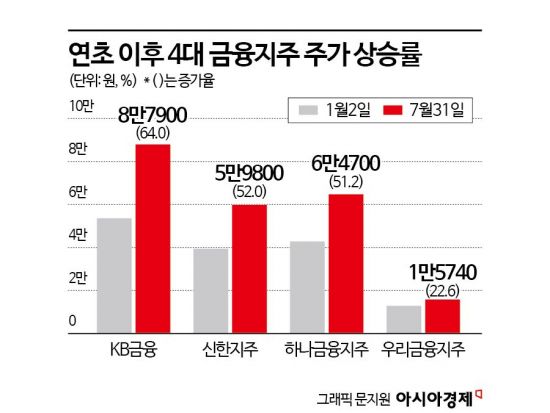
The stock prices of the four major financial holding companies have risen by an average of 47% since the beginning of this year. They have attracted market attention with their 'value-up model student' behavior, such as recording earnings surprises in the first half of the year and presenting a mid-to-long-term target of a 'total return ratio of 50%.' Although concerns about the exhaustion of positive factors have increased as they recently hit new 52-week highs, there is also analysis that expectations for value-up policies in the second half of the year remain strong.
According to the financial investment industry on the 1st, the four major financial holding companies (KB, Shinhan, Hana, Woori) rose by an average of 47% based on the closing price on July 31 compared to the beginning of the year (January 2). KB Financial Group had the highest increase at 64%, while Woori Financial Group had the lowest at 22.6%.
Among the four major financial holding companies, three except Hana Financial Group hit intraday record highs on June 29. KB Financial rose to 92,400 KRW, Shinhan Financial Group to 64,200 KRW, and Woori Financial Group to 16,960 KRW. Hana Financial Group recorded a high of 67,800 KRW on July 3.
The stock prices were driven up as the first half earnings exceeded market expectations. The combined net profit of the four major financial holding companies in the first half reached 9.3526 trillion KRW, marking the highest half-year performance ever. Although there was a significant burden in the first quarter due to compensation costs related to Hong Kong equity-linked securities (ELS), they recovered in the second quarter and achieved high profits through net interest margins.
The outlook remains bright even when extended to an annual basis. According to FnGuide, the combined consolidated sales of the four major financial holding companies in 2024 are estimated at 105 trillion KRW, operating profit at 24 trillion KRW, and net profit at 17 trillion KRW. Compared to the same period last year, these figures represent average increases of 4.3%, 15.6%, and 12.1%, respectively. The consensus estimate for the entire domestic financial industry’s operating profit is 39 trillion KRW, with over 60% concentrated in these four companies.
In addition to the raised earnings expectations, value-up plans are also being announced. For example, Shinhan Financial Group disclosed plans last week including a return on equity (ROE) of 10%, a shareholder return ratio of 50%, and the cancellation of 50 million shares. They also announced a policy to cancel more than 50 million shares by 2027. Analysts view the specification of concrete timelines rather than simple disclosures as positive. Woori Financial Group also set a mid-term target of a total return ratio of 50%.
The stock price outlook for the second half is also positive. First, financial companies continue steady share buybacks. For instance, Shinhan Financial Group and KB Financial are estimated to be purchasing stocks worth 4 to 5 billion KRW daily. Previously, KB Financial announced a plan to buy back shares worth 400 billion KRW.
Jae-woo Kim, a researcher at Samsung Securities, said, "During the third-quarter earnings season, additional share buyback events by Shinhan Financial Group and Hana Financial Group remain. Assuming that the corporate value enhancement plans of KB Financial and Hana Financial pass the board of directors, it is highly likely that these will take place during the third-quarter earnings season."
Furthermore, a value-up exchange-traded fund (ETF) tracking the KRX Value-Up Index, which includes 'value-up excellent companies,' is scheduled to be launched in the fourth quarter, and it is highly likely that many financial stocks will be included. The government plans to compose the index with companies that have excellent corporate value and those expected to enhance value so that institutional investors such as pension funds can use it as a benchmark. In fact, the National Pension Service, a major domestic institutional investor, is expected to play a stabilizing role in supply and demand. The National Pension Service officially announced in March that it would decide on capital injection into the stock market once the specific direction of the value-up program is revealed.
Hye-jin Park, a researcher at Daishin Securities, explained, "With solid earnings and proactive capital policies, sentiment improvement is optimal. The announcement of the KRX Korea Value-Up Index in the third quarter and the launch of the value-up ETF in the fourth quarter are continuously creating a favorable environment for supply and demand."
She also added, "If the dividend income separate taxation, announced in the tax law revision by the Ministry of Economy and Finance in July, is realized, explosive responses are expected. Additionally, measures such as raising the limit of Individual Savings Accounts (ISA) and establishing domestic investment-type ISAs include many provisions that could serve as catalysts for undervalued financial stocks." The tax law revision bill is scheduled to pass the Cabinet meeting on the 27th of this month and will be submitted to the regular National Assembly session in September, where approval or rejection will be decided.
© The Asia Business Daily(www.asiae.co.kr). All rights reserved.
![Clutching a Stolen Dior Bag, Saying "I Hate Being Poor but Real"... The Grotesque Con of a "Human Knockoff" [Slate]](https://cwcontent.asiae.co.kr/asiaresize/183/2026021902243444107_1771435474.jpg)















