Impact of Memory Demand Recovery Due to AI Market Expansion
Semiconductor Sales Reach 28.56 Trillion Won
Q2 Overall Performance Also an 'Earnings Surprise'
Operating Profit Exceeds 10 Trillion Won for the First Time in 7 Quarters
Samsung Electronics' semiconductor division recorded an operating profit exceeding 6 trillion won in the second quarter of this year, influenced by the 'memory boom' and other factors. Building on this, Samsung Electronics significantly improved its overall performance in the second quarter, achieving an 'earnings surprise.'
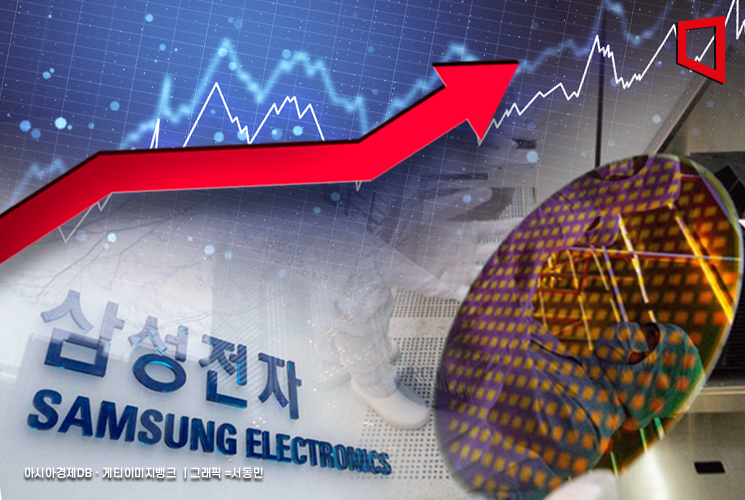
Samsung Electronics announced on the 31st that its consolidated operating profit for the second quarter of this year was tentatively estimated at 10.4439 trillion won, a 1462.29% increase compared to the same period last year. This marks the first time in seven quarters since the third quarter of 2022 (10.852 trillion won) that Samsung's quarterly operating profit has exceeded 10 trillion won.
Revenue reached 74.0683 trillion won, up 23.44% from the same period last year. Quarterly revenue has remained in the 70 trillion won range for two consecutive quarters. Net profit increased by 470.97% to 9.8413 trillion won.
By division, the Device Solutions (DS) division, responsible for the semiconductor business, recorded sales of 28.56 trillion won and an operating profit of 6.45 trillion won. The recovery in demand and price increases for memory semiconductors, driven by the expansion of the artificial intelligence (AI) market, are interpreted as major factors behind the significant improvement in the semiconductor division's performance. The memory segment saw continued market recovery supported by strong demand for generative AI server products, alongside increased demand in the enterprise-owned server market, expanding demand for DDR5 and high-capacity SSD products. The System LSI segment improved its performance due to increased supply of system-on-chip (SoC) and image sensor products for major customers' new products, achieving record-high sales for the first half of the year. The foundry business doubled its number of customers in AI and high-performance computing (HPC) sectors compared to last year, driven by expanded orders for advanced processes below 5 nanometers.
The Device eXperience (DX) division recorded sales of 42.07 trillion won and an operating profit of 2.72 trillion won. The Mobile eXperience (MX) segment, responsible for smartphones, saw a decline in sales in the second quarter compared to the first quarter, which saw new model launches, due to the off-season in the smartphone market. The S24 series achieved double-digit growth in both shipments and sales in the second quarter and the first half compared to last year. Harman recorded sales of 3.62 trillion won and an operating profit of 320 billion won, with improved performance driven by increased sales of consumer audio products centered on portable and True Wireless Stereo (TWS) devices. The Display segment posted sales of 7.65 trillion won and an operating profit of 1.01 trillion won, supported by expanded sales of high-resolution, high-refresh-rate new products centered on the gaming monitor market and increased demand for OLED TVs in the premium TV market. Samsung Electronics' capital expenditure in the second quarter was 12.1 trillion won, with 9.9 trillion won allocated to semiconductors and 1.8 trillion won to displays.
© The Asia Business Daily(www.asiae.co.kr). All rights reserved.
![Clutching a Stolen Dior Bag, Saying "I Hate Being Poor but Real"... The Grotesque Con of a "Human Knockoff" [Slate]](https://cwcontent.asiae.co.kr/asiaresize/183/2026021902243444107_1771435474.jpg)















