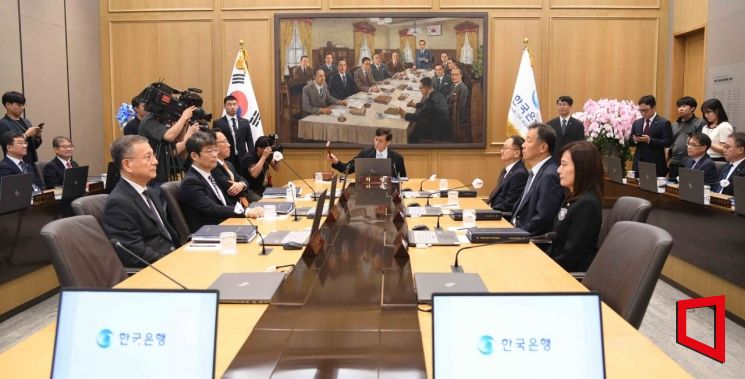
 Lee Chang-yong, Governor of the Bank of Korea (center in the photo), is striking the gavel at the Monetary Policy Committee meeting held on the 11th at the Bank of Korea headquarters in Jung-gu, Seoul. Photo by Joint Press Corps
On the 11th, the Monetary Policy Committee of the Bank of Korea unanimously decided to keep the base interest rate at 3.50%, citing concerns such as high exchange rates, rising housing prices, and household debt. However, they gave a positive assessment regarding price stability.
According to the minutes of the Monetary Policy Committee meeting held on July 11, released by the Bank of Korea on the 30th, one member stated at the meeting, "In the high inflation phase, the pass-through effect of the exchange rate on prices is greater," adding, "The recent sustained high exchange rate level could have a significant impact on domestic prices."
Another member argued, "Stability in the foreign exchange market must be a prerequisite for lowering the base interest rate," and "It is a matter of concern that despite a substantial current account surplus, the exchange rate remains in the high 1300 won range." He also added, "An interest rate cut should not reverse economic restructuring efforts or trigger a rise in real estate prices in some regions."
He emphasized, "There is also concern about the somewhat strong increase in household loans recently, especially related to housing loans," and "It is very regrettable that deleveraging of the economy was not boldly achieved during the high interest rate period."
Another member also stated, "Due to still high expected inflation rates, it is necessary to observe whether prices settle within the target range, and financial stability aspects such as increased exchange rate volatility, a sharp rise in household loans, and elevated housing prices in the Seoul metropolitan area must also be considered."
Regarding prices, a positive evaluation was made. One member said, "The consumer price inflation rate in June was 2.4%, and the core inflation rate was 2.2%, converging toward the target of 2%," adding, "The stabilization of prices, the primary goal of monetary policy, is encouraging and is considered a result of the long-standing high interest rate policy."
He continued, "If this downward trend in inflation continues, considering the weak domestic demand, an environment conducive to considering a base interest rate cut is being formed."
Another member also evaluated, "Although uncertainties on the supply side of prices remain, they are gradually stabilizing," and "At least in terms of the part where monetary policy operates, prices appear to be on a downward path approaching the target level."
© The Asia Business Daily(www.asiae.co.kr). All rights reserved.
![Clutching a Stolen Dior Bag, Saying "I Hate Being Poor but Real"... The Grotesque Con of a "Human Knockoff" [Slate]](https://cwcontent.asiae.co.kr/asiaresize/183/2026021902243444107_1771435474.jpg)















