Statistics Korea Announces Supplementary Survey on Elderly Population
Elderly Population Increases by 502,000
Economic Activity Participation Rate Rises to 60.6%
The average monthly pension amount for the elderly increased by 9.6% year-on-year as of May. Among them, the proportion of recipients in the relatively high bracket of over 500,000 won also rose.
On the 30th, Statistics Korea announced a supplementary survey on the elderly population (aged 55-79) based on the May 2024 Economically Active Population Survey.
According to the survey results, the proportion of elderly people who received a pension over the past year was 51.2% (8,177,000 people) as of May, up 0.9 percentage points from the same month last year. Among them, the proportion was 54.4% for men and 58.1% for women, both showing an upward trend.
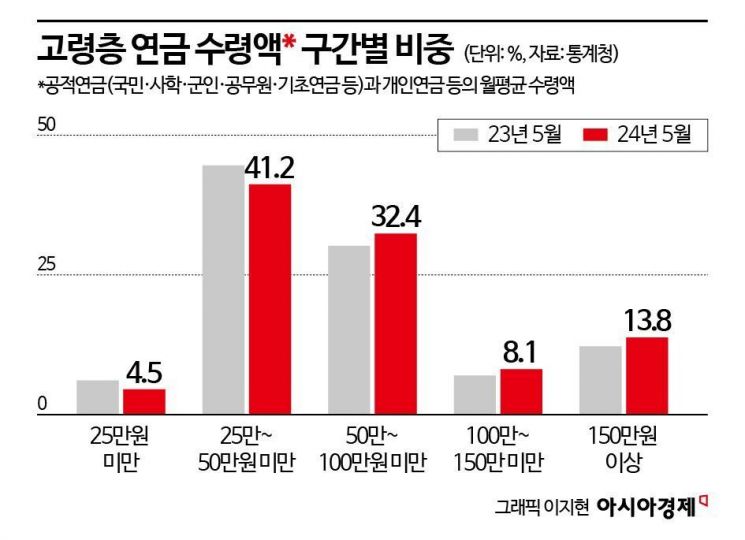
The average monthly pension amount was 820,000 won, an increase of 9.6%. By bracket, the proportions were highest in the following order: ▲ 250,000 to less than 500,000 won (41.2%) ▲ 500,000 to less than 1,000,000 won (32.4%) ▲ 1,500,000 won or more (13.8%).
In particular, the proportion of recipients in the higher brackets increased. The proportions in the under 250,000 won and 250,000 to less than 500,000 won brackets decreased by 1.6 percentage points and 3.4 percentage points respectively compared to the same month last year, but the proportions in the 500,000 to less than 1,000,000 won (up 2.2 percentage points), 1,000,000 to less than 1,500,000 won (up 1.1 percentage points), and 1,500,000 won or more (up 1.6 percentage points) brackets showed an upward trend.
The elderly population was 15,983,000, an increase of 502,000 from the same month last year. The economic participation rate of the elderly was 60.6%, up 0.4 percentage points. Both the number of employed and unemployed elderly increased, with the employment rate rising 0.1 percentage points to 59.0%, and the unemployment rate increasing 0.3 percentage points to 2.5%.
Looking at the industrial distribution of employed elderly, health, social, and welfare sectors (12.8%) and agriculture, forestry, and fisheries (12.4%) were high. By occupation, simple labor workers (23.6%) and service workers (13.8%) stood out.
The average tenure at the longest-held job among those with employment experience was 17 years and 6.1 months, an increase of 2.1 months compared to the same month last year. The average age at leaving the longest-held job was 52.8 years, up 0.1 years year-on-year.
The proportion of job seekers in the past year was 20.7%, up 0.9 percentage points from the same month last year. The main job search routes were the Ministry of Employment and Labor and other public employment agencies (36.5%), followed by introductions and requests from friends and acquaintances (31.0%). The proportion of those with employment experience in the past year was 67.2%, up 0.5 percentage points year-on-year.
The proportion of elderly who hope to work in the future was 69.4% (11,093,000 people), up 0.9 percentage points from the same month last year. The desired working age averaged 73.3 years, an increase of 0.3 years. Regarding job selection criteria, both men and women pointed out that the timing and amount of work were the most important factors.
© The Asia Business Daily(www.asiae.co.kr). All rights reserved.
![Clutching a Stolen Dior Bag, Saying "I Hate Being Poor but Real"... The Grotesque Con of a "Human Knockoff" [Slate]](https://cwcontent.asiae.co.kr/asiaresize/183/2026021902243444107_1771435474.jpg)















