The Korea Forest Service announced on the 30th that applications and registrations for foreign worker employment permits (E-9) in the forestry sector will be conducted from the 5th to the 16th of next month.
Applications for foreign worker employment permits can be made by employers through the Ministry of Employment and Labor’s website ‘Worknet’ after posting a job opening for domestic workers and failing to hire anyone for more than 7 days.
Additionally, applicants must not have arbitrarily transferred domestic workers for the purpose of employing foreign workers within two months prior to the job posting date, and must have no history of wage arrears. Employment insurance and industrial accident insurance must also be subscribed to.
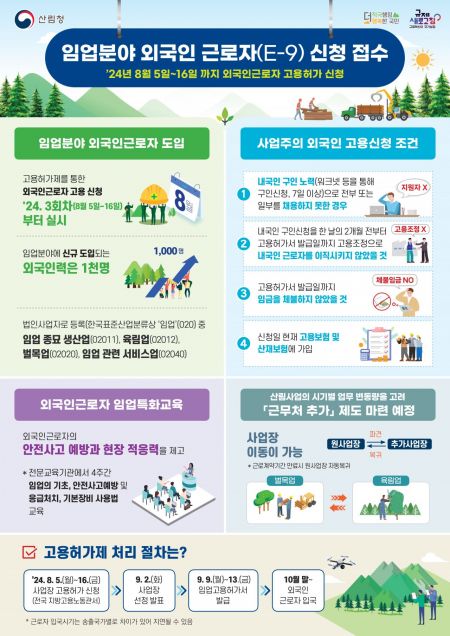
Eligible workplaces for foreign worker employment permit applications are corporate workplaces in the forestry sector classified under the Korean Standard Industrial Classification, including ▲seedling production ▲silviculture (forest tending) ▲logging (timber harvesting) ▲forestry-related services ▲national forest management teams ▲log production ▲and forestry cooperatives and the Korea Forestry Cooperative Federation.
Employment permit applications can be submitted during the period via the ‘Employment 24’ or the Foreign Worker Employment Management System websites. However, new applicant workplaces must visit the local Employment and Labor Office in person for information verification and registration.
After receiving the employment permit, foreign workers to be hired must familiarize themselves with necessary matters for domestic employment activities at the Human Resources Development Service of Korea or foreign worker training institutions, and then receive a 4-week ‘Forestry Specialized Training’ at the Forestry Comprehensive Training Institute before being assigned to the workplace.
Meanwhile, in the agriculture and livestock sectors, foreign workers have been employable under the ‘Foreign Worker Employment Permit System’ since its initial implementation in 2004. However, the forestry sector was not included in the permit system’s scope, making foreign worker employment practically impossible until now.
The application of the foreign worker employment permit system to the forestry sector was identified as an agenda item at the ‘Mountain Area Utilization and Forest Industry Revitalization’ meeting hosted by the Regulatory Innovation Promotion Team in February last year, and after one year of field opinion gathering and regulatory improvement meetings, the decision was made.
With the application of the foreign worker employment permit system, forestry sites can now employ foreign workers entering with a non-professional employment (E-9) visa this year. Foreigners issued an E-9 visa can stay in Korea for up to 3 years from the date of entry (with visa extensions up to a maximum of 1 year and 10 months), allowing them to work regularly on site.
The Korea Forest Service expects that employing foreign workers in forestry will help resolve difficulties faced by mountain villages such as rugged terrain, high labor intensity, and aging populations, thereby stabilizing labor supply and contributing to increased productivity.
© The Asia Business Daily(www.asiae.co.kr). All rights reserved.
![Clutching a Stolen Dior Bag, Saying "I Hate Being Poor but Real"... The Grotesque Con of a "Human Knockoff" [Slate]](https://cwcontent.asiae.co.kr/asiaresize/183/2026021902243444107_1771435474.jpg)















