Decaffeinated Coffee Sold Beyond Large Cafes to Convenience Stores
Starbucks Surpasses 100 Million Cups Sold in About 7 Years
"Low Spec Trend Continues... Market Expected to Grow Further"
As the 'Healthy Pleasure' trend of enjoying health management gains momentum, the popularity of decaffeinated coffee is heating up day by day in Korea, the coffee republic where people used to cry out for a 'caffeine transfusion' as soon as they woke up. Now, not only major coffee franchises but also convenience stores offer decaffeinated coffee.
According to the Korea Agro-Fisheries & Food Trade Corporation (aT) on the 27th, the import volume of decaffeinated coffee last year was 6,521 tons, a 278% increase compared to 1,724 tons in 2018, five years ago. In the first half of this year (January to June), the import volume of decaffeinated coffee was 3,371 tons, about 20% more than the previous year (2,833 tons).
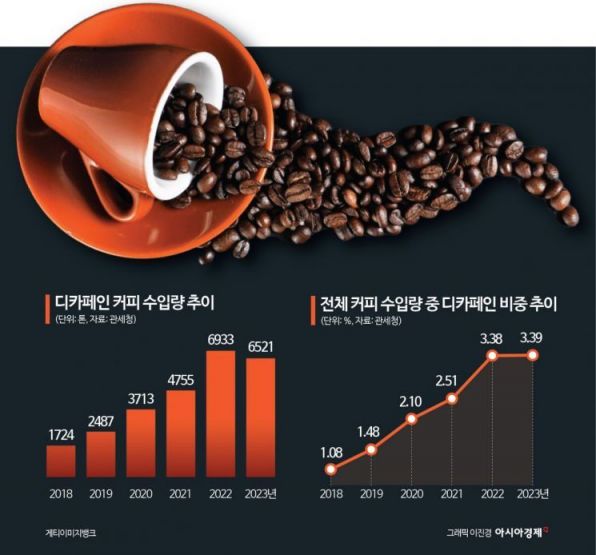
Decaffeinated coffee is a beverage made from coffee beans that have had more than 90% of their caffeine removed (according to Korean standards) using hot water or carbon dioxide. In the past, decaffeinated coffee was mainly sought after by people sensitive to caffeine. However, as the taste and quality of decaffeinated products have gradually improved, demand has expanded to general consumers who want to reduce caffeine intake or enjoy a variety of coffee flavors and aromas.
In fact, Compose Coffee announced on the 16th that the cumulative sales of decaffeinated Americano have surpassed 50 million cups this year. In response to the demand for decaffeinated coffee, Compose Coffee has been gradually introducing decaffeinated beans in some stores since August last year. A Compose Coffee representative said, "As coffee consumption per person increases, the number of customers feeling burdened by caffeine has also grown," adding, "With the ongoing 'Low Spec' craze mainly among the younger generation, the popularity of decaffeinated coffee is expected to continue for some time."
Starbucks Korea, which introduced decaffeinated coffee in August 2017, surpassed cumulative sales of 100 million cups last May. Starbucks decaffeinated coffee exceeded 10 million cups in cumulative sales in 2018, the year after its launch, and sold 20 million cups in 2022. Choi Hyun-jung, head of food and beverage development at Starbucks Korea, said, "Decaffeinated coffee, which has established itself as a drink that can always be enjoyed without burden, is expected to continue its steep growth this year," adding, "Starbucks, which has broadened the base of the domestic decaffeinated coffee market, will continue to introduce differentiated products targeting customers who enjoy decaffeinated beverages."
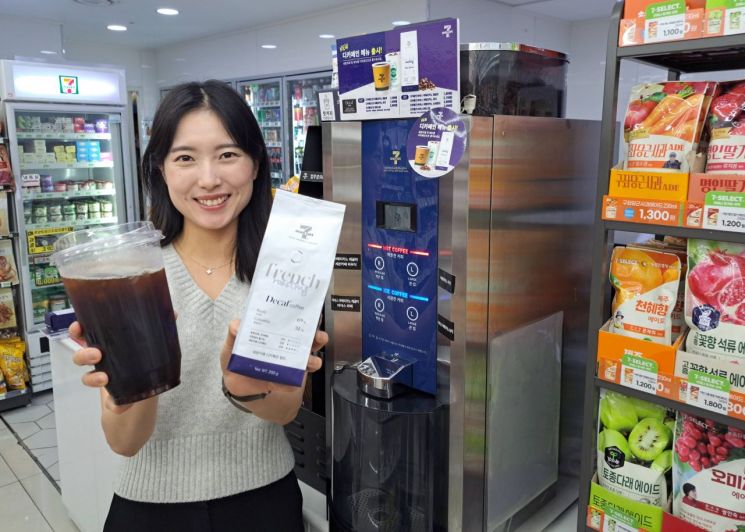
Due to the rapidly increasing demand, decaffeinated coffee can now be enjoyed not only at large coffee franchises but also at convenience stores. Since the 15th, Seven Eleven has been selling 'Seven Cafe Decaf' at over 200 stores nationwide. Seven Eleven conducted dozens of tests to preserve the smooth and savory flavor of coffee without caffeine. As a result, they developed and are using a decaffeinated bean blend composed of Brazilian (69%) and Colombian (31%) beans, different from the regular Seven Cafe beans. Unlike typical coffee shops, they apply the same price as regular Seven Cafe coffee without any additional charge, easing the price burden for decaf consumers in this high-inflation era.
A Seven Eleven representative said, "An analysis of sales of decaffeinated coffee products (beverages, mixes, one-cup) in stores last month showed a 70% increase compared to a year ago," adding, "We will continue to expand sales points so that decaffeinated coffee can be purchased at all branches in the future."
© The Asia Business Daily(www.asiae.co.kr). All rights reserved.
![Clutching a Stolen Dior Bag, Saying "I Hate Being Poor but Real"... The Grotesque Con of a "Human Knockoff" [Slate]](https://cwcontent.asiae.co.kr/asiaresize/183/2026021902243444107_1771435474.jpg)
















