Volatile Stock Market, Bank Stocks Show Resilience
Value-Up Expectations Remain Until Year-End
"Favorable Interest Rate Environment Changes in H2 Also Positive for Bank Stocks"
Despite recent increased volatility in the stock market, bank stocks, which have shown resilience, are expected to continue performing well in the second half of the year following their strong showing in the first half. This outlook is based on the continued anticipation of the value-up program and the expectation that the interest rate environment in the latter half of the year will be favorable for bank stocks.
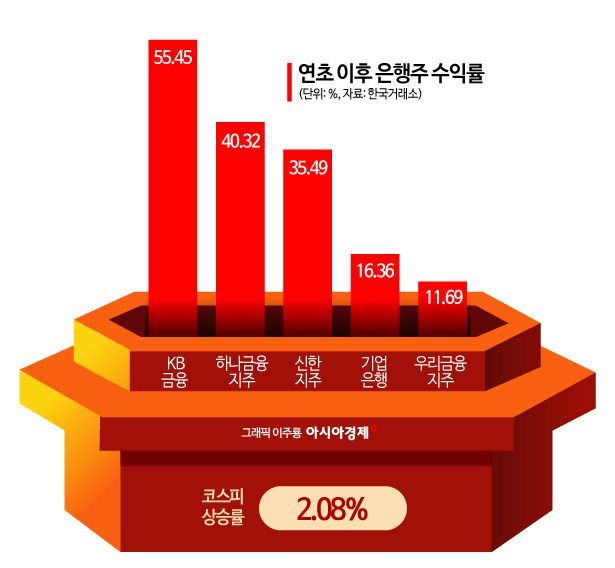
According to the Korea Exchange on the 26th, KB Financial Group closed at 84,000 won the previous day, marking a 55.45% increase since the beginning of the year. During the same period, other banks such as Hana Financial Group (40.32%), Shinhan Financial Group (35.49%), Industrial Bank of Korea (16.36%), and Woori Financial Group (11.69%) also showed strong performance. Throughout the first half of this year, bank stocks have established themselves as beneficiaries of corporate value-up programs, outperforming the KOSPI return of 2.08% over the same period.
Value-Up Expectations Remain... "Bank Stocks Could Become Market Leaders"
In the securities industry, there is a forecast that bank stocks will continue their upward rally in the second half and could become the market's 'leading stocks.' Ha In-hwan, a researcher at KB Securities, stated, "Because expectations for the government's value-up program still remain, we are focusing on financial stocks as one of the leading stocks in the second half." He added, "Looking at the progress of Japan's value-up program, stocks with lower price-to-book ratios (PBR) generally had higher returns, and among them, bank stocks had the highest ratio."
Some concerns have been raised about the uncertainty surrounding the revision of related laws, which is a critical factor for the implementation of the value-up policy. In response, Ha said, "Among investors, opinions vary regarding the feasibility of revising tax laws and commercial laws because it is difficult to predict policy changes. However, the dominant expectation is that one or two revisions will likely be made."
Additionally, Ha mentioned the historical movement of the financial sector in the domestic stock market. He said, "The Korean financial sector has moved in 20-year cycles. In the 1980s, securities stocks led, and in the 2000s, insurance stocks were prominent. Now, in the 2020s, attention can be focused on bank stocks."
Higher Possibility of Interest Rate Cuts in the Second Half... "Favorable for Bank Stocks"
Experts expect the U.S. Federal Reserve (Fed) to cut interest rates in September. Accordingly, the securities industry analyzes that bank stocks could benefit from a decline in short-term interest rates and an expansion of the yield curve.
Choi Jung-wook, a researcher at Hana Securities, said, "If short-term interest rates fall due to policy rate cuts, concerns about the soundness of vulnerable sectors, including project financing (PF), may ease due to improvements in the real estate market, increasing expectations for a reduction in bad debt costs." He added, "Furthermore, if Trump's active deregulation policies are applied, it would be positive for bank stock prices."
Choi also noted, "Trump is expected to implement policies that raise concerns about inflation, such as protectionism. As a result, long-term interest rates may rise or not fall significantly, and the yield curve, which has been inverted for years, could normalize again." He added, "Bank stocks tend to outperform when long-term interest rates rise or when the yield curve steepens."
© The Asia Business Daily(www.asiae.co.kr). All rights reserved.

















