Kishida "Securing Funds for Large-Scale Investment Over Several Years"
The Japanese government is focusing its efforts on domestic mass production and research and development support for next-generation semiconductors.
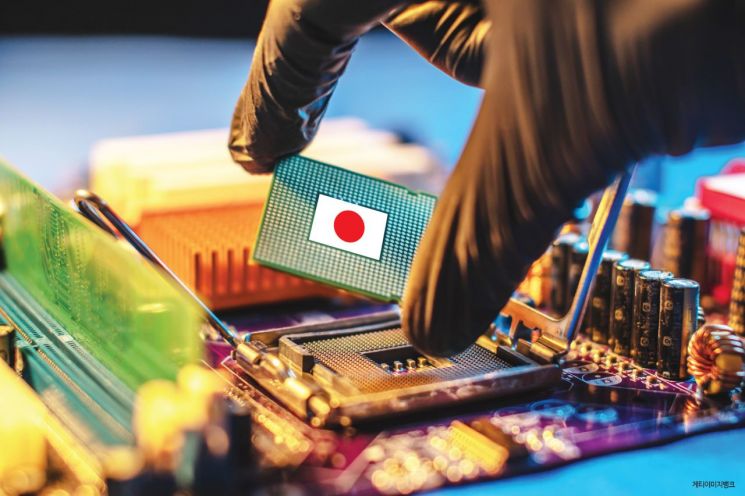
According to the Shinkei Shimbun and Kyodo News on the 24th, Japanese Prime Minister Fumio Kishida visited the 'Rapidus' factory under construction in Chitose City, Hokkaido, in the afternoon and told reporters, "I want to submit the necessary bills for (semiconductor) mass production to the Diet at an early stage."
He emphasized, "We will secure the necessary funds and make large-scale investments systematically over several years, and support research and development."
Kyodo News reported, "(The government) aims to submit the bill at the autumn extraordinary Diet session and intends to strengthen advanced technology competitiveness from an economic security perspective," adding, "The government is also considering guaranteeing large loans needed in the future to attract funds."
Next-generation semiconductors refer to semiconductors with circuit line widths narrower than existing products, requiring advanced technology for manufacturing. Companies in Korea, the United States, and Taiwan are developing related technologies, and Japan established Rapidus in 2022 to produce next-generation semiconductors. Eight major Japanese companies, including Toyota, Kioxia, Sony, NTT, SoftBank, NEC, Denso, and Mitsubishi UFJ Bank, participated in funding Rapidus. Rapidus plans to mass-produce cutting-edge 2-nanometer (nm; one billionth of a meter) products by 2027.
Accordingly, the Japanese government decided to provide 920 billion yen (approximately 8.2 trillion won) in support. However, it is expected that Rapidus will need 5 trillion yen (approximately 44.5 trillion won) to mass-produce next-generation semiconductors, making fundraising a critical issue. The next-generation semiconductor support law is expected to include measures to assist Rapidus in securing funds.
Kyodo News stated, "The Japanese government is also considering drafting a bill to guarantee repayments so that Rapidus can easily obtain loans from financial institutions," adding, "It is unusual for the government to establish a guarantee system for private companies."
Japan's share of the global semiconductor market once reached 50% in the 1980s but fell below 10% in 2017 due to competition from Korea and Taiwan. Apart from establishing Rapidus, the Japanese government is promoting the semiconductor industry through various policies, including attracting Taiwan's TSMC, the world's largest foundry (semiconductor contract manufacturing) company, to set up a factory in Kyushu.
© The Asia Business Daily(www.asiae.co.kr). All rights reserved.
![Clutching a Stolen Dior Bag, Saying "I Hate Being Poor but Real"... The Grotesque Con of a "Human Knockoff" [Slate]](https://cwcontent.asiae.co.kr/asiaresize/183/2026021902243444107_1771435474.jpg)















