2Q Sales 1.1569 Trillion Won... 1H 2.1038 Trillion Won
'Earnings Surprise' with 4th Plant Operating Rate Increase
Logix Separate Basis Profit Margin Reaches 41%
Industry First Confident in Achieving 'Annual Sales 4 Trillion Won'
Rapid Production Capacity Expansion Followed by Orders
Samsung Biologics (Samsung Bio) succeeded in surpassing 1 trillion KRW in sales in the second quarter, recording the highest-ever second-quarter performance. Both the securities industry and the company itself are approaching the visible goal of achieving 'annual sales of 4 trillion KRW.'
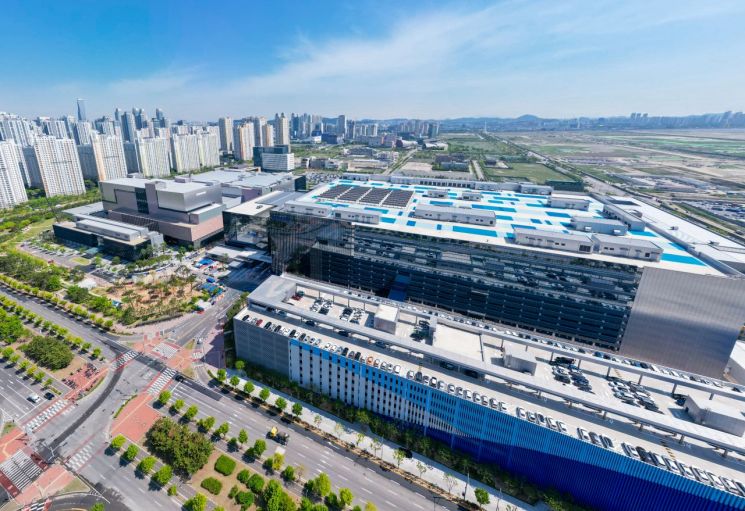
On the 24th, Samsung Bio announced through a public disclosure that its consolidated sales for the second quarter of this year amounted to 1.1569 trillion KRW, with an operating profit of 434.511 billion KRW. Compared to the same period last year, sales grew by 33.56% and operating profit by 71.45%. For the first half of the year, sales exceeded 2 trillion KRW, and operating profit reached 655.8 billion KRW.
The company analyzed this as "a result of the smooth ramp-up of Plant 4 based on large-scale orders, a favorable exchange rate environment, and milestone receipts following the approval of biosimilar products."
This growth trend continued even on a standalone basis for Samsung Bio. Second-quarter sales were 810.2 billion KRW, a 27% increase compared to the same period last year. Despite an increase in costs such as depreciation of Plant 4, operating profit, which had decreased by 0.7% year-on-year in the first quarter, returned to a 30% growth trend. Notably, the standalone operating profit margin reached 41%.
Subsidiary Samsung Bioepis continued its growth with sales of 529.9 billion KRW and operating profit of 257.1 billion KRW, representing year-on-year growth of 107% and 514%, respectively. Bioepis stated, "Both sales and operating profit rose sharply due to milestones from new biosimilar product approvals."
Industry's First 'Annual Sales of 4 Trillion KRW' Within Reach
This second-quarter sales mark the first quarterly sales exceeding 1 trillion KRW recorded by Samsung Bio this year, following the third and fourth quarters of last year. With the likelihood of surpassing 1 trillion KRW in sales again in the third and fourth quarters this year, it is expected that Samsung Bio will become the first in the domestic pharmaceutical and bio industry to exceed 'annual sales of 4 trillion KRW.' The company had already set a sales growth target of 10-15% for this year in January, projecting sales of 4.1564 trillion KRW as the midpoint, while the securities industry expects even higher sales of 4.292 trillion KRW, reflecting a 16.2% growth.
 Samsung Electronics Vice Chairman Lee Jae-yong is visiting the Samsung Biologics Songdo Campus in Yeonsu-gu, Incheon, inspecting the production facilities of Samsung Biologics Plant 4.
 [Photo by Yonhap News]
The continuous sales growth of Samsung Bio is driven by Plant 4, the world's largest single plant with a production capacity of 240,000 liters, which is currently undergoing full operation. Plant 4 initially started operating with a capacity of 60,000 liters in October 2022, and since June last year, it has been in full operation with an additional 180,000 liters of production facilities. Contract Development and Manufacturing Organization (CDMO) facilities undergo a 'ramp-up' process where actual internal operations gradually increase even after the plant is completed and officially starts 'full' operation. This process takes about one and a half to two years, after which all production facilities can engage in commercial production at 'full operation.'
Therefore, the revenue impact from the CDMO plant is reflected only after about a year, indicating that the effects of Plant 4 are now fully materializing. Researcher Heomin Heo from Kiwoom Securities stated, "It is presumed that the 60,000 liters have been in full operation since the second quarter," adding, "Performance improvements for Samsung Bio are expected due to the full operation of Plants 1 to 3 and the 60,000 liters." Furthermore, since the remaining 180,000 liters could be fully operational as early as this year, expectations are high for a steeper rise in second-half performance.
'Virtuous Cycle' Where Increased Production Capacity Leads to More Orders
Samsung Bio is not stopping there; to maintain the title of the world's largest production capacity, it is constructing Plant 5, scheduled for completion in April next year. Once Plant 5, with a capacity of 180,000 liters, is completed, Samsung Bio will secure a total production capacity of 784,000 liters. Moreover, the company plans to maximize production capacity by completing Plants 6 to 8, each with the same capacity (180,000 liters) as Plant 5, by 2032.
Samsung Bio is accelerating production capacity expansion because of rapidly increasing order volumes. This year, it has signed contracts with global big pharma companies such as Belgium's UCB and the U.S.'s MSD, and on the 2nd of this month, it secured an order worth a staggering 1.06 billion USD (approximately 1.4637 trillion KRW) from a single contract.
 John Rim, CEO of Samsung Biologics, is speaking at a press conference held in San Diego, USA, on the 5th (local time).
 [Photo by Samsung Biologics]
Samsung Bio's cumulative orders this year amount to 2.5399 trillion KRW. In terms of contract quality, the number of global big pharma companies among the top 20 by market capitalization that are customers has increased from just three in 2018 to 16. Furthermore, if the U.S. Biosecurity Law, expected to pass within the year, leads to regulatory trends against China, Samsung Bio is expected to benefit from a spillover effect, further expanding orders.
Based on the solid global network built by Samsung Bio CEO John Rim, who has worked for over 30 years at big pharma companies such as Roche, Genentech, and Astellas, the strategy of actively responding to customer demands has been effective. As orders continue, Samsung Bio is reportedly swiftly considering expanding its third bio campus.
This year, Samsung Bio will also expand its production portfolio by entering the antibody-drug conjugate (ADC) market, a global trend leading the oncology market. It plans to complete an ADC-dedicated production facility in Songdo, Incheon, within the year. Through the Samsung Life Science Fund, formed with Samsung C&T and Samsung Bioepis, the company is investing in Swiss Araris and Korea's AimedBio to provide customers with a 'toolbox' that offers diverse options for antibodies, linkers, and cytotoxic drugs.
© The Asia Business Daily(www.asiae.co.kr). All rights reserved.
![Clutching a Stolen Dior Bag, Saying "I Hate Being Poor but Real"... The Grotesque Con of a "Human Knockoff" [Slate]](https://cwcontent.asiae.co.kr/asiaresize/183/2026021902243444107_1771435474.jpg)


















