Targeting Integrated Combat Systems and Korean-style Integrated Mast
Expectations for Manned-Unmanned Hybrid Systems Including Unmanned Surface Vehicle Haeryeong
Hanwha Systems will participate in the ‘International Ocean Defense Show (IODS) 2024’ held in Perth, Australia from the 24th to the 26th, targeting the global market with integrated combat system technology.
 Hanwha Systems is showcasing 'Haeryeong,' an unmanned surface vessel scheduled to be deployed for coastal reconnaissance and surveillance missions for the first time in Korea, at the Australian Maritime Defense Exhibition. (Photo by Hanwha Systems)
Alongside Hanwha Ocean, they will set up a booth to exhibit key equipment that can maximize the combat capabilities of naval vessels, such as the Integrated Combat System (ICS) and the Korean Destroyer Integrated Mast (KDDX I-MAST).
The Integrated Combat System (ICS) enables integrated operation of various onboard systems that previously performed individual functions, including the Integrated Control System (ECS), Integrated Bridge System (IBS), and Manned-Unmanned Teaming (MUM-T). It also allows unmanned surface vessels and unmanned underwater vehicles, which had to be controlled separately, to be operated within a single combat system.
It is expected that future naval vessel equipment, designed with integration in mind, can be easily applied to next-generation vessels requiring smooth control of manned and unmanned systems, maximizing operational efficiency even in environments with relatively fewer crew members.
The Integrated Mast is a core piece of equipment for the ‘Korean Destroyer (KDDX)’. It is a sensor composite structure that enhances the key performance of the Korean Destroyer, namely its concealment or ‘stealth capability,’ and is a new concept weapon system developed purely with domestic technology.
By integrating multifunction phased array radar, infrared detection and tracking equipment, electronic warfare equipment, and communication antennas into a single large structure designed and mounted flat, radar reflection is significantly reduced, enhancing stealth functionality. It is designed to greatly improve vessel survivability by providing not only ballistic protection but also protection against nuclear, biological, and chemical (NBC) threats, electromagnetic pulse (EMP) shielding, and infrared (IR) signal reduction capabilities.
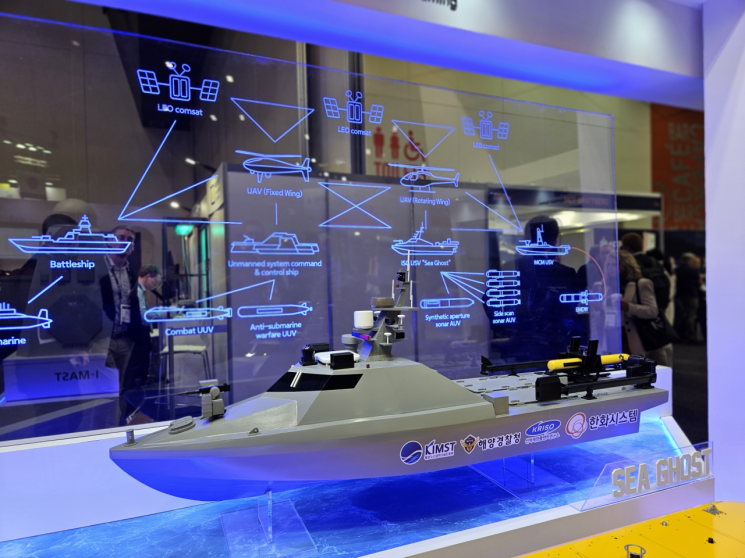
The Maritime Manned-Unmanned Teaming (MUM-T) system is a system that can effectively integrate manned and unmanned forces. It can connect various maritime manned and unmanned systems, including low Earth orbit communication satellites, unmanned surface vessels Haeryeong, and unmanned underwater vehicles for anti-submarine reconnaissance, thereby greatly expanding operational range.
By utilizing low Earth orbit communication satellites, it is possible to establish a hyperspace and ultra-high-speed communication infrastructure from coastal areas near land to the open ocean. Integrating manned and unmanned forces across surface, underwater, and air domains maximizes mission execution areas and capabilities.
© The Asia Business Daily(www.asiae.co.kr). All rights reserved.
![Clutching a Stolen Dior Bag, Saying "I Hate Being Poor but Real"... The Grotesque Con of a "Human Knockoff" [Slate]](https://cwcontent.asiae.co.kr/asiaresize/183/2026021902243444107_1771435474.jpg)















