Emotion Procedures Conducted by Each Court
Serious Delays in Medical and Construction Cases
Affects Long-Term Unresolved Case Rate
Integrated Management Expected to Expedite Trials
The court has taken steps to establish a ‘control tower’ to accelerate the ‘expert appraisal’ procedures, which are considered a major cause of trial delays. In particular, construction and medical cases often require expert appraisals, but it takes a long time to receive responses, there are significant discrepancies between appraisers, and many appraisal requests are returned, all of which contribute to trial delays.
In medical appraisals, it is not uncommon for requests to be returned months later by specialists or professors, sometimes repeatedly. In construction cases, when outsourced to private expert appraisers, appraisal fees can vary by more than double, causing difficulties in managing appraisal costs.
The court is now actively working on creating a center to comprehensively manage these appraisal issues, drawing attention to whether this will lead to faster appraisal procedures and realistic appraisal fees.
The Court Administration Office has decided to establish an ‘Appraisal Management Center’ to address the problems of delayed and poorly conducted appraisal procedures. This is to consolidate and oversee appraisal procedures that were previously handled individually by trial courts.
Once the center is established, appraisal management committee members who are experts in construction and medical fields will select appraisers considering their specialties and willingness to conduct appraisals. This will reduce delays caused by returned appraisal requests, inadequate appraisals, fact-finding inquiries, and reappraisals. The center will be headed by a judge, and appraisal management committee members will likely serve concurrently as full-time professional psychological committee members. Approximately 10 additional experts will be appointed to form the committee.
Additionally, plans are underway to increase medical appraisal fees, which have not kept pace with inflation, expand the institutions eligible for medical appraisals, and allow medical school professors who retired within the last 10 years to conduct appraisals.
The appraisal evaluation process will be simplified to enable more appraisers to be evaluated. Out of 136,959 appraisals conducted last year, only 1,026 underwent appraiser evaluation, resulting in a very low evaluation implementation rate of 0.75%.
A presiding judge at the Seoul Central District Court said, “Regardless of whether it is a physical appraisal or a medical record appraisal, fact-finding inquiries often receive no response or are significantly delayed,” adding, “Integrating appraisal management could clarify the causes of such issues and greatly assist in proceeding with future appraisal procedures.”
A lawyer from the law firm Yehun, which handles many construction and real estate cases, said, “The delay in appraisals, which play a key role as evidence in trials, is a serious problem, and since there was no mechanism to control insincere appraisals, if the court manages this through a control tower in the future, improvements can be expected in both quality and speed.”
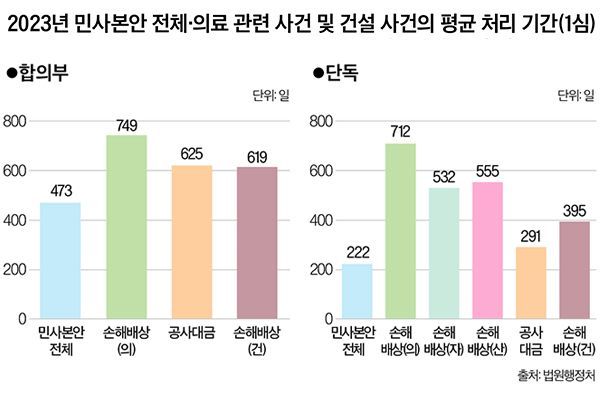
According to the Court Administration Office, medical-related cases with a high rate of appraisals among civil cases [Personal Injury Compensation (Medical): medical-related cases, Personal Injury Compensation (Auto): automobile-related cases, Personal Injury Compensation (Industrial): worker’s occupational injury cases] and construction cases [Construction Payment, Personal Injury Compensation (Construction): construction-related cases] had significantly longer processing times compared to other main cases. Last year, delays in medical and construction cases were severe in both first-instance collegiate civil cases and single-judge cases.
These delays were also found to affect the rate of long-term unresolved cases. An analysis of the 2023 long-term unresolved rates for Personal Injury Compensation (Auto), Personal Injury Compensation (Industrial), and Personal Injury Compensation (Medical) showed that the overall long-term unresolved case rate in first-instance collegiate civil cases was 11.9%, whereas it was 26.4% for Personal Injury Compensation (Medical) cases. In first-instance single-judge cases, the overall long-term unresolved rate was 2.7%, but it was 14.8% for Personal Injury Compensation (Medical), 13.1% for Personal Injury Compensation (Auto), and 11.4% for Personal Injury Compensation (Industrial) cases.
A survey conducted last year by the court targeting judges and lawyers on the medical appraisal system revealed that 82.2% of judges and 84.4% of lawyers ‘strongly agreed’ that delays in physical and medical record appraisal procedures are at a serious level.
Park Suyeon, Han Suhyun, Legal Times Reporters
※This article is based on content supplied by Law Times.
© The Asia Business Daily(www.asiae.co.kr). All rights reserved.
![Clutching a Stolen Dior Bag, Saying "I Hate Being Poor but Real"... The Grotesque Con of a "Human Knockoff" [Slate]](https://cwcontent.asiae.co.kr/asiaresize/183/2026021902243444107_1771435474.jpg)















