Nuclear Research Institute, World's First Discovery of Inner Ear Damage Caused by Microplastics
A study has found that microplastics can damage the ear, potentially affecting human hearing and balance.
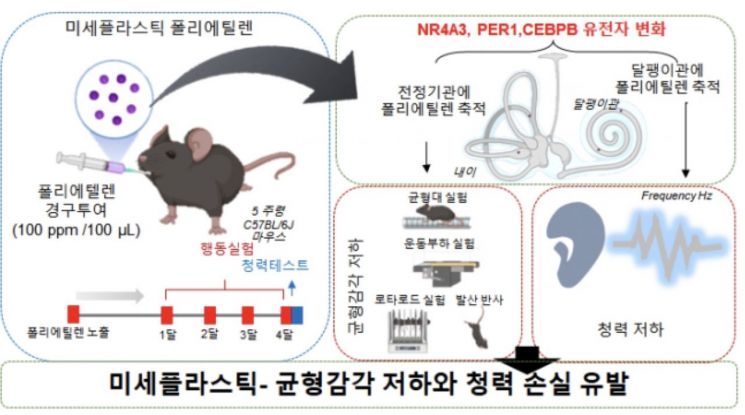
The Korea Institute of Radiological & Medical Sciences (Director Jin-Kyung Lee) announced on the 23rd that a joint research team consisting of Dr. Jin-Soo Kim from the Radiation Medicine Research Institute, Professor Min-Hyun Park from the Department of Otorhinolaryngology at Seoul National University College of Medicine, and Professor Jong-Hoon Choi from the Department of Convergence Engineering at Chung-Ang University’s College of Creative ICT Engineering, revealed for the first time in the world that microplastics can damage the inner ear, causing hearing loss and impaired balance.
The inner ear, a part of the ear, consists of the cochlea, vestibule, and semicircular canals, which detect sound and maintain body equilibrium.
The research team conducted an experiment by feeding polyethylene, a type of plastic commonly used in disposable products, to mice daily at a dose of 10 micrograms (one-millionth of a gram) for four months.
After confirming that 0.144 micrograms of polyethylene had accumulated in the cochlea (responsible for hearing) and vestibule (responsible for balance) of the inner ear, hearing tests showed that the control group responded at 31.7 decibels, while the polyethylene intake group responded at 54 decibels. The research team confirmed that the polyethylene intake group responded to sounds 22.3 decibels louder than the control group, indicating hearing function impairment caused by polyethylene.
Mice with microplastics accumulated in their inner ears were also measured to have reduced exercise endurance and weaker grip strength in their feet, suggesting an impact on maintaining balance.

Additionally, the research team confirmed that polyethylene exposure increased the expression of certain genes in the inner ear tissue, raised hearing thresholds, and decreased glucose metabolism in the temporal lobe of the brain, proving that microplastics damage the inner ear, causing hearing loss and balance disorders.
This research was published online on July 18 in the international environmental science journal, Journal of Hazardous Materials (IF=12.2, top 3.35% in environmental science).
The research team stated, “This inner ear study once again demonstrates the biological hazards of microplastics,” and added, “We hope this serves as a wake-up call regarding the indiscriminate use of plastics.”
© The Asia Business Daily(www.asiae.co.kr). All rights reserved.
![Clutching a Stolen Dior Bag, Saying "I Hate Being Poor but Real"... The Grotesque Con of a "Human Knockoff" [Slate]](https://cwcontent.asiae.co.kr/asiaresize/183/2026021902243444107_1771435474.jpg)

















