Hand, foot, and mouth disease, which has been recognized as an illness affecting children, is reaching its worst situation in Japan. Medical institutions are crowded with patients suffering from hand, foot, and mouth disease, and adults are also infected, complaining of severe pain.
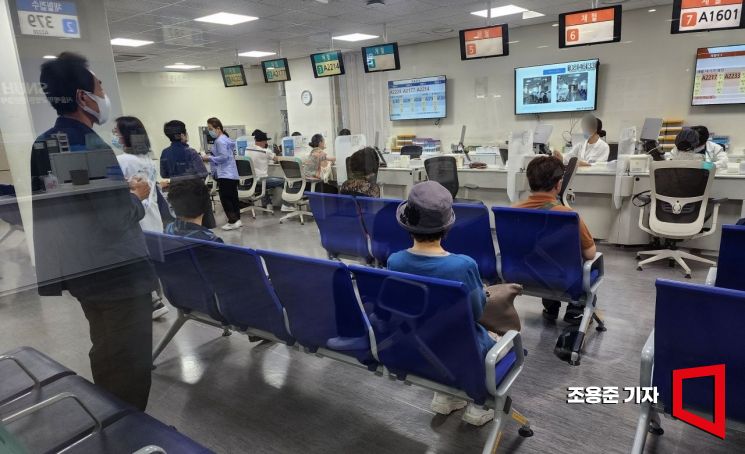 People waiting for medical treatment at a large hospital in Seoul. Not related to the article content.
On the 24th, Japan's TV Asahi reported that despite various government measures, hand, foot, and mouth disease is spreading at an unprecedented pace. According to a report released on the 23rd, the number of patients per medical institution reached 13.34, the highest in the past 10 years. A 4-year-old child who visited a pediatric clinic had rashes on the hands and feet and a body temperature over 37 degrees Celsius. Although hand, foot, and mouth disease is mainly known as a "childhood illness," adults are also getting infected. A woman in her 40s living in Kyoto began showing symptoms after her 2-year-old daughter contracted the disease. She experienced a fever of 39 degrees Celsius for about three days, and the rash spread all over her body. The woman said, "The soles of my feet hurt so much that I couldn't walk," and added, "The pain was like being stabbed with a knife, making every step agonizing and causing me to groan in pain."
In Korea as well, hand, foot, and mouth disease is spreading ahead of the vacation season. According to the Korea Disease Control and Prevention Agency's sentinel surveillance results, as of the second week of June, there were 34.1 cases of hand, foot, and mouth disease per 1,000 outpatient visits. This shows an increasing trend higher than in 2019, when the disease was highly prevalent. Hand, foot, and mouth disease is characterized by blisters and ulcers in the mouth and blistering rashes on the hands and feet. Red spots appear on the body, which are sometimes mistaken for heat rash caused by hot and humid summer weather or marks from mosquito or insect bites.
The Korea Disease Control and Prevention Agency emphasizes that if symptoms such as a rash accompanied by a high fever over 38 degrees Celsius, weakness in the limbs, vomiting, or seizures appear, prompt medical attention should be sought. Symptoms usually appear 3 to 7 days after infection, and the disease is highly contagious to the extent that if one child in a daycare or kindergarten is infected, the entire class is likely to be affected. Therefore, if hand, foot, and mouth disease is confirmed, children cannot return to school without a doctor's certificate of full recovery. Most patients recover within a week, but in severe cases, it can progress to meningitis.
© The Asia Business Daily(www.asiae.co.kr). All rights reserved.
![Clutching a Stolen Dior Bag, Saying "I Hate Being Poor but Real"... The Grotesque Con of a "Human Knockoff" [Slate]](https://cwcontent.asiae.co.kr/asiaresize/183/2026021902243444107_1771435474.jpg)















