Amendment to Subordinate Legislation of the Plant Protection Act
Starting next year, failure to report the occurrence of fire blight in fruit trees or to comply with prevention guidelines will result in up to a 60% reduction in compensation for losses.
The Ministry of Agriculture, Food and Rural Affairs announced on the 23rd that it will amend the subordinate regulations of the Plant Quarantine Act to strengthen farmers' obligations to comply with prevention guidelines and actively respond to plant pests and diseases such as fire blight, effective from the 24th.
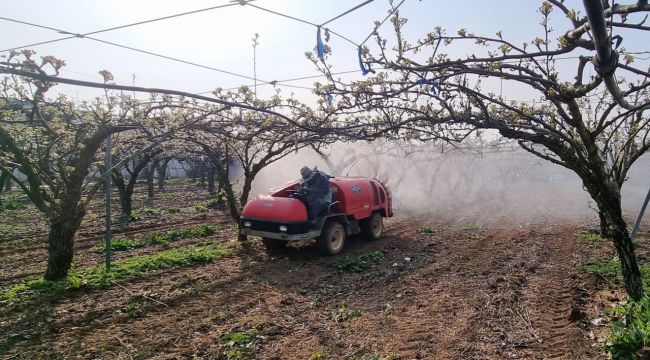 A scene of pest control being carried out to prevent fire blight disease in fruit trees. (Stock photo)
The newly enforced subordinate regulations of the Plant Quarantine Act specify the provisions delegated by the law promulgated in January this year.
An official from the Ministry of Agriculture, Food and Rural Affairs stated, "Fire blight is a bacterial disease that causes apple and pear trees to wither and die as if burned by fire, and it can spread easily. Since there is no appropriate treatment, early surveillance and rapid on-site response are crucial."
So far, the government has continuously promoted measures to control fire blight, including pre-removal of suspected trees, timely pesticide application, and education on farmers' control guidelines. In particular, this year, the crisis level was raised early from 'caution' to 'alert' on May 29, and active control efforts such as surveillance by management officers and sending text messages to restrict access to affected orchards have been made.
As a result, as of the 22nd, fire blight occurred in 136 farms covering 67.9 hectares, which is 72% of the area and 63% of the number of farms compared to the same period last year. Considering that fire blight generally decreases from July, the Ministry expects the scale of damage to be reduced this year.
The government has established a system to support this through the amendment of subordinate regulations, recognizing that farmer participation such as timely application of preventive pesticides during the flowering period and rapid and accurate surveillance and diagnosis are important to control fire blight, which is difficult to eradicate once it occurs.
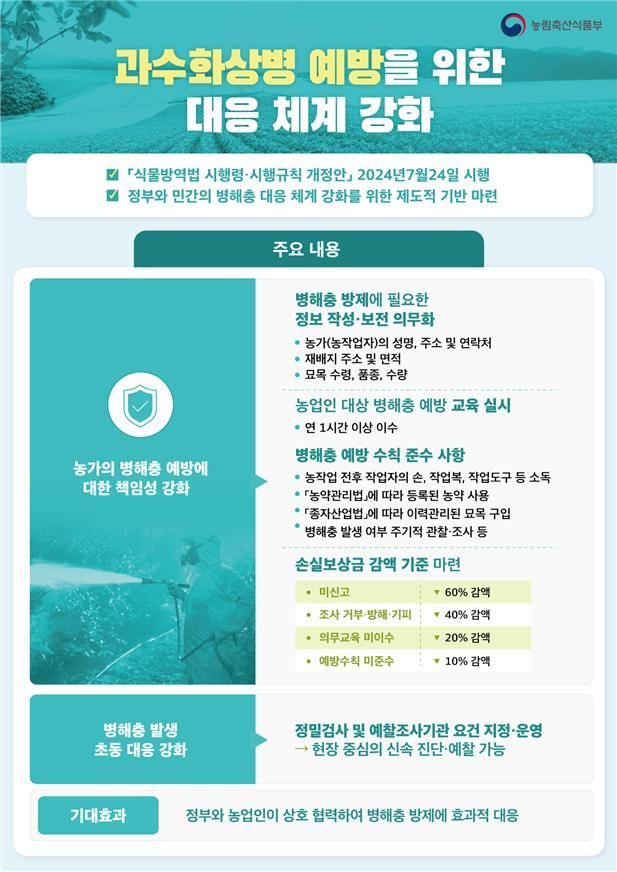
First, farmers are required to complete at least one hour of pest and disease control education annually and comply with prevention guidelines, with specific criteria for reducing compensation if violated. The reductions are as follows: 60% for failure to report, 40% for refusal or obstruction of investigation, 20% for failure to complete prevention education, and 10% for non-compliance with prevention guidelines.
However, to enhance farmers' understanding, the requirements for completing pest and disease prevention education and compliance instructions for farm workers will undergo a six-month guidance period and will be applied starting January next year.
Additionally, a legal basis has been established allowing the national or local government heads to request information related to pest and disease control from plant growers and farm workers, such as orchard access, preventive pesticide application, and seedling purchase details. A fine of up to 3 million KRW will be imposed for false reporting or failure to prepare and retain such information.
Choi Myung-cheol, Director of Food Policy at the Ministry of Agriculture, Food and Rural Affairs, said, "Through this amendment of the subordinate regulations of the Plant Quarantine Act, farmers' responsibility is increased by mandating information provision, control education, and compliance with prevention guidelines, and a system has been established for private specialized institutions such as universities and research institutes to participate in pest and disease control. As climate change causes more diverse pest and disease outbreaks and greater damage, the government and private sector will closely cooperate to establish an effective response system."
© The Asia Business Daily(www.asiae.co.kr). All rights reserved.
![Clutching a Stolen Dior Bag, Saying "I Hate Being Poor but Real"... The Grotesque Con of a "Human Knockoff" [Slate]](https://cwcontent.asiae.co.kr/asiaresize/183/2026021902243444107_1771435474.jpg)

















