Death During Cancer Battle
‘Achim Isul’ and ‘Chingu’ Songs of the Spirit of the Era
1991 Daehangno Small Theater Hakjeon Opening
Cradle of Artists Like Kim Gwang-seok and Hwang Jeong-min
"I did all I could."
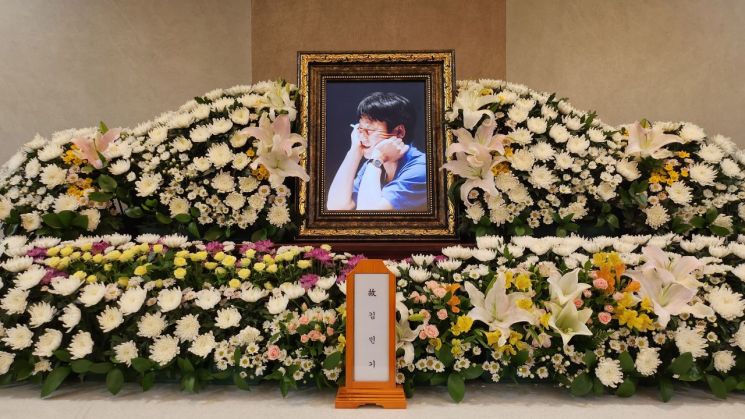 On the 22nd, the funeral hall at Seoul National University in Jongno-gu, Seoul, was set up as the mourning place for the late singer Kim Min-ki (representative of the theater company Hakjeon). July 22, 2024. [Provided by Hakjeon] [Image source=Yonhap News]
Singer Kim Min-ki, who left a significant mark on Korean popular culture as the representative of Hakjeon, a symbol of the Daehangno small theater culture, and with songs embodying the spirit of the times such as "Achim Isul" and "Sangnok-su," passed away on the night of the 21st at the age of 73.
He was diagnosed with stage 4 stomach cancer last fall and was undergoing chemotherapy while recuperating at his home in Ilsan, Goyang-si, Gyeonggi Province. His condition rapidly worsened due to pneumonia, and he was admitted to the emergency room on the 20th, passing away the following day.
On the 22nd, a Hakjeon official stated, "Although the representative left suddenly, regarding the closure of Hakjeon, he left the words 'I did all I could.'"
Kim Min-ki, who dreamed of becoming a painter as a boy, was born in 1951 in Iksan, Jeonbuk, as the youngest of ten siblings. After moving to Seoul, he attended Gyeonggi Middle and High School, immersing himself in art. In 1969, he entered the Department of Painting at Seoul National University. However, disappointed by the standardized teaching methods, he put down his brush after one semester and formed the folk song duo "Dobidu" with his high school classmate Kim Young-se (CEO of Inno Design), beginning his career as a singer. In 1970, he performed at the Myeongdong YWCA "Cheonggaeguri's House" stage, where he composed "Achim Isul" and also met singer Yang Hee-eun.
His debut album "Kim Min-ki," released in 1971, is regarded as a masterpiece that sincerely captured the critical perspective of contemporary youth embracing themselves and the world with anguish. The track "Achim Isul" won the "Healthy Song Seoul City Cultural Award" in 1971 for its beautiful lyrics, but with the social atmosphere freezing after the "October Yushin" in 1972, most songs on his album were banned within a year and all copies were confiscated.
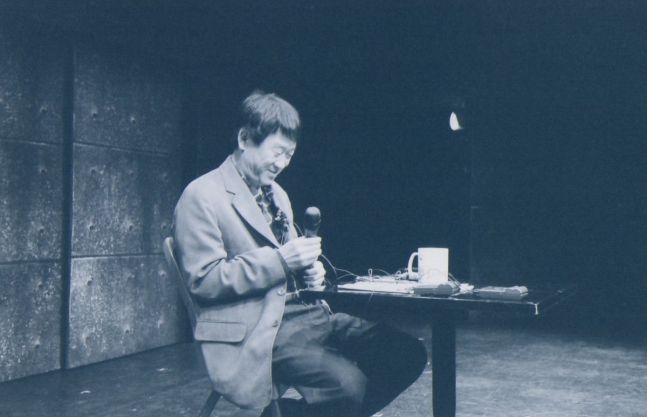 The late Kim Min-gi holding a microphone on the Hakjeon stage during his lifetime. He founded Hakjeon in 1991 and set a milestone in the domestic original musical scene by performing works such as "Subway Line 1."
 [Photo by Hakjeon]
After his military discharge, to avoid government oppression, he worked at a sewing factory in Bupyeong in 1977, where he composed "Sangnok-su" as a congratulatory song for a joint wedding ceremony of fellow workers. Living as a construction site laborer, coal miner, and farmer in the Civilian Control Line village, Kim Min-ki continued his creative activities by releasing works such as the song ritual "Lights of the Factory" and Yang Hee-eun's "Song of the Old Soldier."
In 1983, Kim Min-ki returned to Seoul and produced albums "People Searching for Songs" and "Songs of the Nation." He also directed the play "The Stopped Funeral Has No Chief Mourners." In 1993, to raise funds for the opening of Hakjeon, he compiled his songs into a total of four volumes titled "The Complete Works of Kim Min-ki" (1993), marking his first album release since the ban on his debut album.
Showing deep interest in theatrical arts following music, he opened the small theater "Hakjeon" in Daehangno, Jongno-gu, Seoul, on March 15, 1991, staging live concerts, plays, musicals, and various other genres. True to its name, meaning "learning field," Hakjeon faithfully served as a nursery for nurturing talents in the cultural and artistic fields. Hakjeon presented a total of 359 works and is credited with laying the foundation for domestic original musicals by producing works such as "Subway Line 1" and "Mosquito." In 2007, he received the German cultural honor "Goethe Medal" for "Subway Line 1," becoming the fourth Korean recipient after Seo Hang-seok, Yun Isang, and Paik Nam-june.
Hakjeon was also famous as an actor academy. Stars of Chungmuro such as Seol Kyung-gu, Hwang Jung-min, and Jo Seung-woo emerged through "Subway Line 1." Popular music singers including the late Kim Kwang-seok, Deulgukhwa, Ahn Chi-hwan, Lee So-ra, and Yoon Do-hyun also showcased their talents on the Hakjeon stage.
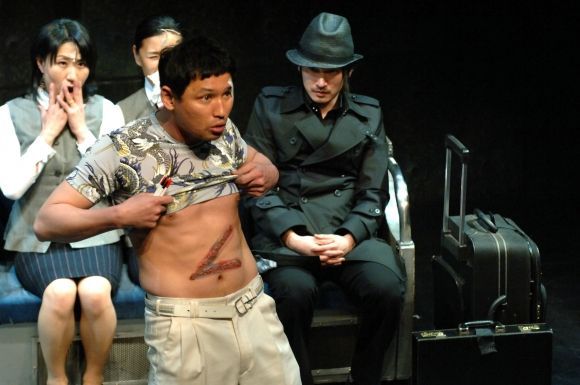 A scene from the 3,000th performance celebration of the musical "Jihacheol 1hoseon" starring actor Hwang Jung-min and others. The special performance held at Hakjeon for three days from March 27 to 29, 2006, featured over 80 participants including Jo Seung-woo, Bang Eun-jin, and Bae Hae-sun.
 [Photo by Hakjeon]
After securing a stable repertoire with original musicals, he suddenly began producing plays for children and adolescents. Although this genre was almost barren in the domestic performing arts scene, he consistently presented works addressing the realities of Korean youth such as "We Are Friends," "Gochujang Tteokbokki," and "Like Superman!" on the Hakjeon stage with exceptional affection and responsibility. He expressed his belief that "children are the future, and they must grow up watching good performances for Korea's future culture to be bright," and despite operating at a loss, he never raised ticket prices for children's performances.
In November last year, amid prolonged financial difficulties and health issues, Kim Min-ki decided to close Hakjeon. When news spread, offers of help poured in from all directions, but he declined them all. Hakjeon's final performance was the children's play "Gochujang Tteokbokki."
Hakjeon, which closed on March 15, reopened on the 17th as "Arko Kkumbat Theater," a children and youth-focused performance venue operated by the Korea Arts & Culture Education Service, four months after its closure.
Before his passing, he reportedly requested, "Do not create anything using me." According to the family's wishes, the funeral will not accept condolence money or floral tributes.
However, a public memorial space for him will be established in front of Hakjeon's courtyard.
He is survived by his spouse Lee Mi-young and two sons. The funeral procession will take place at 8 a.m. on the 24th. The burial site is Cheonan Park Cemetery. Before departing for the burial site, the hearse will pass through the front yard of Hakjeon.
© The Asia Business Daily(www.asiae.co.kr). All rights reserved.
![Clutching a Stolen Dior Bag, Saying "I Hate Being Poor but Real"... The Grotesque Con of a "Human Knockoff" [Slate]](https://cwcontent.asiae.co.kr/asiaresize/183/2026021902243444107_1771435474.jpg)

















