Ministry of Science and ICT Selects Urban Operators for 'Digital Twin Pilot Zone (Urban Type)' Project
National Funding to Support Creation of Digital Twin Korea's Flagship Model from 2024 to 2026 (3 Years)
Busan Metropolitan City announced that it has been finally selected for the Ministry of Science and ICT's 'Digital Twin Pilot Zone (Urban Type) Establishment Project' competition.
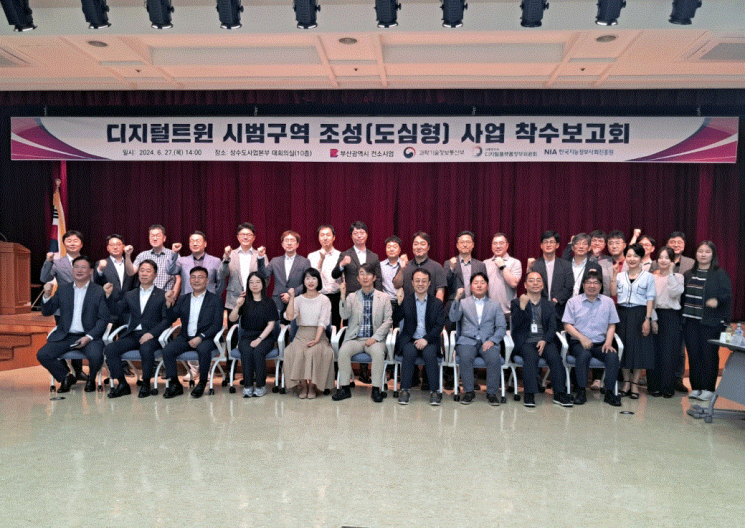 Officials involved in the Digital Twin Pilot Zone Development Project are taking a commemorative photo at the kickoff meeting.
'Digital twin' refers to a technology that mirrors the physical characteristics of real-world objects in a virtual space, implements them as 3D models, synchronizes and analyzes them with reality, and utilizes this for decision-making and support in the real world.
This project, which will be carried out over three years (2024?2026), aims to respond to public demand in a customized manner through the creation of a digital twin pilot zone that integrates and concentrates digital twin technology and service achievements, and to discover representative models for targeting overseas markets.
The competition was hosted by the Ministry of Science and ICT and organized by the National Information Society Agency (NIA).
The city formed the 'Busan Metropolitan City Consortium' together with Korea Land and Geospatial Informatix Corporation (LX), a specialized agency for digital twin platform services, and related organizations. As a result of proposing citizen safety service development and customized living environment analysis services for the public, the consortium achieved the feat of being finally selected as the 'urban type' project operator.
In May last year, the city signed a business agreement with Korea Land and Geospatial Informatix Corporation (President Uh Myungso) for joint cooperation in establishing a digital twin city management and operation system for Busan, which served as the foundation for forming the 'Busan Metropolitan City Consortium.'
The consortium consists of the city, Korea Land and Geospatial Informatix Corporation (Digital Twin Division, Busan-Ulsan Regional Headquarters), Busan IT Industry Promotion Agency, Dong-A University, AST Holdings, All4Land, Edentns, and Gaia3D.
The proposals made by the city consortium include: ▲ Establishment of a cloud-based integrated digital twin platform ▲ Development of 12 types of digital twin services that the public can experience for solving urban issues ▲ Creation of a reference model considering future platform and service expansion and export.
Accordingly, the city plans to secure 4.7 billion KRW in national funding this year and invest a total of approximately 6.8 billion KRW, including city funds and private investment, into the project. Additional national funding will be secured in 2025?2026 to establish a representative model for Digital Twin Korea in the future.
Busanjin-gu, which is the geographic center and original downtown of Busan and faces many pending issues, has been designated as the pilot zone for 2024, where digital twin service models will be developed. In 2025 and 2026, the pilot zone will be expanded, and four new service models (a total of 12) will be developed each year.
In June, the city held a kick-off meeting with the Ministry of Science and ICT, the Digital Platform Government Committee (DPG), the National Information Society Agency (NIA), and consortium members. Through a subsequent business briefing for Busanjin-gu officials, a governance system including a working-level consultative body was established, with the plan to create a safer city of Busan that citizens can truly feel.
Mayor Park Hyungjun stated, "The 'digital twin service' promoted through this competition selection is an opportunity to showcase the appeal of 'Global Hub City Busan' as a safe and convenient city, and I expect it will serve as a cornerstone for making Busan a happy city where people want to live again if given the chance."
© The Asia Business Daily(www.asiae.co.kr). All rights reserved.
![Clutching a Stolen Dior Bag, Saying "I Hate Being Poor but Real"... The Grotesque Con of a "Human Knockoff" [Slate]](https://cwcontent.asiae.co.kr/asiaresize/183/2026021902243444107_1771435474.jpg)















