"Explaining Yeondon Pork Cutlet" Direct Clarification
"Over 30 Years in Business, This Is the First Time for Such a Case"
Baek Jong-won, CEO of The Born Korea and a broadcaster, directly addressed the 'Yeondon Bolkatsu' incident, raising his voice against what he called "corporate destruction."
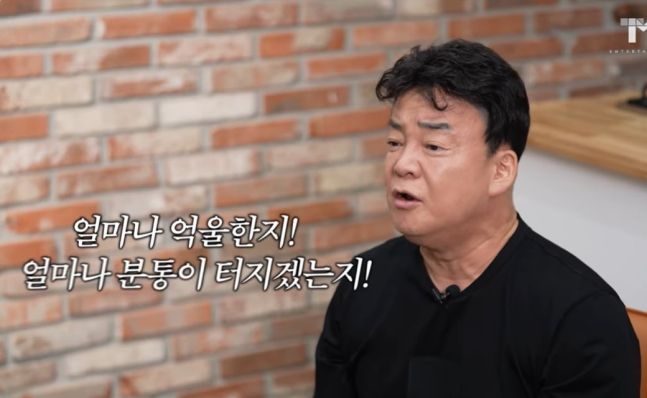
On the 22nd, CEO Baek uploaded a video titled 'Explaining Yeondon Bolkatsu' on his YouTube channel. He urged viewers to watch the video until the end, saying, "Please watch until the end to understand how unfair and frustrating this is," and fully refuted the controversial articles. Baek opened by saying, "It started when eight Yeondon Bolkatsu franchisees took collective action in June, and as false information was amplified and reproduced, The Born Korea has been criticized."
First, regarding the franchisee association's claim that The Born Korea brand's duration is 3.1 years, which is about half the franchise industry average of 7.7 years, CEO Baek explained, "To the general public, it might seem like 'They're complete frauds' or 'I knew it. They create too many brands, but does this brand only last a little over three years?' However, operating period and brand duration are different."
He pointed out, "The Fair Trade Commission's public data only discloses operating periods. If a store closes after three months, the duration is three months, but if it hasn't closed, the operating period is three months," clarifying the distinction. He added, "An operating period of 3.1 years means many stores opened recently," and refuted, "Saying 'everything failed in 3.1 years' is a completely different expression." He also noted, "Among our brands, some are 10 or 20 years old, but brands that rapidly expanded after 2010 are small-scale. Since these brands are less than five years old, their operating periods are naturally short."
Regarding the claim that sales per store have decreased compared to 2010 while headquarters sales increased ninefold, he said, "If that were true, we would be a bad company. In 2010, we did not have the small brands we pursue now. Naturally, larger stores have higher sales," and explained, "By 2023, there are more small stores, and if sales from smaller spaces reach half of previous levels, that's a success."
CEO Baek clarified, "Average sales per pyeong (approx. 3.3 square meters) were 17.82 million KRW in 2010 and increased to 23.5 million KRW last year, indicating improved profitability of small stores." Regarding the ninefold increase in headquarters sales, he stated, "The number of franchise stores increased from 247 in 2010 to 2,785 in 2023, an 11-fold increase."
He said, "The operating profit of a franchise company is obvious. It always comes from the franchisees' pockets," adding, "Our company's operating profit margin is not high. I do not tolerate that." He continued, "When raw material prices rise like now, it's really tough, but we try not to raise prices because we want franchisees to run their businesses well and for a long time."
CEO Baek appealed, "Since starting business in 1993, this is the first time such a case has occurred," and said, "It seems franchisees have been unintentionally harmed a lot. It's one thing for me to feel wronged alone, but this is a company issue and concerns the lifeline of about 2,900 franchise stores." He concluded, "This is really unacceptable. This is corporate destruction. This must not happen."
© The Asia Business Daily(www.asiae.co.kr). All rights reserved.
![Clutching a Stolen Dior Bag, Saying "I Hate Being Poor but Real"... The Grotesque Con of a "Human Knockoff" [Slate]](https://cwcontent.asiae.co.kr/asiaresize/183/2026021902243444107_1771435474.jpg)















