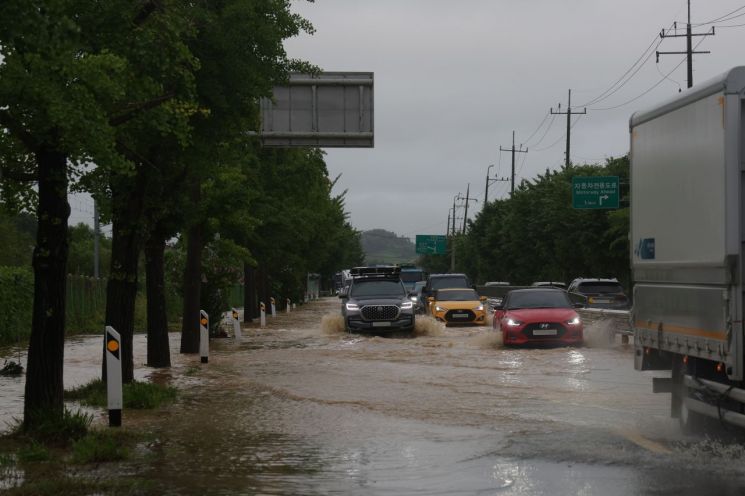
The combined loss ratio for automobile insurance among non-life insurance companies in the first half of the year has exceeded the break-even point of 80%. With continuous damage from flooding due to heavy rains during the July monsoon season, the loss ratio is expected to worsen in the second half, making a premium increase for automobile insurance inevitable next year.
According to the insurance industry on the 22nd, the cumulative loss ratio for automobile insurance from January to June this year among seven non-life insurers?Samsung Fire & Marine Insurance, Hyundai Marine & Fire Insurance, DB Insurance, KB Insurance, Meritz Fire & Marine Insurance, Lotte Insurance, and Hanwha General Insurance?was 80.1%, which is 2.4 percentage points higher than the same period last year (77.7%).
The non-life insurance industry considers a loss ratio of around 80% as the break-even point for automobile insurance, taking into account operating expenses.
In the first half, DB Insurance had the lowest automobile insurance loss ratio at 78.7%, followed by Meritz Fire & Marine Insurance at 78.8%, Samsung Fire & Marine Insurance at 79.2%, KB Insurance at 79.4%, Hyundai Marine & Fire Insurance at 80.7%, Hanwha General Insurance at 81.8%, and Lotte Insurance at 82.1%.
The damage amount caused by this year’s monsoon has already exceeded 30 billion KRW. According to the industry, as of 9 a.m. on this day, 3,427 vehicles damaged by flooding during the monsoon season have been recorded by 12 non-life insurers selling automobile insurance since the 6th of this month. The estimated damage amount is 31.069 billion KRW.
Non-life insurers are taking measures to minimize flood risks using their own emergency systems. Since last month, the financial authorities have also been operating an 'Emergency Evacuation Alert System' in collaboration with automobile insurers, the Korea Insurance Development Institute, and the General Insurance Association of Korea. This system provides evacuation guidance using automobile insurance subscription information and can be received regardless of whether the vehicle is insured or subscribed to Hi-Pass if it is at risk of flooding or secondary accidents.
© The Asia Business Daily(www.asiae.co.kr). All rights reserved.
![Clutching a Stolen Dior Bag, Saying "I Hate Being Poor but Real"... The Grotesque Con of a "Human Knockoff" [Slate]](https://cwcontent.asiae.co.kr/asiaresize/183/2026021902243444107_1771435474.jpg)















