Economic Ministers' Meeting on the 23rd
Ministry of Land, Infrastructure and Transport Announces 'Measures to Revitalize Overseas Investment and Development Projects'
Government and Public Institutions Collaborate to Support Export of 'K-New Towns'
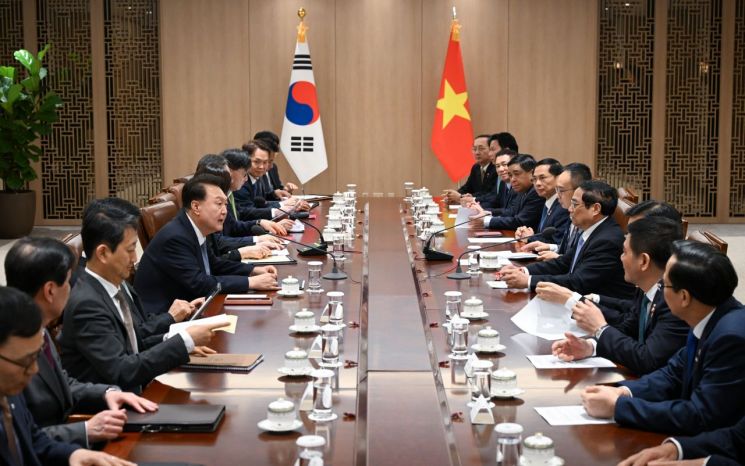
The government has set a new goal in the overseas construction sector to achieve $10 billion (approximately 13.9 trillion KRW) in orders for overseas investment development projects, including K-New Towns, by 2030. The core objective is to improve the overseas order structure of domestic construction companies by shifting from simple contracting to high value-added projects. The Ministry of Land, Infrastructure and Transport (MOLIT) announced the "Plan to Revitalize Overseas Investment Development Projects" containing these details at the Economic Ministers' Meeting held at the Government Seoul Office on the 23rd.
Park Sang-woo, Minister of MOLIT, stated, "It is time to expand entry into the high value-added top-tier market of overseas investment development projects," adding, "To this end, the public sector will actively play a role and promote a fleet-type order system where the private sector participates together."
Until now, construction companies have accumulated overseas orders mainly through simple contracting. MOLIT explained that going forward, construction orders will be carried out as 'overseas investment development projects.' These projects involve taking full responsibility for all processes from project planning, development, and financing to construction, operation, and management.
The industry says that the profitability of investment development projects is in the 10% range, about twice as high as the 3-5% level of contracting projects. This is because, as equity investors, companies can directly set more favorable business conditions, and as project implementers, they can manage the entire project and reduce financial costs by shortening construction periods.
Looking at the overseas construction orders of domestic companies from 2019 to last year, contracting projects accounted for 95%, while investment development projects made up 5%. MOLIT expects that if the $10 billion target is achieved by 2030, the share of investment development projects could rise to 15-20%.
The Public Sector Lays Infrastructure to Facilitate Private Sector Entry
The government will first secure opportunities for investment development project orders by deploying public institutions with high credibility and negotiation power with partner governments. Public institutions have experience in large-scale infrastructure projects and the advantage of being able to raise funds at low interest rates.
First, the role of the Korea Overseas Infrastructure & Urban Development Corporation (KIND), a MOLIT-affiliated agency, will be expanded. KIND plans to actively make equity investments to facilitate the commercialization of projects desired by domestic companies overseas. The equity investment limit will be increased from 30% to 50%, and KIND will be allowed to become the major shareholder of the projects. Investment requirements for KIND will also be relaxed. Previously, decisions were based solely on order amounts, but going forward, the accompanying entry effects of related industries, including equipment and vehicles, will also be considered.
Other public institutions such as the Korea Rail Network Authority, Korea Railroad Corporation, Korea Expressway Corporation, Korea Airports Corporation, Incheon International Airport Corporation, and Korea Land & Housing Corporation will also establish public-private joint entry strategies. These institutions will act as lead investors to secure business opportunities for private companies. For example, when exporting railways, the Korea Rail Network Authority and Korea Railroad Corporation will establish railway plans and signaling systems to lay infrastructure overseas, after which private companies will undertake railway construction and vehicle supply, enabling joint entry.
Public-Private Cooperation for Vietnam's First 'K-New Town' Export
The government will also support the export of 'K-New Towns' by Korean construction companies. K-New Towns are a representative form of 'overseas investment development projects.' The Vietnam Southeast New Town Development Project, identified as a cooperation task during the Korea-Vietnam summit tour in June last year, is expected to become the first city export project. The project involves developing a city for 110,000 residents in the Bac Ninh Province near Hanoi, Vietnam. Feasibility studies will be conducted this year, and bidding will take place next year. MOLIT plans to provide mid- to long-term support considering the characteristics of large-scale, long-term urban development projects.
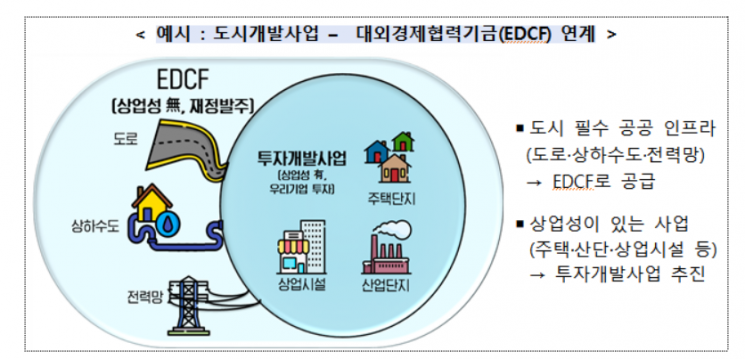
Kim Sang-moon, Director of the Construction Policy Bureau at MOLIT, explained, "A MOLIT-affiliated public institution will act as the project implementer to first discover projects, and private construction companies will participate through equity investment and construction orders." He added, "New town export projects take more than 20 years and require large-scale funding. The government will support K-New Town export projects by linking with Official Development Assistance (ODA) and the Economic Development Cooperation Fund (EDCF)."
For example, parts of the overall project that are not commercially viable, such as roads, water supply and sewage, and power grids around the new town, will be constructed by the partner government using Korea's EDCF loans or provided as free ODA. Once infrastructure is established, domestic construction companies can invest in profitable projects such as housing complexes, industrial complexes, and commercial facilities within the new town to generate profits.
Meanwhile, a 'Global Plant, Construction, and Smart City (PIS) Phase 2 Fund' will be created to support entry into investment development projects. Director Kim said, "Since 2019, we have been operating the PIS Fund Phase 1, and so far, investments totaling 1.1 trillion KRW have been made in 21 projects in the U.S., Saudi Arabia, Vietnam, and Malaysia." He continued, "We will start raising the Phase 2 Fund this year. The public sector will invest to create a 440 billion KRW mother fund, and next year, an additional 660 billion KRW in private investments will be added, expanding the total to 1.1 trillion KRW."
This fund will expand support not only for new contracts of Korean companies but also for acquiring equity in projects already invested in. Additionally, investment allocation barriers among plants, construction, and infrastructure will be removed to allow companies to concentrate investments in preferred projects.
© The Asia Business Daily(www.asiae.co.kr). All rights reserved.
![Clutching a Stolen Dior Bag, Saying "I Hate Being Poor but Real"... The Grotesque Con of a "Human Knockoff" [Slate]](https://cwcontent.asiae.co.kr/asiaresize/183/2026021902243444107_1771435474.jpg)

















