Joincheol "Pay Broadcasting Development Fund Within 1% of Sales"
Overseas Imposes Similar Obligations as Existing Broadcasters
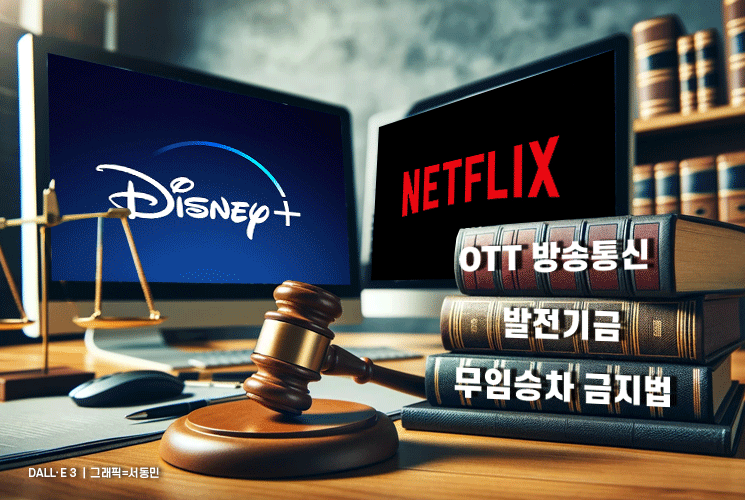
Measures to impose a kind of tax on overseas online video service (OTT) companies such as Netflix and Disney+ are being promoted both domestically and internationally. As the influence of global OTTs grows day by day, there is a movement to impose obligations similar to those on existing broadcasters.
Jo In-cheol, a member of the National Assembly's Science, Technology, Information and Broadcasting and Communications Committee from the Democratic Party of Korea, recently introduced a bill known as the 'OTT Broadcasting and Communications Development Fund (Bangbal Fund) Free Riding Prohibition Act.' The government collects the Broadcasting and Communications Development Fund from terrestrial broadcasters, comprehensive programming channels, news channels, and pay broadcasters to promote broadcasting and communications. However, Netflix, which ranks first in domestic OTT users and recorded sales of 823.3 billion won last year, is excluded from this public resource collection.
The 'Broadcasting and Communications Development Basic Act Amendment' proposed by Representative Jo includes provisions to impose the Bangbal Fund of up to 1% of the previous year's sales on operators whose number of users or traffic volume exceeds a certain level.
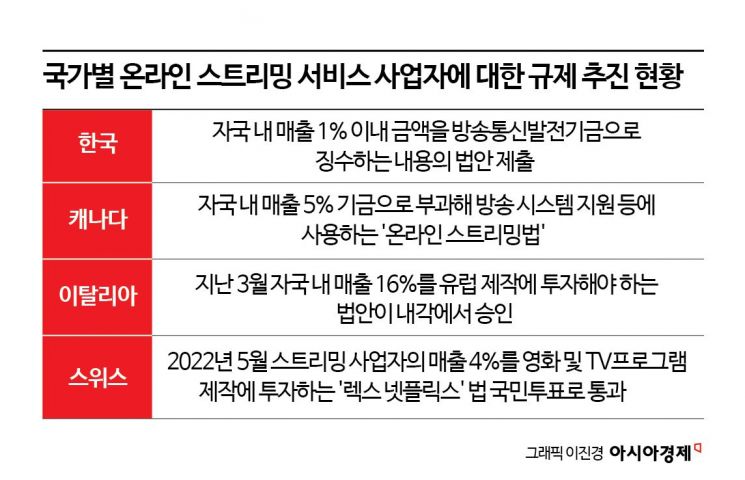
Such attempts are actively underway in Europe and Canada. In April last year, the Canadian government amended the Broadcasting Act for the first time in about 30 years to include online streaming services under existing regulations. This is an attempt to place all video and audio streaming platforms such as Netflix, Amazon Prime Video, Disney+, Apple Music, and Spotify under the same regulations as existing broadcasters.
The Canadian Radio-television and Telecommunications Commission (CRTC) announced a policy last year to mandate online streaming service providers to contribute 5% of their Canadian revenue to support the country's broadcasting system. This applies to operators with annual broadcasting revenue exceeding 10 million Canadian dollars, and it is estimated that 200 million Canadian dollars will be raised annually. However, operators opposed the move, saying it would cause side effects such as increased user fees, and eventually entered into legal battles, leading to a standoff with the government.
Earlier, European Union (EU) countries have imposed investment obligations on global OTTs such as Netflix to protect their domestic broadcasting and film ecosystems. France and Italy require OTT companies to invest up to 20% of the revenue earned within their countries locally. Switzerland put a bill to a national referendum requiring 4% of revenue to be reinvested in Swiss film and TV program production, receiving 58% support. It is even said that the nomination of Paolo Sorrentino's 'The Hand of God' for the 2022 Oscars was thanks to the Italian government's regulations supported by Netflix's investment.
Lee Soo-yeop, a research fellow at the Media Future Research Institute, said, "It is necessary to refer to European systems to encourage OTTs to contribute to revitalizing the domestic production market and securing diversity," adding, "While imposing a domestic production scheduling obligation ratio equivalent to that of broadcasters, providing tax benefits for domestic content investment resources is also an option."
© The Asia Business Daily(www.asiae.co.kr). All rights reserved.
![Clutching a Stolen Dior Bag, Saying "I Hate Being Poor but Real"... The Grotesque Con of a "Human Knockoff" [Slate]](https://cwcontent.asiae.co.kr/asiaresize/183/2026021902243444107_1771435474.jpg)

















