First Implementation This Year Under Capital Markets Act Amendment
Also Used in Investigation of Kakao's SM Acquisition
Insider Cooperation Essential for Swift Investigation
Reduced Penalties for Voluntary Reporting and Testimony
Since the full implementation of leniency under the Capital Markets Act on January 19 this year, cases of cooperation in investigations and trials using this system have been emerging one after another. Leniency, which was mainly used in cartel cases under the Fair Trade Act, is now being actively applied to violations of the Capital Markets Act such as insider trading and stock price manipulation, and it is expected to have a significant impact on related investigations and trials.
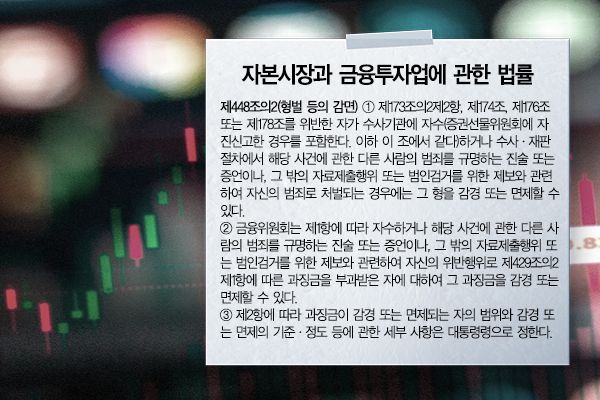
Leniency is a system that allows perpetrators of unfair trade practices to receive reduced criminal penalties if they voluntarily report violations or testify about others' crimes. With the amendment to the Capital Markets Act last year (establishment of Article 448-2), it became applicable to unfair practices such as the use of undisclosed information and market manipulation.
According to a comprehensive report by the Legal Times on the 19th, it has been confirmed that Junho Lee, head of Kakao Enter's Investment Strategy Division, applied for leniency with the prosecution in connection with the investigation into Kakao's SM Entertainment stock price manipulation case. During the prosecution's investigation of Kim Beom-su, Kakao's founder (Chairman of the Management Innovation Committee), Lee also made statements related to Kim's charges, and the prosecution reportedly requested an arrest warrant based on this. If the applicant cooperates with the investigative authorities throughout the investigation and trial process and provides consistent testimony, the prosecution will determine whether to apply leniency by considering factors such as the applicant's contribution to crime clarification. If leniency is applied, the prosecutor can reduce the sentence requested for the applicant by up to half. If the applicant returns all illicit gains obtained, non-prosecution measures such as suspension of indictment are also possible.
Since the implementation of leniency this year, there have been several other cases of leniency applications to the prosecution, and it is known that many defense lawyers representing suspects have recently inquired about leniency. A prosecution official stated, "It is true that there are cases of leniency applications, but we cannot disclose which cases they are for the sake of protecting the suspects' privacy."
For whistleblowers who apply for leniency to ultimately receive sentence reductions, strict conditions must be met. This is because there could be disputes over credibility, with concerns that leniency might be abused to reduce sentences.
In the legal community, leniency is expected to enable swift investigations and punishments in insider trading and stock price manipulation cases, which are conducted secretly. Capital market crimes have been growing in scale and becoming more organized, but since they are conducted covertly among the parties involved, it has often been difficult to uncover the truth and punish offenders. Utilizing leniency can enable rapid investigations through insiders.
The full introduction of leniency was also triggered by the ‘SG Securities stock price crash incident.’ Last year’s amendment to the Capital Markets Act expanded criminal leniency, previously used in cartel cases under the Fair Trade Act, to unfair practices in the capital market. This is to strictly punish capital market crimes such as market manipulation and use of undisclosed information, which are conducted secretly and are difficult to investigate without insider cooperation.
However, there are criticisms that the conditions for sentence reduction are too strict for leniency applicants to use it as an incentive to cooperate during investigations and trials. A former prosecutor turned lawyer said, “From the leniency applicant’s perspective, non-prosecution measures such as suspension of indictment would be the greatest incentive to cooperate with investigations, but the requirements for suspension of indictment are stringent,” adding, “Detailed operation should be considered within the bounds of legal sentiment.”
Another former prosecutor lawyer said, “Since the system was introduced recently, there are few practical cases of its use so far,” and added, “Depending on the investigation and trial results of the Kakao case, it could become an opportunity for the system to be established.”
Hyunkyung Lim, Legal Times Reporter
※This article is based on content supplied by Law Times.
© The Asia Business Daily(www.asiae.co.kr). All rights reserved.
![Clutching a Stolen Dior Bag, Saying "I Hate Being Poor but Real"... The Grotesque Con of a "Human Knockoff" [Slate]](https://cwcontent.asiae.co.kr/asiaresize/183/2026021902243444107_1771435474.jpg)















