Trends in Fresh Fruit Shipments and Summer Vegetable Supply
The government expects that with the full-scale shipment of new seasonal fruits starting this month, prices of major fruits such as apples, peaches, and grapes will stabilize. In the case of lettuce, which suffered supply reductions due to damage from recent heavy rains, supply levels are expected to recover to average levels after early next month.
The Ministry of Agriculture, Food and Rural Affairs announced this on the 22nd during a briefing on 'New Seasonal Fruit Shipment Trends and Summer Vegetable Supply and Demand Trends.'
First, apples, which had high prices due to decreased production last year, began new apple shipments such as Summer King and Tsugaru (Aori) from mid-July, and prices have shifted to a downward trend as the last stored stock of the 2023 harvest is shipped. According to the Ministry, the retail price for 10 apples dropped from 34,066 won in late June to 30,697 won in mid-July. However, this is still 8.6% higher compared to the previous year.
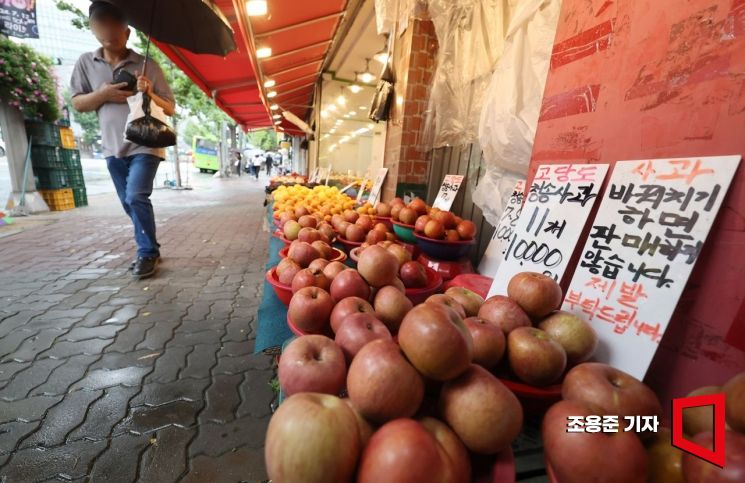 On the 2nd, fruits were displayed at a store near the Cheonggwan Market in Yeongdeungpo-gu, Seoul. Photo by Jo Yongjun jun21@
Park Soon-yeon, Director of Distribution and Consumption Policy at the Ministry, said, "Although prices remain high due to last year's production decrease, shipments of new apples have been expanding since last weekend, so prices are expected to stabilize soon. Especially, the Fuji variety, which accounts for 66% of total production, is growing well, so apple production this year is expected to recover to average levels."
Pears, which were produced last year and are currently in storage and distribution, are expected to maintain high prices until new pears are shipped in August. However, since there was no cold damage in spring this year and growth is good, with the number of fruit sets and bagged fruits increasing by 22.2% compared to last year, production is expected to be higher than average. Therefore, the Ministry expects prices to stabilize from late August when new pears are shipped in full. Kim Sang-dong, Secretary General of the Korea Pear Association, also stated, "The pear black spot disease that occurred in some farms in the Naju area this spring is now stable with no further spread, and there is no significant disruption expected in this year's production."
Additionally, peaches have shown stable trends with retail prices falling by 16.1% compared to last year due to increased shipment volumes. Grapes have also shown stable prices as production increased without weather-related damage such as cold injury, and shipment volumes have increased compared to previous and average years.
Lettuce, which sees increased demand in summer, suffered flood damage in the main production areas of Nonsan and Iksan. Currently, recovery of damaged cultivation facilities and replanting (reseeding) are underway, and it is expected to take 2 to 3 weeks after replanting before shipments resume. The Ministry forecasts that supply will recover to average levels after early August.
Director Park said, "Fruit production is expected to be stable, so prices are likely to stabilize, but vegetables tend to have large fluctuations in production depending on weather conditions such as heavy rain, high temperatures, and typhoons. Considering possible upcoming weather variables like heatwaves and typhoons, we plan to make every effort to ensure stable supply by closely managing growth through timely pest control, discounted supply of pesticides and nutrients, and technical guidance to farmers to prevent additional damage."
© The Asia Business Daily(www.asiae.co.kr). All rights reserved.
![Clutching a Stolen Dior Bag, Saying "I Hate Being Poor but Real"... The Grotesque Con of a "Human Knockoff" [Slate]](https://cwcontent.asiae.co.kr/asiaresize/183/2026021902243444107_1771435474.jpg)
















