Possibility of Forcing Passage of Broadcasting 4 Laws and Yellow Envelope Law Increases
Chance Remains for Negotiation Between National Assembly Speaker and Ruling and Opposition Floor Leaders
The ruling and opposition parties, continuing their standoff without even holding an opening ceremony, are expected to clash again with unlimited debate (filibuster) at the plenary session on the 25th. Following the ruling party's rejection of Speaker Woo Won-sik's mediation proposal, the Democratic Party of Korea has solidified its plan to push through the four broadcasting laws (Broadcasting Act, Broadcasting Culture Promotion Act, Korea Educational Broadcasting System Act, and the Act on the Establishment of the Korea Communications Commission), the Yellow Envelope Act (amendments to Articles 2 and 3 of the Labor Union Act), the nationwide 250,000 won support law, and the special law on jeonse fraud.
On the 22nd, a National Assembly Speaker's office official said, "If the situation does not change, the plenary session will be held on the 25th, and the four broadcasting laws will be processed." However, the official added, "There are many variables over the next four days, including a luncheon meeting between Speaker Woo and the floor leaders of the ruling and opposition parties." If the opposition party moves to push through the bills, the ruling party plans to counter with unlimited debate lasting seven nights and eight days, one day per bill.
Earlier, on the 17th, Speaker Woo proposed a mediation plan centered on the Broadcasting Act to resolve the standoff between the ruling and opposition parties. He requested the People Power Party to halt the appointment process of the public broadcasting board members of the Korea Communications Commission, and asked the Democratic Party to stop legislative action on the four broadcasting laws and discussions on the impeachment of Lee Jin-sook, the expected chairperson of the Korea Communications Commission. Additionally, he proposed forming a nationwide consultative body including both parties and the political sector to re-examine the four broadcasting laws from scratch. On the 19th, People Power Party floor leader Chu Kyung-ho stated, "We cannot accept the demand to halt the appointment schedule of the public broadcasting board," effectively rejecting the proposal.
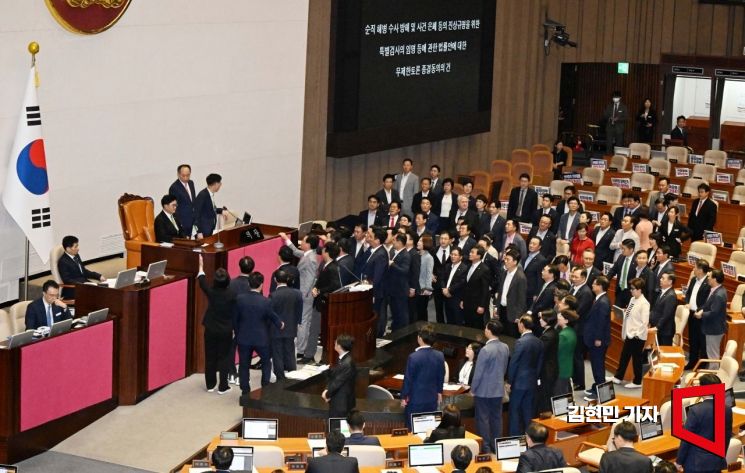 Members of the People Power Party are protesting Speaker Woo Won-shik's request to end the unlimited debate (filibuster) during the plenary session held at the National Assembly on the 4th. Photo by Kim Hyun-min kimhyun81@
Although the Democratic Party officially stated it would accept Speaker Woo's request, dissatisfaction is bubbling up in various places. On the 18th, Choi Min-hee, Chairperson of the Science, Technology, Information and Broadcasting and Communications Committee, said, "The unilateral broadcasting control attempt by the Korea Communications Commission, which is pushing through even a two-person illegal composition and a one-person composition, must be stopped first." The Yellow Envelope Act and others are also expected to be processed at the plenary session on the 25th.
Moreover, confrontations between the ruling and opposition parties are inevitable over personnel hearings and impeachment petition-related hearings. On this day, personnel hearings for Kim Byung-hwan, nominee for Financial Services Commission chairman, Kim Wan-seop, nominee for Minister of Environment, and Noh Kyung-pil, Supreme Court justice nominee, are underway. On the 24th and 25th, hearings for nominee Lee Jin-sook will be held, and on the 24th and 25th, personnel hearings for Supreme Court justice nominees Park Young-jae and Lee Sook-yeon are scheduled. On the 26th, a hearing related to the immediate filing of the impeachment motion against President Yoon Seok-yeol is planned.
© The Asia Business Daily(www.asiae.co.kr). All rights reserved.

















