957 Cases Occurred in the Last 5 Years
Only 8 Safety Inspection Devices Available
As heavy rain continues nationwide, sinkhole occurrences are happening across the country. Sinkholes occur for various reasons, including soil erosion caused by rainwater infiltration and ground weakening due to damage to aging water and sewage pipes.
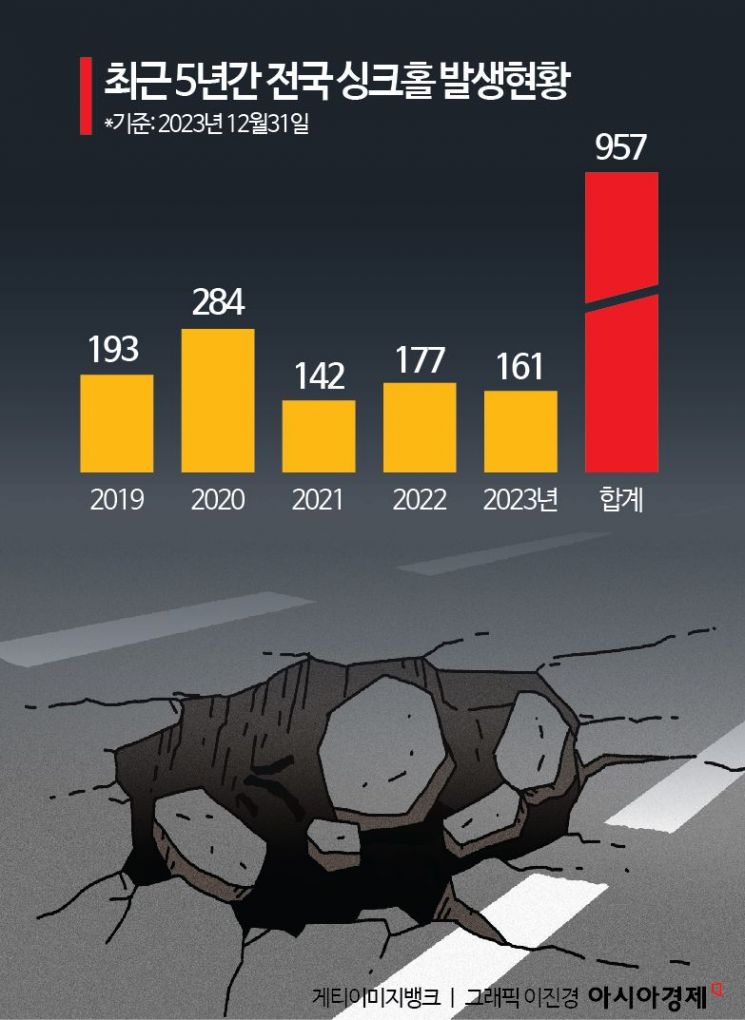
According to Hwang Hee, a member of the Democratic Party of Korea, a total of 957 sinkholes have occurred nationwide over the past five years. By year, there were 193 cases in 2019, 284 in 2020, 142 in 2021, 177 in 2022, and 161 in 2023. By region, Gyeonggi had 197 cases, Gwangju 122, Busan 85, Seoul 81, Jeonbuk 70, Gangwon 68, and Daejeon 66. The main causes were sewage pipe damage with 446 cases (46.6%), poor compaction (backfilling) with 171 cases (17.9%), poor excavation work with 82 cases (8.6%), damage to other buried facilities with 64 cases (6.7%), and water pipe damage with 39 cases (4.1%).
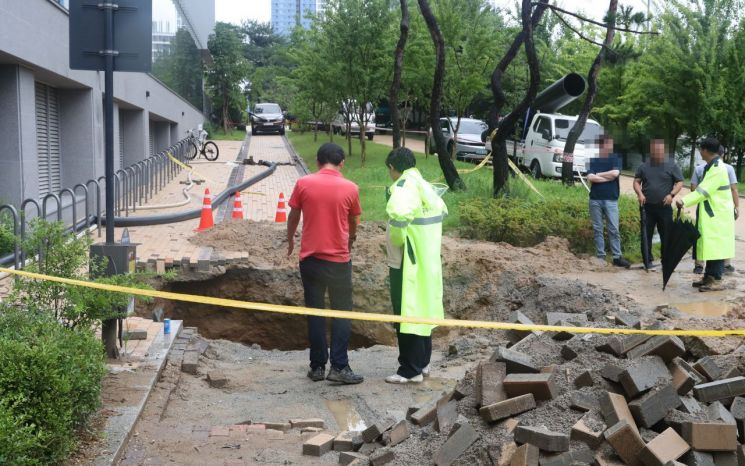
This year, sinkhole damage continues as heavy rain pours down. On the 18th, near the cultural heritage site in Osan, Gyeonggi Province, where a flood warning was issued, sinkhole damage occurred repeatedly, leading to restricted access. On the 16th, a sinkhole measuring 2 meters in diameter and 3 meters deep occurred on a walking trail near an apartment in Sejong City, causing serious injury to a citizen on their way to work. On the 8th, in Seongnam-dong, Dong-gu, Daejeon, a report of a "collapsing road" was received, prompting the fire department to respond and take action.
Local governments are requesting ground investigation safety inspections from the Korea Land and Housing Safety Agency. The length of ground safety inspection sections has been expanding annually: 952 km in 2020, 1,143 km in 2021, 1,386 km in 2022, 1,665 km in 2023, and 1,049 km up to June this year. However, the specialized equipment currently owned by the Korea Land and Housing Safety Agency is limited to a total of eight units: three road vehicle-type (3D) devices, three automatic devices for narrow areas, and two manual devices, making it difficult to efficiently respond to the rapidly increasing requests for ground safety inspections.
Experts unanimously agree that proactive measures are most important. Professor Choi Jae-won of the Korea Road Traffic Authority said, "As heavy rainfalls have been occurring frequently recently, concerns about sinkhole damage are high," and advised, "It is necessary to quickly purchase specialized equipment to prevent such incidents in advance." Professor Kim Ui-su of the Department of Safety Engineering at Korea National University of Transportation emphasized, "Sinkholes occur when drainage facilities leak or water seeps underground, carrying soil away and creating voids," adding, "Thorough maintenance of drainage facilities is essential, and if construction is planned in risky areas, prior evaluation and careful review must be mandatory."
© The Asia Business Daily(www.asiae.co.kr). All rights reserved.
![Clutching a Stolen Dior Bag, Saying "I Hate Being Poor but Real"... The Grotesque Con of a "Human Knockoff" [Slate]](https://cwcontent.asiae.co.kr/asiaresize/183/2026021902243444107_1771435474.jpg)
















