Average Annual Salary of Korean Workers Based on Purchasing Power Parity (PPP) $47,715
Stagnant Near the $50,000 Threshold
Increased Employment of Elderly and Women Since COVID-19 Lowers Average Wage
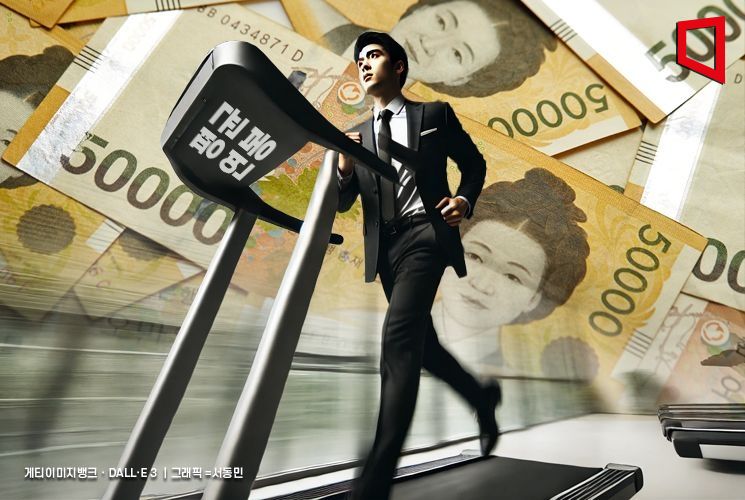
The average annual salary of regular full-time workers in South Korea, based on purchasing power parity (PPP), ranks 21st among OECD countries. Korean workers' salaries, which first exceeded $49,000 in 2020, have been steadily declining since then. This decline is attributed to increased labor market participation by women and the elderly following the COVID-19 period, which has lowered the overall wage average.
Average Salary of Korean Workers in 2023: $47,715
According to the OECD on the 19th, the average annual salary (PPP basis) of regular full-time workers in South Korea last year was $47,715 (approximately 62.29 million KRW).
The PPP (Purchasing Power Parity) based salary is an indicator designed to compare the actual purchasing power of citizens by considering exchange rates and price levels rather than simply comparing wages across countries. The OECD regards PPP-based salaries as the real wages of each country.
The average salary of Korean workers ranked 21st among the 33 OECD member countries for which data is available. Luxembourg ranked first with $85,526, followed by Iceland ($81,378), Switzerland ($79,204), and the United States ($77,226). On the other hand, Mexico had the lowest at $20,090. Japan ranked 24th ($42,118), three places below South Korea.
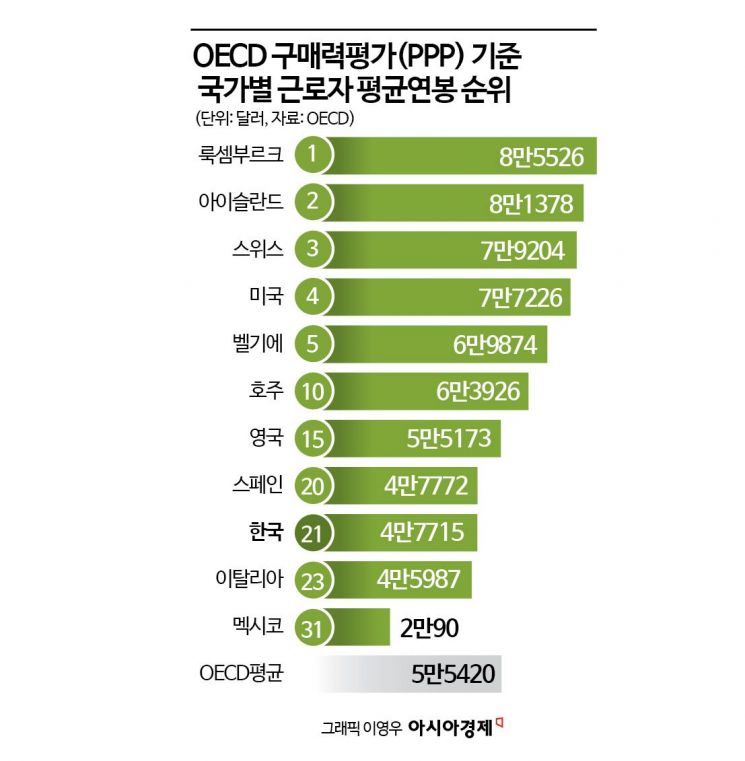
South Korea's salary falls short of the OECD average. The OECD average salary is $55,420, which is $7,705 higher than South Korea's. Countries with similar salaries to South Korea include Spain ($47,772) and Italy ($45,987).
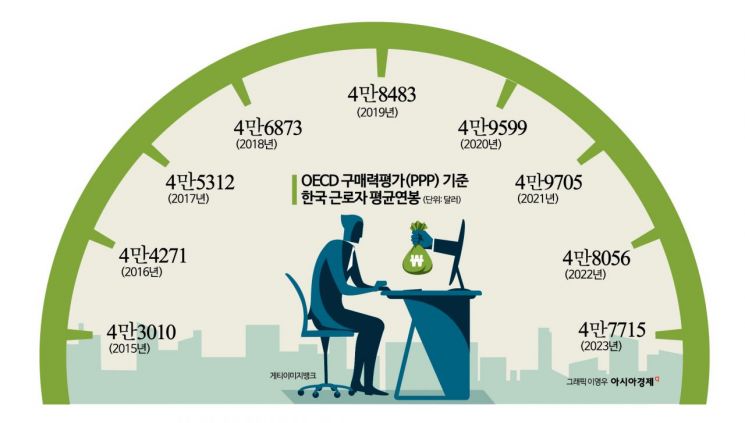
Once close to $50,000, the average salary of Koreans has clearly slowed in recent years. The salary was $48,483 in 2019, increased by 2.3% to $49,599 in 2020, then rose by 0.21% to $49,705 in 2021, showing a slowdown in growth. It then decreased by 3.32% to $48,056 in 2022 and further dropped by 0.71% to $47,715 in 2023, marking a downward trend.
Increased Employment of Elderly and Women Lowers Overall Wage Average
The stagnation in average salary is attributed to the increased supply of elderly and female workers in the labor market around the COVID-19 period, which lowered the overall wage level.
According to Statistics Korea, the employment rate for those aged 60 and above reached 47.4% as of last month. It has been steadily rising from 42.9% in 2021, 44.5% in 2022, to 45.5% in 2023. Particularly, the employment rate for those aged 70 and above increased from 27.5% in 2021 to 32.7% last month. Due to the nature of elderly workers, who tend to be concentrated in low-wage jobs such as public sector positions, this trend lowers the overall wage average.
Women in their 40s and 50s, mainly working in food and accommodation or distribution industries, also appear to have contributed to lowering the average salary. The female employment rate rose from 51.2% in 2021 to 55.6% last month, mostly driven by women in their 40s, 50s, and 60s.
The employment rate for women aged 40-49 increased from 64.2% in 2021 to 67.5% last month, and for women aged 50-59, it rose from 65.3% in 2021 to 68.1% last month. The employment rate for women aged 60 and above also increased from 34% in 2021 to 39.8% last month, leading the overall rise in female employment.
An official from the Bank of Korea stated, "Unlike major countries such as the United States, South Korea saw an increase in labor supply centered on women and the elderly during the COVID-19 pandemic." The official added, "The cumulative effect of increased labor supply over several years appears to have acted as a factor restraining wage growth." The official also noted, "The reason wages are lower than the OECD average is that South Korea's GDP per capita is below the average."
Since OECD wage statistics are calculated in dollars, the recent depreciation of the Korean won against the dollar is also presumed to have had an impact. The average annual won-dollar exchange rate fell to 1,086.3 KRW in 2020 but rose sharply to 1,288 KRW last year. It is expected to reach the 1,300 KRW level this year.
© The Asia Business Daily(www.asiae.co.kr). All rights reserved.
![User Who Sold Erroneously Deposited Bitcoins to Repay Debt and Fund Entertainment... What Did the Supreme Court Decide in 2021? [Legal Issue Check]](https://cwcontent.asiae.co.kr/asiaresize/183/2026020910431234020_1770601391.png)