"Punishment Law Provisions Ambiguous and Unclear"
National Assembly Must Amend Law by End of Next Year
The Constitutional Court has ruled that the current External Audit Act’s provision on false preparation of financial statements and audit reports, commonly referred to as ‘accounting fraud,’ is unconstitutional because it stipulates a ‘multiple fine penalty’ without setting an upper limit on the fine amount.
This is because if the content of a criminal law is ambiguous or unclear, it becomes difficult to comply with the law as it is not clear what conduct is prohibited.
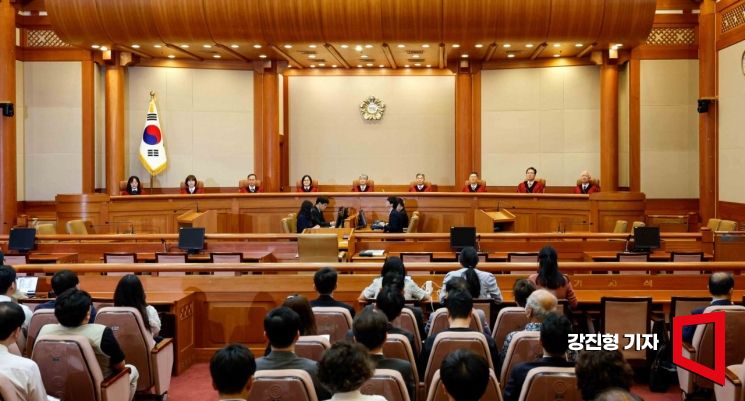
On the 18th, the Constitutional Court, with eight justices voting for constitutional inconsistency and one for partial unconstitutionality, declared Article 39, Paragraph 1 of the Act on External Audit of Stock Companies and Others to be unconstitutional. According to the court’s decision, the current provision will remain effective only until December 31, 2025. If the National Assembly does not amend the law by then, it will lose its effect.
The current law stipulates that if false financial statements are prepared or disclosed during accounting work, or if there are omissions or false entries in the audit report, the offender shall be punished by imprisonment for up to 10 years or a fine. The fine amount is set at no less than twice and no more than five times the profit gained or loss avoided through the violation.
However, there is no separate upper limit on fines in cases where there is no profit or avoided loss, or when it is difficult to calculate them. The Constitutional Court viewed this as “resulting in the inability to impose a fine commensurate with the degree of violation and responsibility.” It further judged that “this prevents courts from imposing fines proportional to the nature and responsibility of the crime, violating the principle of proportionality between responsibility and punishment.”
However, the court set the deadline for legislative amendment by the National Assembly to the end of next year, stating that “simply declaring it unconstitutional and retroactively nullifying its effect would create a legal vacuum.”
Meanwhile, Justice Eun-Ae Lee expressed a partial unconstitutionality opinion, stating, “When the Constitutional Court rules a criminal provision unconstitutional, it is preferable to declare it simply unconstitutional, thereby retroactively nullifying its effect and remedying the rights of the parties involved. In this case, even if it is declared simply unconstitutional, there is little risk of a legal vacuum as punishment can still be imposed under the Certified Public Accountant Act or the Capital Markets Act.”
© The Asia Business Daily(www.asiae.co.kr). All rights reserved.
![Clutching a Stolen Dior Bag, Saying "I Hate Being Poor but Real"... The Grotesque Con of a "Human Knockoff" [Slate]](https://cwcontent.asiae.co.kr/asiaresize/183/2026021902243444107_1771435474.jpg)
















