Google Korea Hosts 'Safer with Google' Event
"A cyberattack only needs to succeed once, but defense must be perfect at every moment?this is the 'defender's dilemma.' Artificial Intelligence (AI) presents an opportunity to resolve this dilemma and secure an advantage for defenders."
On the 18th, Amanda Walker, Head of Security and Privacy Research and Development at Google, made these remarks at the 'Safer with Google' media event held at the JW Marriott Hotel in Seocho-gu, Seoul.
Now in its third year, Safer with Google is a platform to share issues aimed at creating a safer online environment. This year's event focused on security and privacy issues related to AI technology.
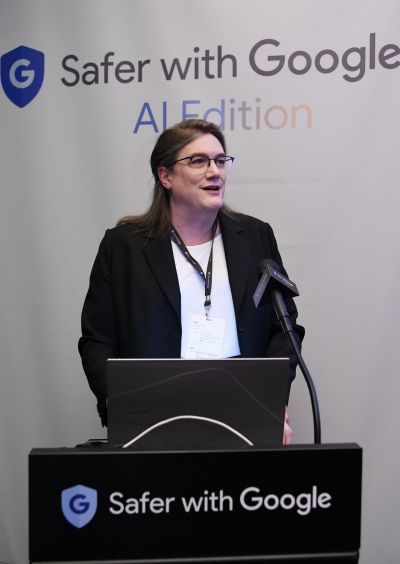 Amanda Walker, Head of Security and Privacy Research and Development at Google
 Photo by Google Korea
According to Google Trends search analysis, South Korea was the country that searched the keywords 'phishing,' 'malware,' and 'ransomware' the most in 2023. It was also among the top 10 countries worldwide that searched for 'fraud' the most last year. Phishing refers to attacks that lure victims to malicious websites via emails or text messages. Malware is malicious software, and ransomware is a type of malware that encrypts data and demands a ransom.
During the same period, interest in security-related topics reached its highest level in 13 years. This indicates that concerns and interest in cybersecurity are increasing alongside AI technology development. Walker noted, "Although this is a global trend, security threats such as phishing attacks have notably increased in the Asia-Pacific region."
This also illustrates the 'duality' of AI. While AI accelerates the detection of cyberattacks, it can also serve as a tool that aids attackers. Jin Kwak, a professor in the Department of Cybersecurity at Ajou University, explained, "Even without extensive hacking knowledge, attackers can use AI to enhance crude code and easily obtain attack tools. Conversely, defenders find it difficult to protect themselves without AI technology."
The imbalance in security personnel is another major issue. While new security threats emerge daily due to AI advancements, the supply of security professionals does not meet the demand. Walker emphasized, "Especially small and medium-sized enterprises find it difficult to build AI security teams. Even if they have personnel, acquiring the skills to respond to new attacks is challenging."
In response, Google is simultaneously investing in research and education on security technologies. Last year, Google conducted cybersecurity and AI education for 4,000 developers, corporate employees, and teachers in South Korea.
On the other hand, Google is leveraging AI technology to help general users engage in safe online activities. For example, Gmail filters about 10 million spam emails per minute using AI-based spam filtering. Using machine learning (ML), it blocks 99% of spam emails worldwide daily and prevents over 100 million phishing attempts. Google Search blocks more than 40 billion spam sites daily in its search results.
Kim Kyung-hoon, President of Google Korea, stated, "Google is committed to responsible AI development," and emphasized, "Building a safe and sustainable internet environment requires the cooperation of all members of the AI ecosystem."
Meanwhile, during the afternoon session of the event, key stakeholders and AI experts?including Kang Do-hyun, 2nd Vice Minister of the Ministry of Science and ICT; Won Yoo-jae, Honorary President of the Korea Institute of Information Security & Cryptology; Walker; and President Kim?will share insights on security technologies in the AI era. Discussions will also cover generative AI usage guidelines and approaches for safe AI. Following this, track sessions will be organized by cloud, developers, startups, and research sectors to provide practical insights that professionals can apply in their work and research fields.
© The Asia Business Daily(www.asiae.co.kr). All rights reserved.
![Clutching a Stolen Dior Bag, Saying "I Hate Being Poor but Real"... The Grotesque Con of a "Human Knockoff" [Slate]](https://cwcontent.asiae.co.kr/asiaresize/183/2026021902243444107_1771435474.jpg)















