Few Applicants Expected for September Residency Recruitment
"Government Guidelines Needed for Hospital-Level Preparation"
The government reiterated that it will proceed smoothly with the recruitment schedule for new residents in the second half of the year after finalizing the scale of resident vacancies at each training hospital. However, due to strong opposition from the medical community regarding the blanket resignation processing of existing residents, only a very small number of resigning residents are expected to apply for the September resident recruitment starting on the 22nd. Training hospitals agreed that they need specific guidelines from the government policy to prepare at the individual hospital level.
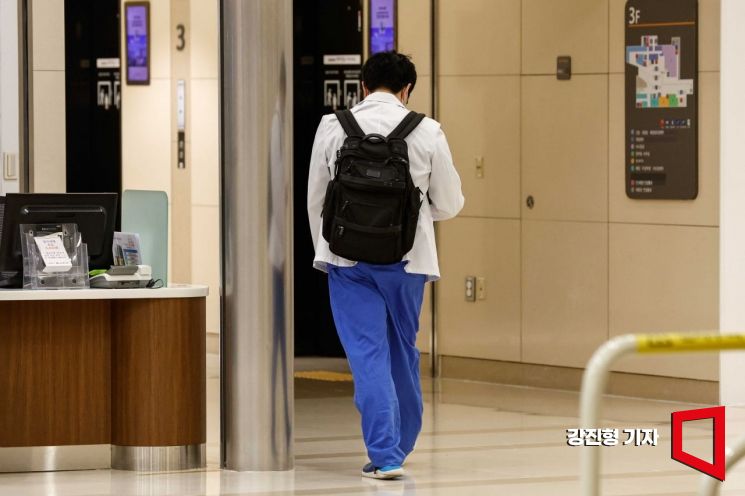 A doctor is walking through the lobby of a large hospital in Seoul. Photo by Jinhyung Kang aymsdream@
On the 18th, the government announced at the Central Disaster and Safety Countermeasure Headquarters (CDSCH) briefing on doctors' collective action that successful candidates for the second half resident recruitment will start work on September 1. Applications will be accepted from the 22nd until the end of this month, and written and practical exams will be held at each training hospital in August.
Previously, the government requested all training hospitals nationwide to complete the resignation procedures for residents by the 15th, finalize the number of residents to be recruited in the second half by hospital, and submit this to the Resident Training Environment Evaluation Committee under the Ministry of Health and Welfare by the 17th. It also stated that special exceptions would be applied to residents who return and those who take the training in September.
However, even if the second half resident recruitment schedule proceeds, the number of applicants is expected to be low because resigning residents are maintaining their stance not to return to the medical field. A resident, A, who submitted a resignation letter to a training hospital in Seoul, said, "I don't think many people are aiming for the fall turn (second half resident recruitment)," adding, "The important timing for accepting resignation letters for residents has not even been properly set."
Park Dan, Emergency Response Committee Chair of the Korean Intern Resident Association, also expressed regret toward hospital directors who succumbed to the massive power despite unreasonable policies and unconstitutional administrative orders regarding the acceptance of resignation letters by training hospitals through personal social media the day before. He stated, "We are preparing legal responses such as criminal complaints and civil lawsuits against hospital directors who violated residents' labor rights by delaying severance pay and obstructing employment at other institutions."
Medical school professors also hold negative views on the processing of existing residents' resignations and the recruitment of new residents in the second half. The Korean Medical School Professors Association, the Korean Medical School Emergency Response Committee, and representatives of professors from 40 medical school training hospitals issued a statement on the 16th, saying, "The timing for processing and accepting resignation letters should not be unilaterally decided but determined after sufficient discussion with the individual residents," and warned, "Following the trickery in this second half resident recruitment process may inadvertently alienate affiliated residents from training hospitals, leading to a fatal mistake that causes the collapse of essential medical care."
With few residents expected to apply for the second half recruitment, hospitals say they have no proper countermeasures. A representative from multiple Big 5 hospitals (Seoul National University, Samsung Seoul, Seoul Asan, Seoul St. Mary's, Severance Hospitals) said, "Due to the structure of the hospital industry, there is not much that individual hospitals can prepare for," adding, "We have no choice but to follow the government's direction."
There are also opinions that it is urgent to specify related policies so that training hospitals can fill medical gaps through structural transitions of tertiary general hospitals according to government plans. The government's 'Tertiary General Hospital Structural Transition Pilot Project' aims to reduce general beds by up to 15% and increase the proportion of intensive care patients to over 50%, allowing tertiary general hospitals to focus on treating severe emergency patients and research.
A representative from one of the Big 5 hospitals said, "There are definitely parts where the idea of focusing on severe cases does not match reality, and the government has no choice but to provide guidelines on these parts," adding, "As the Korean Stroke Society recently stated, policies related to severe and emergency medical care, such as revising the patient classification system (KDRG), need to be specified for individual hospitals to prepare."
Previously, the Korean Stroke Society expressed concern that if the current patient classification system for stroke is not changed, most stroke patients may not be treated at tertiary general hospitals. This is because, under the current classification system, most stroke patients, who are severe and emergency cases, are classified under general treatment disease groups.
© The Asia Business Daily(www.asiae.co.kr). All rights reserved.
![Clutching a Stolen Dior Bag, Saying "I Hate Being Poor but Real"... The Grotesque Con of a "Human Knockoff" [Slate]](https://cwcontent.asiae.co.kr/asiaresize/183/2026021902243444107_1771435474.jpg)
















