Increased Possibility of Implementing Computers Without Quantum Error Correction, Published in Science Advances
A research team has found that a quantum spin liquid, a key material for next-generation quantum computing, can be realized in cobalt-based honeycomb structured oxides.
The joint research team led by Professor Son Changhee from the Department of Physics at UNIST (President Park Jongrae) and Professor Kim Heungsik from the Department of Semiconductor Physics at Kangwon National University (President Chung Jaeyeon) succeeded in increasing quantum fluctuations in cobalt-based honeycomb structured oxides. This is the world's first confirmation of the feasibility of realizing a quantum spin liquid.
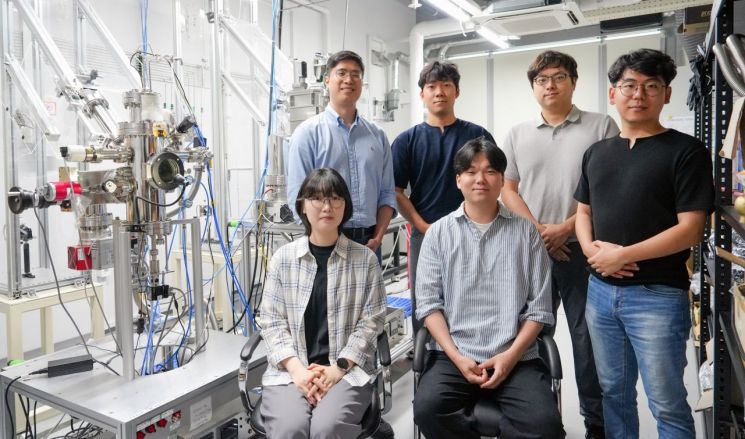 UNIST research team. (From the second row, counterclockwise from the left: Professor Changhee Son, Researcher Miju Park, Researcher Kyehyun Kim)
In ordinary magnets, the spins of electrons align as the temperature drops, similar to how water turns into ice. However, in a quantum spin liquid, the spins do not align even at extremely low temperatures and remain in a liquid state. This new state of matter could accelerate the development of ultrafast quantum computers and innovative communication technologies.
The research team fabricated cobalt-based honeycomb structured oxides into thin films and successfully controlled the distortion of the crystal structure. By increasing quantum fluctuations, they reduced the spin alignment temperature to less than half. This proves that controlling lattice distortion is a key variable in increasing quantum fluctuations.
Professor Philip Anderson, who won the Nobel Prize in Physics in 1973, proposed the possibility of the existence of quantum spin liquids, but realizing them has not been easy. Most candidate materials for quantum spin liquids lack strong quantum fluctuations, making it difficult to suppress spin alignment.
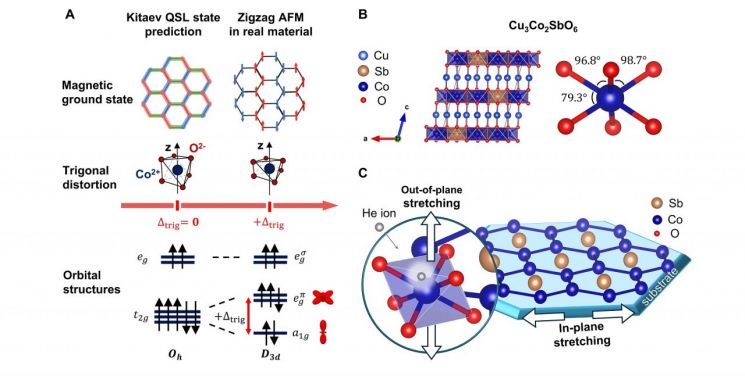 Schematic diagram of thin-film heterostructure engineering of a candidate material for quantum spin liquid state.
Professor Son Changhee explained, "This study shows that thin film structures can effectively control the spin interactions in candidate materials for quantum spin liquids. If a quantum spin liquid can be realized in thin film form, it could enable the implementation of topological quantum computers that do not require quantum error correction."
The results of this research were published online in Science Advances on July 5, 2024. The study was supported by the Ministry of Science and ICT, the National Research Foundation of Korea, and the Pohang Accelerator Laboratory.
© The Asia Business Daily(www.asiae.co.kr). All rights reserved.
![Clutching a Stolen Dior Bag, Saying "I Hate Being Poor but Real"... The Grotesque Con of a "Human Knockoff" [Slate]](https://cwcontent.asiae.co.kr/asiaresize/183/2026021902243444107_1771435474.jpg)
















