400-Year-Old Plaque... Returns from Japan After 30 Years
Japanese Researcher Murakami Tsuneo Donates Kanghang
Analects Xue Er Chapter "I Will Follow What I Like"
The calligraphic plaque personally written over 400 years ago by Joseon Dynasty Confucian scholar Sueun (睡隱) Kang Hang (姜沆) has returned to his hometown, Naesan Seowon in Yeonggwang, after 29 years in Japan, passing through former Prime Minister Lee Nak-yeon.
The donation ceremony for Kang Hang’s Jong-o Soho plaque was held at 3 p.m. on the 17th at Naesan Seowon in Bulgap-myeon, Yeonggwang-gun, Jeollanam-do. Naesan Seowon is the shrine dedicated to Kang Hang. A plaque (扁額) is a framed sign hung at the center top of a building or gate.
On this day, the ceremony honored the meaning left by the scholar over 400 years ago. The event was hosted by the Kang Hang Cultural Festival and the Yeonggwang Naesan Seowon Preservation Society, and organized by Gwangju University.
Former Prime Minister Lee Nak-yeon, who received the plaque from Japanese Kang Hang researcher Mr. Murakami Tsuneo, was joined by Sato Shinichiro, chairman of the Sueun Kang Hang Research Association in Japan; Kim Dong-jin, chairman of the Kang Hang Memorial Project Association (President of Gwangju University); and Kang Jae-won, chairman of the Naesan Seowon Preservation Society. Local Confucian scholars from Gwangju Hyanggyo, Yeonggwang Hyanggyo, and Iheung Seowon, as well as elementary, middle, and high school students from Yeonggwang, also attended.
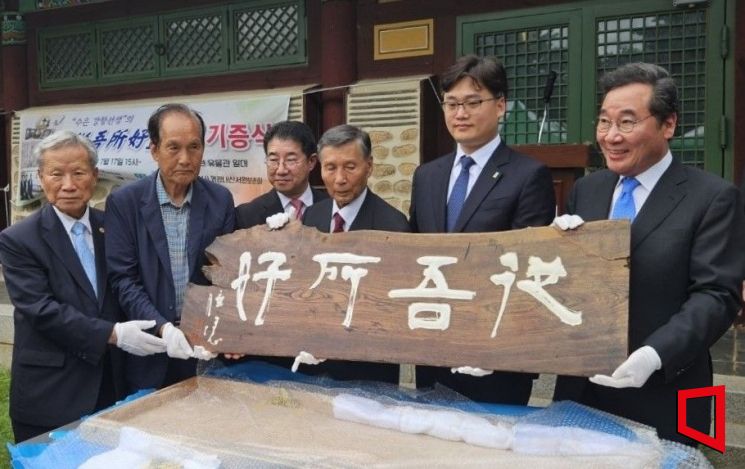 On the 17th, the 'Jongo Soho (從吾所好) plaque' handwritten by Seok Ganghang, who lived over 400 years ago, returned to Korea from Japan after 30 years at Naesan Seowon in Bulgap-myeon, Yeonggwang-gun, Jeollanam-do.
 [Photo by Kim Geonwan yacht@]
The returned plaque measures 1.5 meters in length and 55 centimeters in width, weighing 27 kilograms. It is known that Kang Hang wrote it for someone in the Kang family clan while living in Yeonggwang until 1618, after completing his detention in Japan from 1597 to 1600.
The recipient hung the plaque on the front of the family shrine and preserved it for generations, but around 1950, the shrine deteriorated and collapsed, damaging the plaque. It is presumed that the plaque was later taken to Japan by a collector, though the details of this process remain unclear.
Mr. Murakami Tsuneo (村上恒夫, age 90), a Japanese Kang Hang researcher and former public official of Ozu City Hall, received the plaque in August 1995, repaired and preserved it. Considering his health, Mr. Murakami donated the plaque to former Prime Minister Lee Nak-yeon on May 23. The plaque returned to Korea on June 27 via Incheon Customs.
Kang Hang was a Confucian scholar and militia leader from Yeonggwang, Jeollanam-do. During the Japanese invasions of Korea (1592?1598), he was taken to Japan and spread Confucianism in the Ozu and Kyoto regions, earning the title "Father of Japanese Neo-Confucianism."
The inscription on the plaque, Jong-o Soho (從吾所好), is a saying from Confucius in the Analects, Xue Er chapter, meaning "to follow what one likes." It expresses, "If pursuing wealth is worthwhile, even if it means becoming a man who holds a horsewhip, I would do so; but if it is not worthwhile, I will follow what I like."
The phrase is also interpreted as "It is valuable to act in ways where thought and mind lead and the body willingly follows," indicating a guiding principle for modern society.
Former Prime Minister Lee Nak-yeon said, "The plaque returning to its hometown will contribute to domestic and international academic research honoring Kang Hang and provide great teachings to future scholars. I hope it will also greatly aid cultural exchange between Korea and Japan."
© The Asia Business Daily(www.asiae.co.kr). All rights reserved.
![Clutching a Stolen Dior Bag, Saying "I Hate Being Poor but Real"... The Grotesque Con of a "Human Knockoff" [Slate]](https://cwcontent.asiae.co.kr/asiaresize/183/2026021902243444107_1771435474.jpg)















