"US to Strengthen Sanctions if Netherlands and Japan Continue Trade with China"
Trump Also Says "Taiwan Takes All US Semiconductors"
New York Fed President Says "Disinflation Trend"
Market Prices in September Rate Cut as a Given
The three major indices of the U.S. New York stock market showed mixed trends in early trading on the 17th (local time). Technology stocks plummeted following news that the U.S. government is considering strong trade restrictions on allied companies in the Netherlands, Japan, and other countries to block China's access to advanced semiconductor technology.
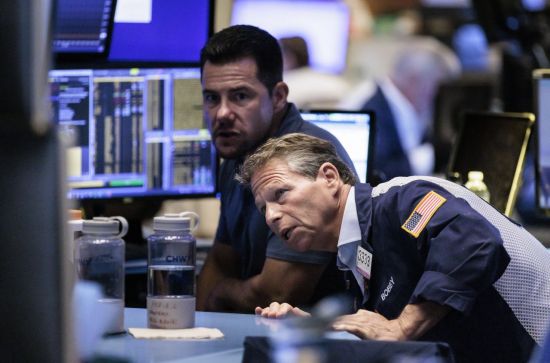
As of 9:50 a.m. at the New York Stock Exchange (NYSE) on the day, the Dow Jones Industrial Average was up 0.1% from the previous close, standing at 40,996.44. The large-cap focused S&P 500 index was down 0.92% at 5,614.79, and the tech-heavy Nasdaq index was trading 1.73% lower at 18,189.69.
By individual stocks, semiconductor-related shares were uniformly weak. Dutch semiconductor equipment maker ASML plunged 9.67%. Taiwan's TSMC was down 6.63%. Nvidia fell 4.5%, while Qualcomm and Broadcom dropped 6.13% and 5.42%, respectively. Other tech stocks also declined together. Apple was down 2.55%, Tesla fell 0.66%, and Microsoft (MS) dropped 1.21%.
Investor sentiment toward technology stocks deteriorated as news spread that the Biden administration would strengthen trade restrictions if semiconductor companies in the Netherlands and Japan continue transactions with China. According to Bloomberg News, the U.S. informed allied officials that if companies such as the Netherlands' ASML and Japan's Tokyo Electron continue to allow China access to semiconductor technology, the U.S. may take additional measures. Among the measures under consideration is the Foreign Direct Product Rule (FDPR), which requires U.S. government approval for exports if U.S.-origin software, equipment, or technology is used even partially in products made abroad.
Comments made by former President Donald Trump, the Republican candidate in the upcoming November U.S. presidential election, targeting Taiwan in an interview with Bloomberg News the previous day, also weighed on semiconductor stocks. Trump stated that Taiwan should share defense costs with the U.S. for its own defense. He criticized the Biden administration's Semiconductor Support Act (CSA), which provides subsidies to overseas companies including those in Taiwan. Trump said, "Taiwan has taken all our semiconductor business," adding, "We are currently giving billions of dollars to have Taiwan build new semiconductor factories in our country, and while they will build them here, they will eventually take them back to their own country."
Earlier that morning, remarks from a Federal Reserve (Fed) official suggesting a rate cut in September were also released. John Williams, President of the Federal Reserve Bank of New York, told the Wall Street Journal (WSJ) in an interview that recent inflation indicators over the past three months show that "we are getting closer to the disinflation trend (slowing price increases) we are looking for," calling it a "positive signal." He added, "I want to see more data that gives additional confidence that inflation is sustainably moving toward the 2% target." This aligns with Fed Chair Jerome Powell's statement on the 15th that "confidence is growing that inflation is coming down to 2%." However, in the interview released the previous day, former President Trump expressed the view that the Fed should not cut rates before the November election.
Nevertheless, the market is pricing in a September rate cut as a given. According to the Chicago Mercantile Exchange (CME) FedWatch tool on the day, the federal funds futures market fully reflects a 100% probability that the Fed will cut rates by at least 0.25 percentage points at the September Federal Open Market Committee (FOMC) meeting. The probability of a cut of 0.5 percentage points or more in November is 61.8%.
U.S. Treasury yields rose slightly. The 10-year U.S. Treasury yield, a global bond yield benchmark, increased by 1 basis point (1 bp = 0.01 percentage points) to 4.17%, while the 2-year Treasury yield, sensitive to monetary policy, rose 2 basis points to around 4.46%.
International oil prices rose on a decline in U.S. crude oil inventories. West Texas Intermediate (WTI) crude oil increased by $0.75 (0.9%) to $81.51 per barrel, and Brent crude, the global oil price benchmark, rose $0.55 (0.7%) to $84.28 per barrel.
© The Asia Business Daily(www.asiae.co.kr). All rights reserved.
![Clutching a Stolen Dior Bag, Saying "I Hate Being Poor but Real"... The Grotesque Con of a "Human Knockoff" [Slate]](https://cwcontent.asiae.co.kr/asiaresize/183/2026021902243444107_1771435474.jpg)















