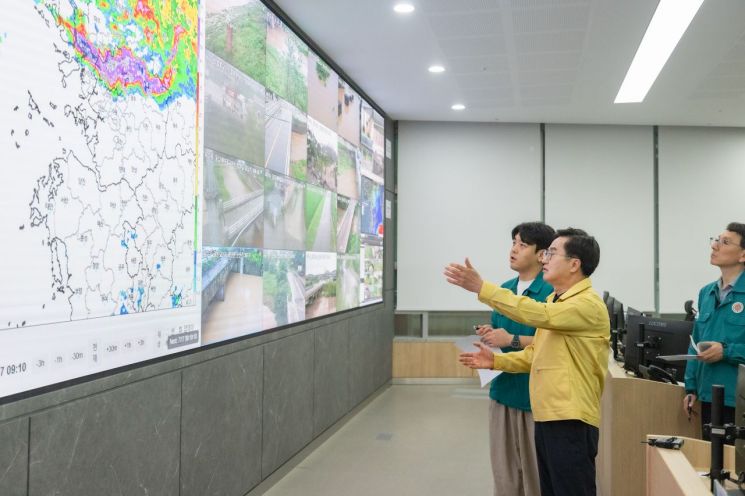
 Gyeonggi Province Governor Kim Dong-yeon visited the Disaster Safety Situation Room on the 17th to encourage the officials and receive a briefing on the current status from them.
Kim Dong-yeon, Governor of Gyeonggi Province, visited the 'Disaster Safety Situation Room' on the morning of the 17th amid heavy rainfall mainly in the northern Gyeonggi region, encouraging officials and urging them to actively protect the lives and safety of residents during the rainy season.
Governor Kim said, "The rainy season is getting longer, and localized heavy rains are occurring repeatedly in short bursts. Due to climate change, natural disasters are also occurring in new forms. A change in the disaster response paradigm that breaks the existing framework is necessary." He encouraged, "Let us not let our guard down so that we can properly respond to weakened ground or retaining wall collapses caused by the prolonged rainy season."
He added, "Our primary duty is to protect the lives and safety of the residents," and urged, "Please continue to be vigilant and not neglect caution and alertness."
According to the Korea Meteorological Administration, the cumulative rainfall from 12 PM on the 16th to 2 PM on the 17th was 358.5 mm at Panmunjom (Paju), 208.0 mm at Baekhak (Yeoncheon), 202.0 mm at Changhyeon (Namyangju), and 201.5 mm at Sangpae (Dongducheon), among others.
On the morning of the 17th, heavy rain warnings were issued for 13 locations in Gyeonggi Province, including Yeoncheon, Paju, Pocheon, Dongducheon, Yangju, Gapyeong, Uijeongbu, Namyangju, Hanam, Yangpyeong, Bucheon, Guri, and Goyang, while heavy rain advisories were issued for 7 locations including Gimpo, Gwangmyeong, Gwacheon, Siheung, Seongnam, Anyang, and Gwangju.
Earlier, Gyeonggi Province activated Emergency Level 1 of the Disaster Safety Countermeasures Headquarters from 9 PM on the 16th, taking preemptive measures against the heavy rain.
Governor Kim issued special instructions on the 17th following the full-scale response led by deputy heads, including: ▲ ensuring thorough safety management with prompt emergency recovery in areas affected by heavy rain to prevent additional damage ▲ conducting urgent monitoring and inspections to address concerns such as landslides, steep slopes, retaining walls, embankments, and construction site collapses due to weakened ground from heavy rainfall ▲ actively implementing pre-evacuation before sunset for residents in landslide-prone areas, semi-basement houses, and mountainous regions to village halls, shelters, relatives’ homes, or lodging facilities to prevent casualties ▲ and thoroughly conducting patrols and management to prevent damage in border areas and around the Imjin River, considering the heavy rainfall in North Korea.
© The Asia Business Daily(www.asiae.co.kr). All rights reserved.
![Clutching a Stolen Dior Bag, Saying "I Hate Being Poor but Real"... The Grotesque Con of a "Human Knockoff" [Slate]](https://cwcontent.asiae.co.kr/asiaresize/183/2026021902243444107_1771435474.jpg)
















