Last Year Drive American Act Proposed
ExxonMobil, Chevron Stock Rise... Solar Companies Decline
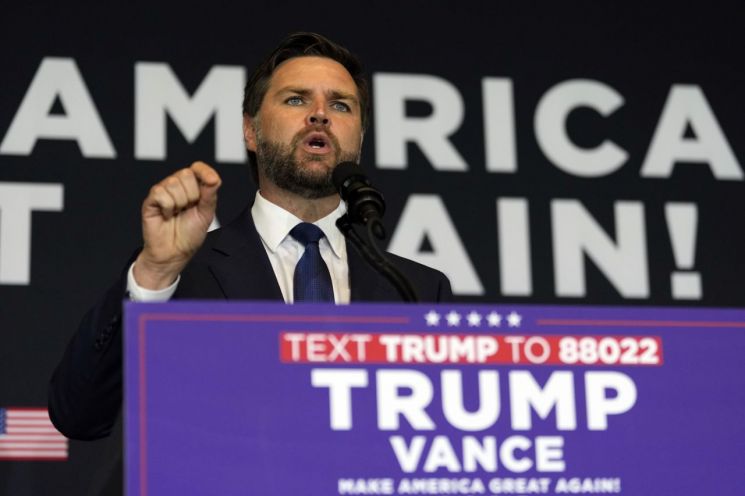 Republican vice presidential candidate and Ohio Senator J.D. Vance is giving a speech at a fundraising event held at the Discovery World Science and Technology Museum in Milwaukee on the 17th (local time). Photo by AP Associated Press [Image source=AP Yonhap News]
Following the assassination attempt, former President Donald Trump’s selection of Senator James David (J.D.) Vance as his vice-presidential candidate has once again stirred the global energy industry. Trump has been a strong critic of President Joe Biden’s green policies, such as solar and wind energy, and Senator Vance is equally hardline. Concerns are growing that if Trump returns to power, environmentally friendly energy policies, including those for electric vehicles, could be rolled back.
According to Bloomberg on the 17th (local time), Senator Vance introduced the so-called “Drive American Act” in September 2023. This bill proposes abolishing the up to $7,500 electric vehicle purchase subsidies implemented under Biden’s Inflation Reduction Act (IRA) and instead offers tax credits for gasoline or diesel internal combustion engine vehicles produced in the United States.
Earlier, just before the IRA was passed in July 2022, Vance appeared on a radio show and criticized, saying, “All electric vehicles are a scam,” adding, “When you plug into the wall, do people think that the Kibler fairies are generating electricity behind the wall? Of course, that (electricity) comes from fossil fuels.”
Senator Vance’s views align closely with those of former President Trump, who has openly called for the repeal of the IRA. Consequently, there are concerns that if Trump is re-elected and Vance becomes vice president, U.S. energy policies, including those on electric vehicles, could change drastically.
Environmental and energy policies are the areas where former President Trump most distinctly differentiates himself from President Biden. According to Trump’s “Agenda 47” released late last year, he proposed “saving the American automotive industry from Joe Biden’s radical Green New Deal” and pledged to repeal mandatory electric vehicle policies.
Trump also declared, “We will provide the cheapest energy and electricity on Earth to America,” pledging to develop affordable energy sources such as U.S. oil, natural gas, nuclear power, clean coal, and hydropower. He emphasized modernizing power lines and building new power plants to enable future manufacturing plants, data centers, and semiconductor facilities to be constructed in the U.S.
These pledges are interpreted as targeting workers in traditional automotive and oil industries who fear job losses due to Biden’s aggressively promoted green policies. The views of former President Trump and Vice Presidential candidate Vance represent not just personal opinions but the broader sentiment of the American conservative base.
The Heritage Foundation, a leading conservative think tank in the U.S., stated in its 2023 publication “Mandate for Leadership 2025: The Conservative Promise” that “the next administration should repeal the Infrastructure Investment and Jobs Act (IIJA) and the IRA.” It also urged the U.S. Department of Energy (DOE) to accelerate energy security and restoration and called on the Nuclear Regulatory Commission to support private nuclear innovation and facility construction.
Changes in U.S. energy policy are expected to significantly impact the domestic electric vehicle and battery industries. Recently, the Korea Institute for Industrial Economics and Trade analyzed the impact by industry under a Trump administration scenario, noting, “Although Trump pledged to repeal the IRA if re-elected, many IRA beneficiary regions in the U.S. are Republican strongholds, so considering vested interests, it is more likely that support will be reduced through executive authority rather than full repeal.” They forecast that the transition to electric vehicles will slow, but demand for Korean-made parts could increase due to the exclusion of China from supply chains.
Analyst Han Byung-hwa of Eugene Investment & Securities recently lowered U.S. electric vehicle sales estimates by 9-12% and advised, “If Trump is elected, electric vehicle sales could decline further during his term. It is advisable to avoid high-valuation stocks and invest mid- to long-term in stocks with less downside risk.”
As the possibility of Trump’s return to power grows, stock market trends in the U.S. are rapidly shifting. Traditional oil companies like ExxonMobil and Chevron are seeing their stock prices rise, while solar companies such as First Solar and SolarEdge are weakening. Tesla, despite being an electric vehicle company, has recently risen following reports that CEO Elon Musk plans to donate $45 million monthly to Trump’s campaign.
© The Asia Business Daily(www.asiae.co.kr). All rights reserved.

















