Integration Committee Repeatedly Recommends 'Change the Name'
Preference for 'Bukbaekjungmin' Only 2-3%, Not Reflected
Unification Ministry: "Public Consensus Important, Focus on Policy Efforts First"
The Presidential Committee for National Integration has repeatedly sparked controversy by proposing to change the term for North Korean defectors to 'Bukbaegyeong Jumin' (North Background Residents). Despite a national research institute survey showing that this term has the lowest preference, the committee continues to push for the change without reflecting the results. Critics argue that equating North Korean defectors with naturalized foreigners could pave the way for recognizing North Korea as a state in the future.
According to a comprehensive report by Asia Economy on the 17th, the Integration Committee commissioned the Korea Institute for National Unification in March this year to conduct a study titled 'Research on Development Plans for Supporting the Settlement of Bukbaegyeong Jumin.' This was shortly after the launch of the 'Special Committee for Accompanying Bukbaegyeong Jumin.' In the study, only 2-3% favored 'Bukbaegyeong Jumin' as an alternative term for North Korean defectors, and these results were reported to the Integration Committee in early last month. An insider from the committee said, "We conducted a perception survey to establish grounds for the change, but received results showing that Bukbaegyeong Jumin had the lowest preference. Since it did not rank, we did not announce it separately and are pushing ahead."
Why Keep Proposing 'Bukbaegyeong Jumin' Despite Lowest Preference?
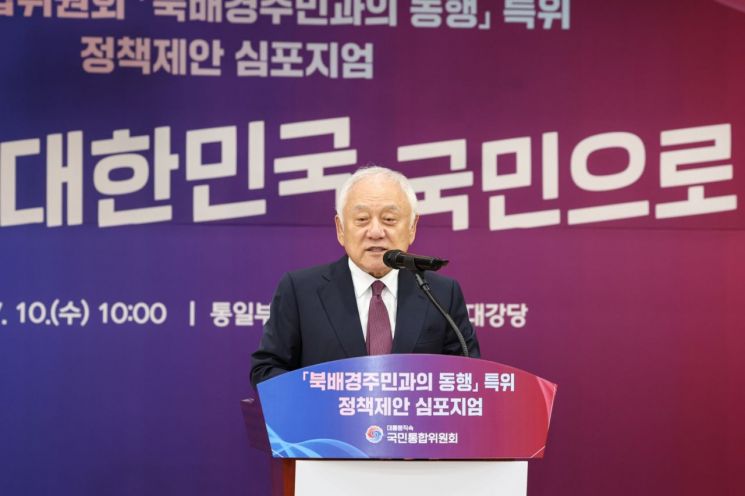 Kim Han-gil, Chairman of the National Integration Committee, is speaking at the policy proposal symposium "Walking Together with North Korean Residents" held on the 10th at the Ministry of Unification's North-South Integration Culture Center in Gangseo-gu, Seoul.
 [Photo by Ministry of Unification]
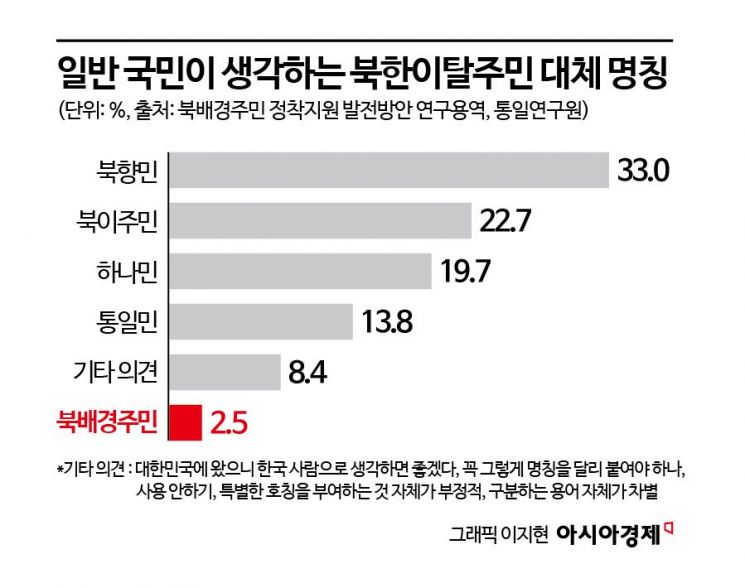
According to partially disclosed data from the Korea Institute for National Unification, perception surveys were conducted with 500 general citizens aged 18 and over and 505 North Korean defectors. When asked about the appropriateness of the term for defectors, general public opinions were divided between appropriate (45.0%) and inappropriate (40.8%). Among respondents who said 'inappropriate,' alternative terms were presented in order: Bukbaegyeong Jumin, Bukijumin (North Migrants), Bukhyangmin (Northbound People), Hanamin, and Tongilmin (Unification People). Bukhyangmin received the highest selection at 33.0%, while Bukbaegyeong Jumin scored only 2.5%, lower than the 'other terms' category.
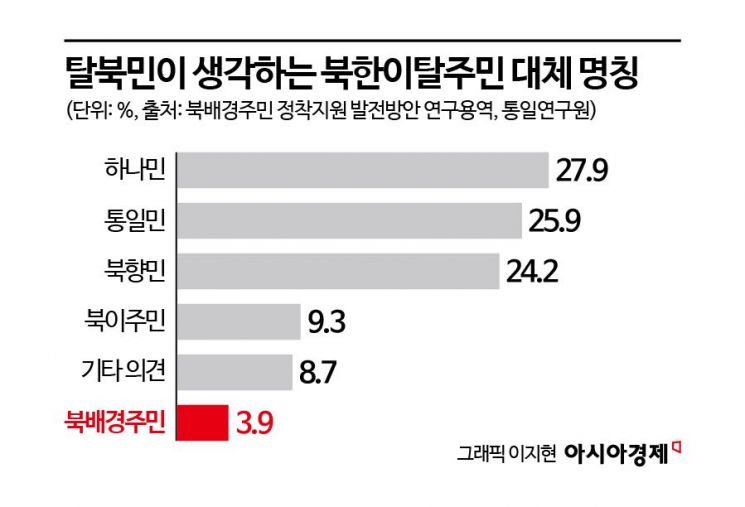
The institute also asked defectors who wanted a name change (58.9%) the same question. Hanamin (27.9%) and Tongilmin (25.9%) were preferred, while Bukbaegyeong Jumin again scored only 3.9%, lower than other suggestions. General citizens who participated in the survey also criticized with comments such as 'Since they came to the Republic of Korea, it would be better to consider them Korean,' 'Is it really necessary to label them differently?' 'Do not use,' 'Assigning special titles is negative,' and 'The very use of distinguishing terms is discriminatory.'
However, Kim Han-gil, chairman of the National Integration Committee, and the committee reiterated the use of 'Bukbaegyeong Jumin' at the policy proposal symposium of the Special Committee for Accompanying Bukbaegyeong Jumin held on the 10th of this month. Nominally, both 'Bukbaegyeong Jumin' and 'Talbuk Gukmin' (North Korean Defector Citizens) are used together, but 'Talbuk Gukmin' was not reflected in the research commissioned by the committee.
The committee cited the term 'Ijubaegyeong Jumin' (migratory background residents) as a similar case to encompass 'children born in third countries.' Under current law, children born in China or elsewhere while their parents defected from North Korea are not recognized as defectors, placing them in a policy blind spot. Some argue that applying a term generally used for naturalized foreigners to North Korean defectors violates the constitution.
Professor Kang Dong-wan of Dong-A University’s Department of Political Science and Diplomacy criticized, "The proposal to change the term to Bukbaegyeong Jumin at the time when the government established 'North Korean Defectors Day' is a discordant and redundant move. It seriously damages the identity of defectors and has a discriminatory nature, creating yet another form of distinction." He added, "Such attempts cause social confusion and conflict rather than integration, representing an anti-unification behavior."
'Criticism of Reinforcing Discrimination'... Government Says 'Public Consensus Is Important'
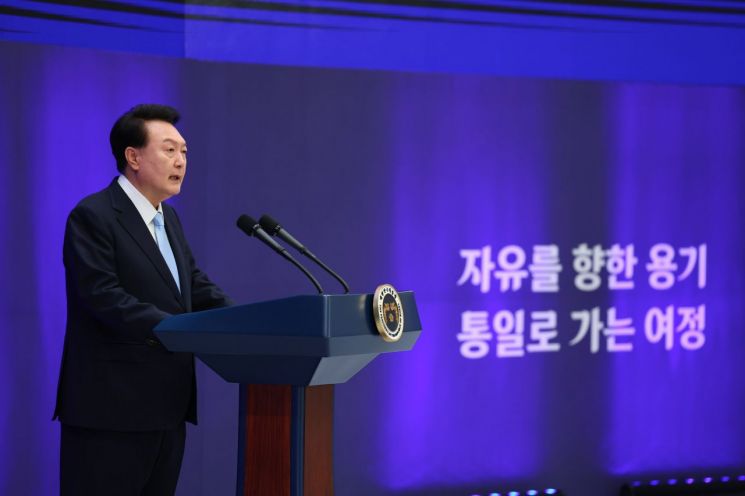 President Yoon Suk-yeol delivers a commemorative speech at the '1st Day of North Korean Defectors Commemoration Ceremony' held at the Blue House State Guest House on the 14th. Photo by Presidential Office Press Photographers Group [Image source=Yonhap News]
Similar incidents occurred during the Roh Moo-hyun administration. In July 2004, Jeong Dong-young was appointed Minister of Unification, and a public hearing in September that year showed low preference for the term 'Saeteomin' (New Settlers). However, the government ignored opposition and officially adopted it as a replacement term from January 2005. It was only after the Lee Myung-bak administration took office in 2008 that the government accepted criticism that the term did not fully encompass all defectors and officially used 'Bukhan Ital Jumin' (North Korean Defectors).
Lee Young-hwan, former head of the Transitional Justice Working Group (TJWG), said, "The 'proposal' from the Presidential Committee means a 'recommendation to the government.' It is procedurally problematic to ignore the survey results and push ahead because the desired outcome was not achieved." He added, "The president showed determination by establishing 'North Korean Defectors Day,' but isn't this having the opposite effect? I hope the presidential office looks into the matter and corrects it."
A high-ranking defector who requested anonymity said, "Negative perceptions of defectors are not just about the word itself but involve various social and political factors. Many defectors still take pride in the term 탈 (Tal), meaning 'to escape,' as it reflects their voluntary departure from North Korea in search of freedom." He urged, "Please carefully consider how much impact and shock a single term defining a group can cause."
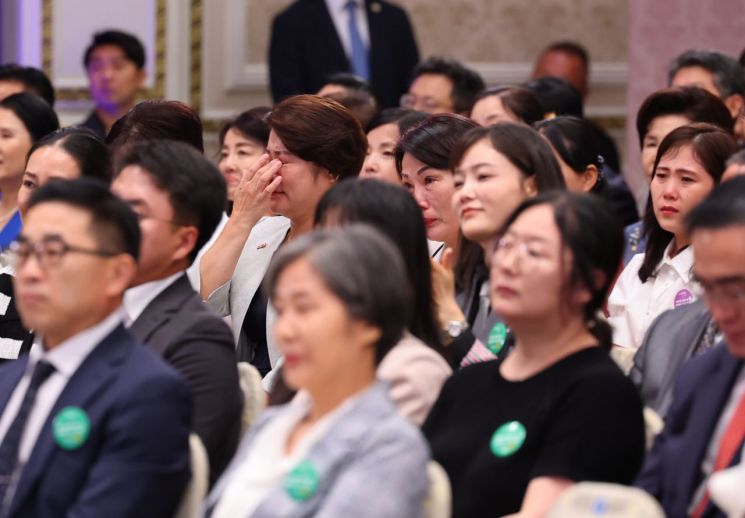 On the 14th, North Korean defectors attending the '1st North Korean Defectors Day Commemoration Ceremony' held at the Blue House State Guesthouse were moved to tears while listening to President Yoon Suk-yeol's commemorative speech. Photo by Presidential Office Press Photographers Group [Image source=Yonhap News]
An official from the Integration Committee said, "We proposed that the Ministry of Unification review new terms that can reflect the identity of defectors, and 'Bukbaegyeong Jumin' and 'Talbuk Gukmin' are just examples. We believe the Ministry of Unification will select a term that well expresses the identity after gathering opinions from the concerned parties."
A Ministry of Unification official commented on the Integration Committee's proposal to change the term to 'Bukbaegyeong Jumin,' saying, "The committee has also explained that public consensus is most important regarding terminology." The official added, "The government believes that to spread positive perceptions of defectors, it is crucial to strengthen policy efforts such as discovering various success stories, social contribution activities, and promoting a culture of integration between South and North Korean residents."
© The Asia Business Daily(www.asiae.co.kr). All rights reserved.
![Clutching a Stolen Dior Bag, Saying "I Hate Being Poor but Real"... The Grotesque Con of a "Human Knockoff" [Slate]](https://cwcontent.asiae.co.kr/asiaresize/183/2026021902243444107_1771435474.jpg)


















