Researchers from 63 Countries Analyze Impact of Message Interventions on Behavior Change
High Climate Change Awareness, but Little Behavioral Change... Published in Science Advances
Behavioral scientists around the world have taken action to address climate change.
A research team led by Professor Jeong Dongil from the Department of Biomedical Engineering at UNIST (President: Park Jongrae) and Professor Seol Sunhye from the Department of Psychology at Pusan National University (President: Choi Jaewon), together with 255 international researchers from 63 countries, analyzed perceptions of and behavioral changes regarding climate change.

The international research team investigated how 11 psychological messages influence public perception and behavior regarding climate change. The messages included themes such as a dark future caused by climate change, scientific consensus, concerns of others, and impacts on future generations.
According to the analysis, messages emphasizing a dark future were effective for sharing information on the internet and social media, but did not influence policy support or changes in personal beliefs. In fact, such negative messaging led to adverse outcomes in activities like tree-planting campaigns. The study demonstrated that negative messages can induce helplessness and hinder behavioral change.
The research team confirmed that motivating behavioral change regarding climate change is a difficult task. They faced challenges in inducing actual behavioral change even with other types of messages. People responded differently to various climate messages, and reactions varied from country to country.
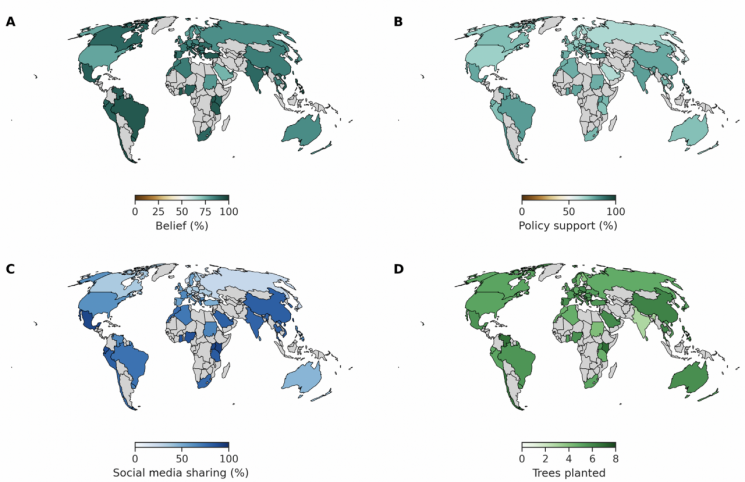
The study showed that there is no universal solution for addressing the climate crisis. However, understanding how each message works and in which contexts it is effective was found to be important. Scientists and policymakers need to design messages tailored to each specific audience.
Professor Jeong Dongil stated, "Through this research, we were able to understand message strategies that lead to changes in perception and behavior regarding climate change," and added, "Research and policy must continue to move forward together in the effort to address climate change."
The research findings were published as a paper in Science Advances on February 7. The study was supported by the Social Science Korea (SSK) program of the National Research Foundation of Korea.
© The Asia Business Daily(www.asiae.co.kr). All rights reserved.
![Clutching a Stolen Dior Bag, Saying "I Hate Being Poor but Real"... The Grotesque Con of a "Human Knockoff" [Slate]](https://cwcontent.asiae.co.kr/asiaresize/183/2026021902243444107_1771435474.jpg)
















