Less Mutual Slander Than Last Broadcast Debate
All Oppose Special Prosecutor Law Demanded by Minjoo Party
Na, Won, Yoon "Party Stance Is to Demand Special Prosecutor If Investigation Is Inadequate"
Han "Proposal of Third-Party Special Prosecutor Law Changes the Game"
Na Kyung-won, Won Hee-ryong, and Yoon Sang-hyun, candidates for the People Power Party leadership, reignited their attacks on candidate Han Dong-hoon regarding the Chae Sang-byeong special prosecutor law and the comment team allegations during the broadcast debate on the 16th. However, compared to the previous broadcast debate where harsh words were exchanged over various policy discussions such as non-consensual rape and foreign voting rights, the level of slander was reduced. This appears to be due to the party leadership and the election commission's excessive warnings against defamatory remarks, as well as awareness of the violent incidents among supporters at the recent joint rally in Daejeon, Sejong, and Chungcheong.
During the third broadcast debate hosted by Channel A in the afternoon, candidate Won asked candidate Han whether he would accept the Chae Sang-byeong special prosecutor law. Han responded that the special prosecutor law proposed by the Democratic Party should never be accepted and said, "I actively support the president's veto power." When Won pressed again about the third-party special prosecutor law proposed by Han, Han replied, "Given the current situation and public sentiment, presenting such an alternative sends a message to the people that we are not passive or running away from veterans' affairs and security issues," adding, "I believe the situation has changed because I proposed a new alternative." When Won asked, "Shouldn't Han, who has nothing to hide, accept the Han Dong-hoon special prosecutor law?" Han countered, "Won is riding on the Democratic Party's groundless claims. Rather, Won's attitude is the problem."
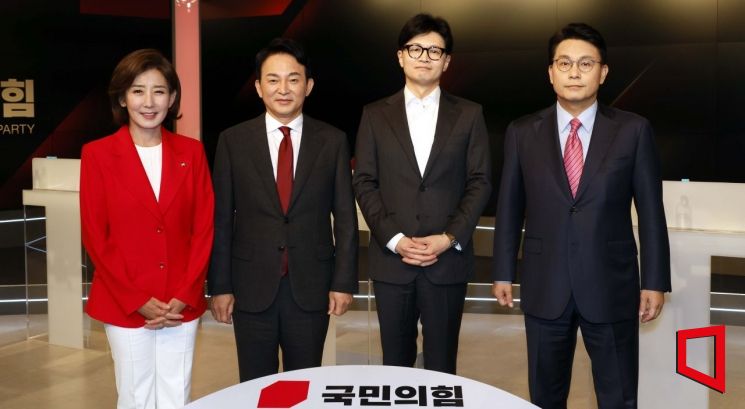 Na Kyung-won, Won Hee-ryong, Han Dong-hoon, and Yoon Sang-hyun, four candidates for the People Power Party leadership, are taking a commemorative photo on the 11th at the MBN studio in Jung-gu, Seoul, before the second broadcast debate for party leader candidates. Photo by the National Assembly Press Photographers Group
Candidates Na Kyung-won and Yoon Sang-hyun said, "We will watch the investigation by the Corruption Investigation Office for High-ranking Officials (CIO) and if the investigation results are insufficient, we will voluntarily request a special prosecutor, which is the party's official stance," emphasizing that it is not the time to propose alternatives. Even candidate Won, who questioned Han, stressed, "Whether it is the Democratic Party's proposal or a third-party proposal, once a special prosecutor investigation starts, it could target the president. We must block it from the start."
Regarding the comment team allegations raised by former Supreme Council member Jang Ye-chan, candidates Won and Yoon launched attacks on Han. Won said it resembled the 'Druking incident,' and Yoon asked if Han was confident, why not accept a special prosecutor investigation and counterattack. Han responded that it was the same logic as Democratic Party lawmaker Yang Moon-seok and criticized it as "reckless." When asked if he planned to sue former Supreme Council member Jang, Han replied, "Won has told me many lies, but I have not sued or filed complaints."
Candidate Na repeatedly questioned Han about the possibility of withdrawing from the race for the presidential election to run for party leadership. Na mentioned, "According to the party constitution and regulations, the leader must resign by September next year to run for president. Will you resign in September next year?" Han avoided a direct answer, saying, "I will handle my own affairs," and laughed, "Aren't you taking it for granted that I will become the party leader?" Meanwhile, Na, who declared she would not run for president, expressed her intention not to run for Seoul mayor in response to the moderator's question, "Even if you do not run for president, will you run for Seoul mayor?" She said, "This party leadership term is two years, covering the local elections. The party leader must do the job properly."
Policy Verification Intensifies... Debates on Non-consensual Rape and Foreign Voting Rights
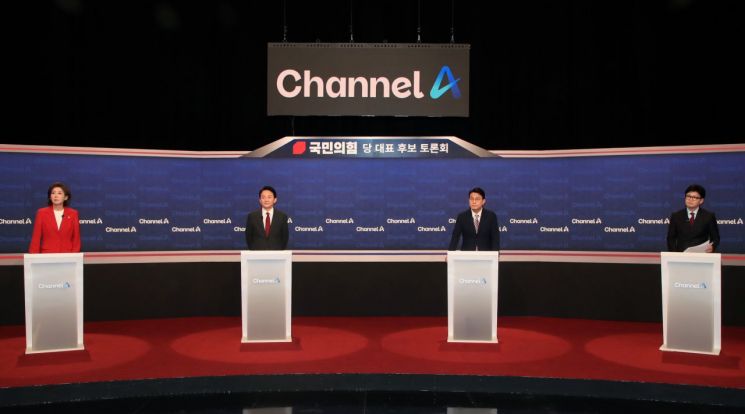
Compared to the previous broadcast debate marked by political clashes, a calmer atmosphere prevailed as candidates engaged in policy discussions. First, candidate Han questioned candidates Na and Won about the non-consensual rape law and foreign voting rights, which they had respectively proposed in the past. Han pointed out to Na, who proposed the non-consensual rape law in September 2018, that "there is a side effect of shifting the burden of proof in practice from the prosecutor to the accused, which could produce unjust victims." Han had previously withdrawn the non-consensual rape law proposal based on data from the Ministry of Gender Equality and Family during his tenure as Minister of Justice.
Na explained, "At the time, regarding the 'Ahn Hee-jung case,' it was appropriate to propose the non-consensual rape law in cases of sexual violence by power." However, Na added, "The non-consensual rape law could create more victims, and it can be supplemented by laws like the Jessica Act," and concluded, "Upon reconsideration, it is better not to maintain the non-consensual rape law." Nevertheless, Na countered during her own debate, "This is a topic of interest in communities most popular among men in their 20s," and said, "As a leader, it would be better to talk about broader legislative frameworks."
Han asked candidate Won, "Regarding the law you proposed and passed as a member of the National Assembly, most foreigners who currently have voting rights are Chinese. How did you come to propose this law directly?" Han pointed out that Koreans cannot vote in China, but Chinese can vote in Korea, which violates the principle of reciprocity. Won replied, "You need 10 lawmakers to propose a bill, so it is common for members of the same party to help each other like a cooperative effort," denying that he was the main proposer of the law. He added, "The law was mainly created with the Korean residents in Japan in mind, but after issues arose regarding Chinese participation in local governance, I have seriously considered the concerns you raised," and agreed with Han on the need to correct the reciprocity issue with China.
Regarding Na's claim that exceptions should be allowed for foreign workers not to be paid the statutory minimum wage, Han partially agreed with differentiated minimum wages by industry and region but opposed any content that could lead to discrimination against foreign workers. Han said, "We are a country that has ratified the International Labour Organization (ILO) Discrimination Convention. How do you plan to overcome this?" and asked, "Are you saying you want to discriminate in wages?" Na responded, "It can be resolved through private contracts, and withdrawing from the ILO convention is very complicated, but there is a way to review this."
Debates also took place on the legalization of same-sex marriage and anti-discrimination laws. Won asked Han for his opinion on legalizing same-sex marriage, and Han replied, "However, incorporating any system into the family system legally complicates various rights and obligations and affects existing relationships. At this stage, it should not be legalized." Won also opposed, saying, "Same-sex marriage is a matter of human order before it is a family system."
Regarding the enactment of anti-discrimination laws, Han said, "Everyone agrees that a democratic country must prohibit discrimination," but added, "Looking at the detailed provisions, it grants excessive authority to the Human Rights Commission, imposes rights and obligations, and stipulates criminal penalties, so it should not pass at this stage." Won also stated, "Prohibiting criticism as discriminatory behavior fundamentally infringes on freedom of expression, which is fundamental to our liberal democracy, so such laws must never be passed."
© The Asia Business Daily(www.asiae.co.kr). All rights reserved.


















