Introduction of New Technologies at Kia EV3 Tech Day
Researchers involved in the development of Kia's electric compact sport utility vehicle (SUV) EV3 took the time to directly introduce the advanced technologies applied to the new car. Despite being an affordable model starting in the 30 million KRW range, the vehicle is packed with features developed for the first time by Hyundai Motor Group, refining its marketability to the fullest. Amid the electric vehicle chasm phenomenon (temporary consumption slowdown) caused by charging inconveniences and still high prices, attention is focused on whether demand will increase.
At the Kia EV3 Tech Day held on the 16th, the researchers who developed the new car came forward to explain the new technologies in detail by field. They introduced the overall development direction as well as the first-ever i-Pedal 3.0, smart regenerative braking system, next-generation air conditioning and thermal management systems among Hyundai Motor Group's new vehicles. The company explained, "Various electrification technologies are the result of continuous research to provide customers with a more convenient electric vehicle usage experience."
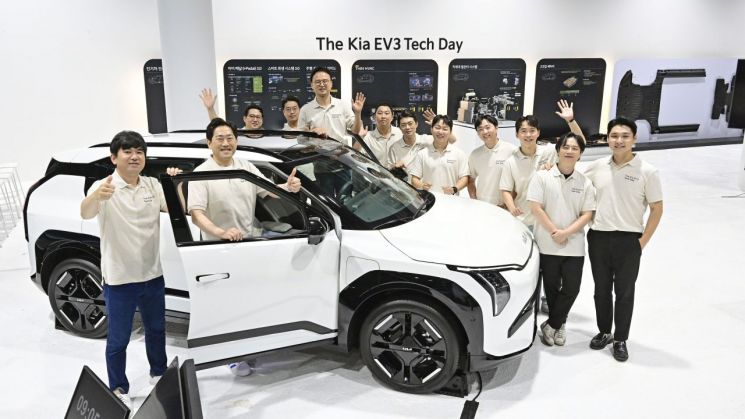 On the 16th, the researchers in charge of developing the EV3, who gave a presentation at the Kia EV3 Tech Day, are taking a commemorative photo together. [Photo by Hyundai Motor Group]
The i-Pedal, which allows acceleration, deceleration, and stopping to be controlled using only the accelerator pedal, is now in its third version, 3.0. Previously, one-pedal operation was only possible at the strongest regenerative braking stage, but the new version enables one-pedal driving at all stages. It is also possible when reversing. This has been one of the requested features among electric vehicle users. Even if the vehicle power is turned off and restarted, the previously set stage is maintained.
The smart regenerative braking system has also become smarter. It combines regenerative braking that charges the battery when the foot is lifted off the accelerator pedal with advanced driver assistance technologies. It adjusts the degree of deceleration by comprehensively utilizing the distance to the vehicle ahead and navigation information. Previously, only speed camera information was used, but the new vehicle operates according to various situations such as left/right turns, curves, speed limits, speed bumps, and roundabouts.
When a company employee drove an actual route for about an hour to compare, the brake was used approximately 109 times at regenerative braking level 0. When using the smart regenerative braking system, the brake usage frequency dropped to 17 times, a reduction of over 80%. This means driving fatigue can be significantly reduced.
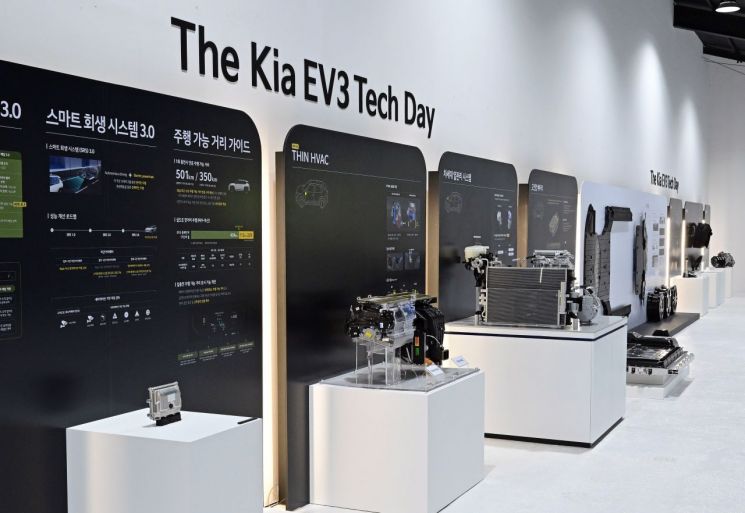
The air conditioning system, which determines the size of the front interior space of the vehicle, was newly designed. While it is common to arrange the internal heat exchanger of the air conditioning system vertically, it was changed to a horizontal stacked arrangement. The internal door operation method was also changed from rotary to swing type. Compared to the previous design, the height was reduced by 33%. The air path inside the system was simplified to reduce noise and power consumption. The thermal management system was improved by simultaneously utilizing the heat from outside air and waste heat from the motor and battery, enhancing heating performance. Since batteries often do not perform well at low temperatures, thermal management is considered a field directly related to electric vehicle performance.
High-performance batteries were made easier to use. Previously, power control was divided into four stages, but it was simplified to three stages (off, power on, start). It became more convenient to use the vehicle power externally both when the ignition is on and in the power-on state.
A driving range guide function was added to allow drivers to intuitively monitor energy efficiency during driving. Previously, the driving range was estimated and displayed based on past energy efficiency, but now the cluster additionally shows the maximum and minimum achievable driving range depending on driving habits. When driving that helps energy efficiency is performed, a green gauge fills to indicate the distance gain. In the opposite case, an orange gauge shows the deterioration amount.
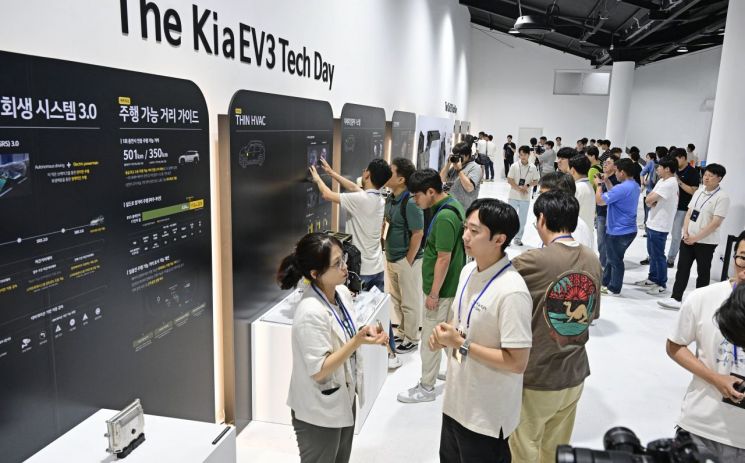 Researchers are explaining the technologies applied to the new car at the Kia EV3 Tech Day held on the 16th at the Pie Factory Studio in Seoul.
 [Photo by Hyundai Motor Group]
The aerodynamic drag coefficient is 0.27Cd, the highest level among compact SUV models. The battery capacity is also 81.4 kWh, the largest among electric vehicles in the same class. The 4th generation battery used in the new car improved energy density at the cell level, increasing density by 22% compared to the Niro EV with the same 400V system. A water-cooled cooling system that lowers battery temperature was applied to enable faster rapid charging. Charging from 10% to 80% battery capacity takes 31 minutes, 12 minutes shorter than the Niro EV.
Additionally, the 3rd generation frequency-responsive valve that reduces road surface vibrations during driving and a recycled material perforated sound-absorbing back for reducing rear-side noise were also applied for the first time in a Hyundai Motor Group new vehicle. The new car was recently registered in the eco-friendly vehicle notification, enabling new car registration and tax benefits. It is expected to be delivered to customers as early as late this month.
© The Asia Business Daily(www.asiae.co.kr). All rights reserved.
![Clutching a Stolen Dior Bag, Saying "I Hate Being Poor but Real"... The Grotesque Con of a "Human Knockoff" [Slate]](https://cwcontent.asiae.co.kr/asiaresize/183/2026021902243444107_1771435474.jpg)

















